


























Views
Downloads
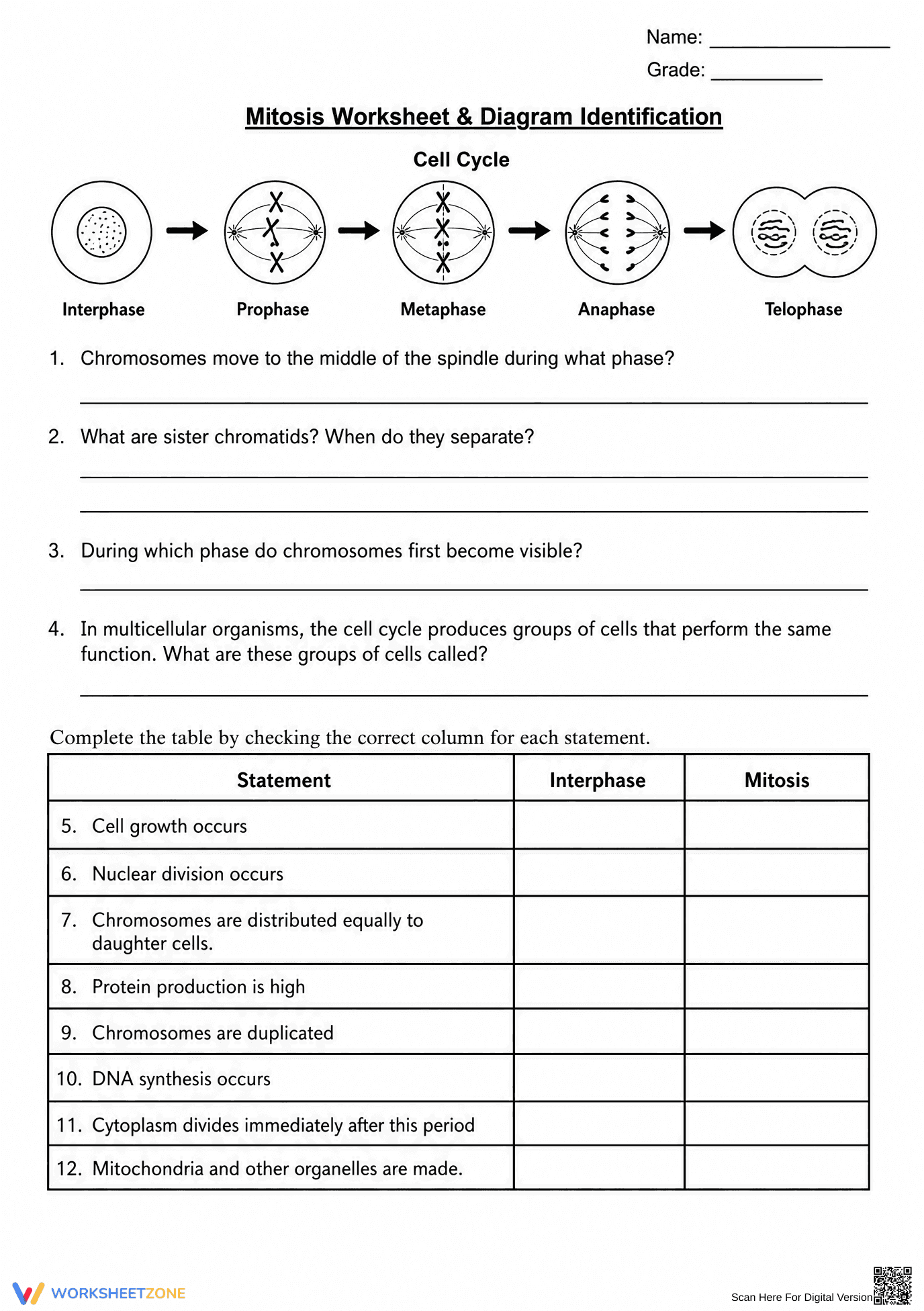

Printable Mitosis Worksheet | Grade 9-12 Cell Cycle
Paste this activity's link or code into your existing LMS (Google Classroom, Canvas, Teams, Schoology, Moodle, etc.).
Students can open and work on the activity right away, with no student login required.
You'll still be able to track student progress and results from your teacher account.
This high school biology worksheet provides students with a clear visual approach to mastering the cell cycle. By analyzing diagrams and categorizing cellular processes, learners solidify their understanding of how cells divide. It is an ideal resource for reinforcing foundational genetics concepts.
At a Glance
- Grade: 9-12 · Subject: Biology
- Standard:
HS-LS1-4— Illustrate the role of cellular division and differentiation.- Skill Focus: Identifying Mitosis Phases
- Format: 1 page · 12 problems · Answer key included · PDF
- Best For: Independent practice or review
- Time: 15–20 minutes
This single-page resource features a labeled diagram illustrating the five stages of the cell cycle: Interphase, Prophase, Metaphase, Anaphase, and Telophase. Students tackle four short-answer questions testing their knowledge of chromosome movement. The bottom half includes an eight-row classification table where learners determine whether specific events, like DNA synthesis, occur during interphase or mitosis. A complete answer key streamlines grading.
This resource is designed for a smooth, zero-prep classroom experience:
- Print (1 minute): Download the PDF and print a class set.
- Distribute (1 minute): Hand out the worksheet as independent practice after your initial lecture on cell division.
- Review (5 minutes): Use the included answer key to quickly go over the table classifications as a class.
With a total teacher prep time of under two minutes, this activity is highly suitable for emergency substitute plans.
This activity is aligned with HS-LS1-4: Use a model to illustrate the role of cellular division (mitosis) and differentiation in producing and maintaining complex organisms. By requiring students to interpret a visual model and categorize biological processes, the worksheet supports this expectation. Both standard codes can be copied directly into lesson plans, IEP goals, or district curriculum mapping tools.
Teachers can deploy this worksheet immediately following direct instruction on mitosis phases. It serves as an excellent formative assessment tool; educators can circulate and observe whether learners confuse interphase processes with active mitotic division. The activity has an expected completion time range of 15 to 20 minutes, making it a perfect station rotation task.
This resource is designed for high school biology students. The clear visual scaffolds make it accessible for English Language Learners processing complex scientific vocabulary. It pairs perfectly with a hands-on microscope lab observing onion root tip cells.
Effective science instruction relies heavily on visual models to bridge the gap between abstract microscopic processes and student comprehension. Aligning with HS-LS1-4, this resource requires students to illustrate the role of cellular division and differentiation by interacting directly with a sequenced diagram of mitosis. According to a ScienceDirect TpT Analysis, instructional materials that combine visual identification tasks with categorical sorting significantly improve long-term retention of complex biological cycles. By prompting learners to first analyze the visual stages of prophase through telophase, and then categorize specific cellular events like DNA synthesis into either interphase or mitosis, this worksheet reinforces dual-coding cognitive pathways. This structured approach ensures that students do not merely memorize vocabulary, but actively construct a working model of how cells replicate and maintain complex organisms. Providing clear visual evidence of learning is essential for mastering high school biology standards.


