


























Views
Plays




Grade 3-5 Logic & Analogies — Printable No-Prep Worksheet
Paste this activity's link or code into your existing LMS (Google Classroom, Canvas, Teams, Schoology, Moodle, etc.).
Students can open and work on the activity right away, with no student login required.
You'll still be able to track student progress and results from your teacher account.
This comprehensive Grade 3-5 reasoning worksheet challenges students to apply critical thinking across multiple domains, including verbal analogies, spatial mirror imaging, and complex mathematical word problems. By engaging with diverse question types, learners strengthen their cognitive flexibility and prepare for standardized testing environments that require rapid switching between logic and literacy skills.
At a Glance
- Grade: 3-5 · Subject: ELA & Math
- Standard:
CCSS.ELA-LITERACY.L.5.5.C— Use word relationships to better understand word meanings and solve logic puzzles- Skill Focus: Logical Reasoning
- Format: 5 pages · 20 problems · Answer key included · PDF
- Best For: Sub plans or logic assessment
- Time: 25–40 minutes
What's Inside
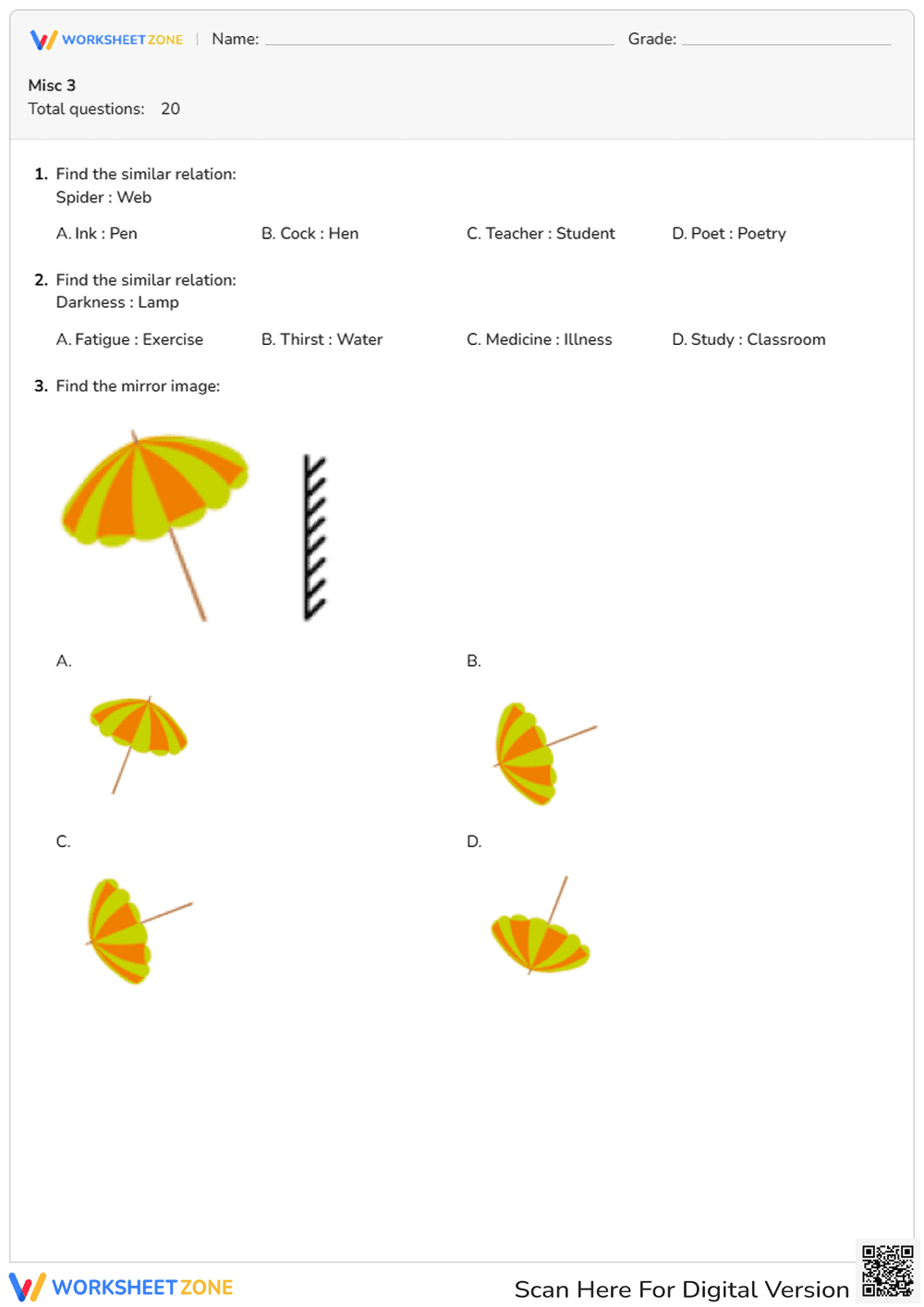
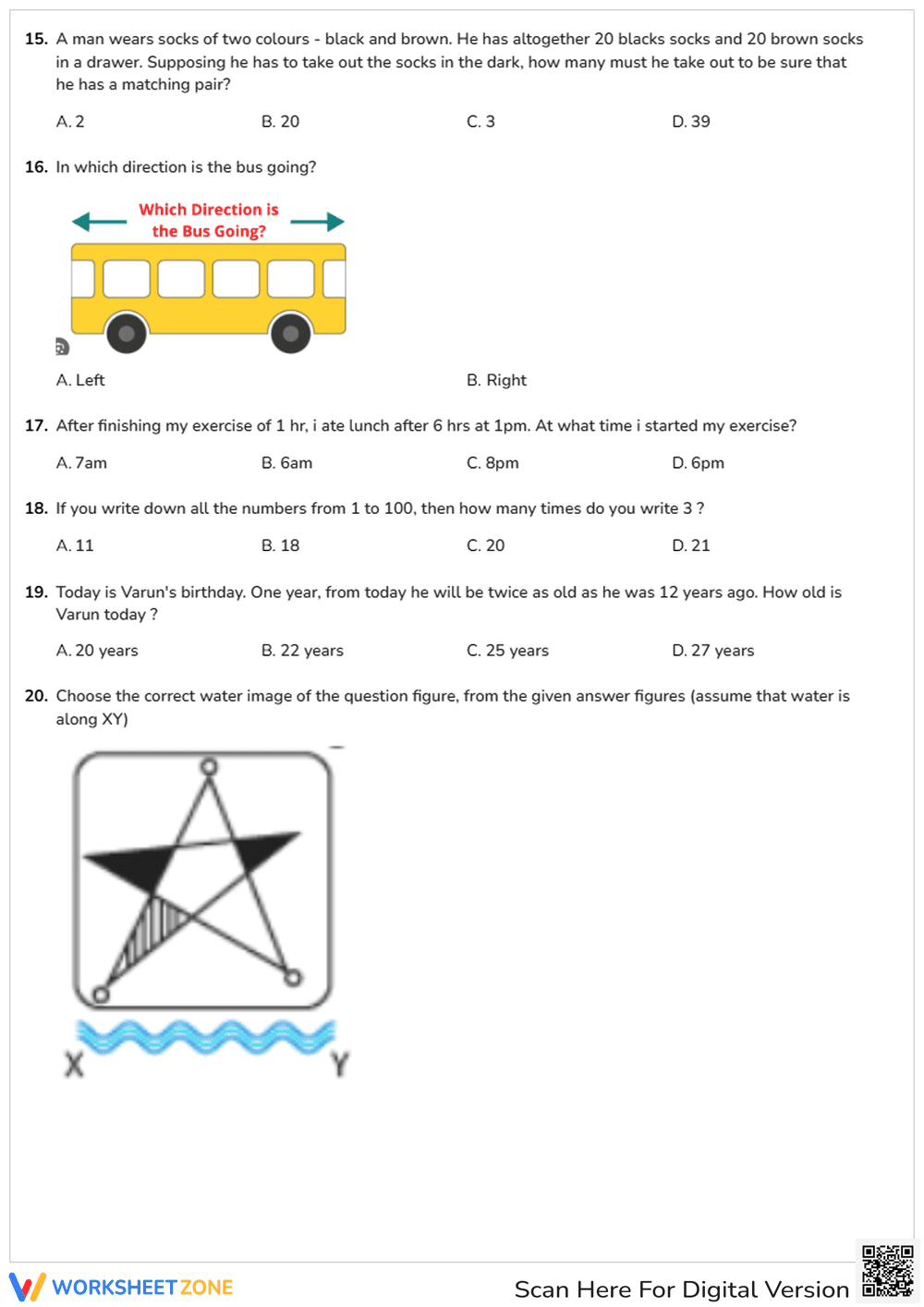
This 5-page PDF contains 20 distinct problems designed to test a wide array of cognitive abilities. It features visual puzzles like mirror and water images, verbal relationship tasks such as analogies, and multi-step age and time word problems. The layout is clean and professional, providing ample space for students to mark their answers. A full answer key is included to facilitate quick grading or student self-correction.
Zero-Prep Workflow
- Print: Send the 5-page PDF to the printer (30 seconds).
- Distribute: Hand out the packets to students for independent work (1 minute).
- Review: Use the included answer key for rapid grading or whole-class review (10 minutes).
This resource requires under 2 minutes of total teacher preparation time. The self-contained nature of the questions makes it an ideal choice for emergency sub plans or unexpected schedule gaps.
Standards Alignment
The primary standard addressed is `CCSS.ELA-LITERACY.L.5.5.C`, which requires students to use the relationship between particular words to better understand each of the words. It also supports `CCSS.MATH.CONTENT.4.OA.A.3` by requiring students to solve multi-step word problems using the four operations. Both standard codes can be copied directly into lesson plans, IEP goals, or district curriculum mapping tools.
How to Use It
Use this as a formative assessment after a unit on logical reasoning to gauge student mastery of non-verbal patterns. Alternatively, assign it as a brain teaser packet for early finishers to keep them engaged with high-rigor content during instructional transitions. Completion time typically ranges from 25 to 40 minutes depending on the specific grade level and student proficiency.
Who It's For
This resource is designed for students in grades 3 through 5 who are developing abstract reasoning skills. It is particularly effective for gifted and talented clusters or as a challenge for students who excel in pattern recognition. Pair this with a vocabulary anchor chart or a direct instruction lesson on spatial transformations for a complete instructional block.
Research from RAND AIRS 2024 indicates that exposure to varied logical reasoning tasks, such as those found in this 20-problem set, significantly improves student performance on high-stakes assessments. By integrating verbal analogies (CCSS.ELA-LITERACY.L.5.5.C) with spatial and mathematical logic, the worksheet targets the fluid intelligence necessary for academic success across disciplines. Fisher & Frey (2014) emphasize that such multi-domain practice helps students build the cognitive stamina required for complex problem-solving. This worksheet provides a structured environment for students to practice these skills independently, ensuring they can identify relationships and patterns without constant teacher intervention. The inclusion of mirror images and coding tasks specifically addresses visual-spatial processing, a key component of the NAEP framework for mathematical literacy. This resource serves as a reliable tool for measuring student progress in critical thinking and logical deduction.


