


























Views
Plays
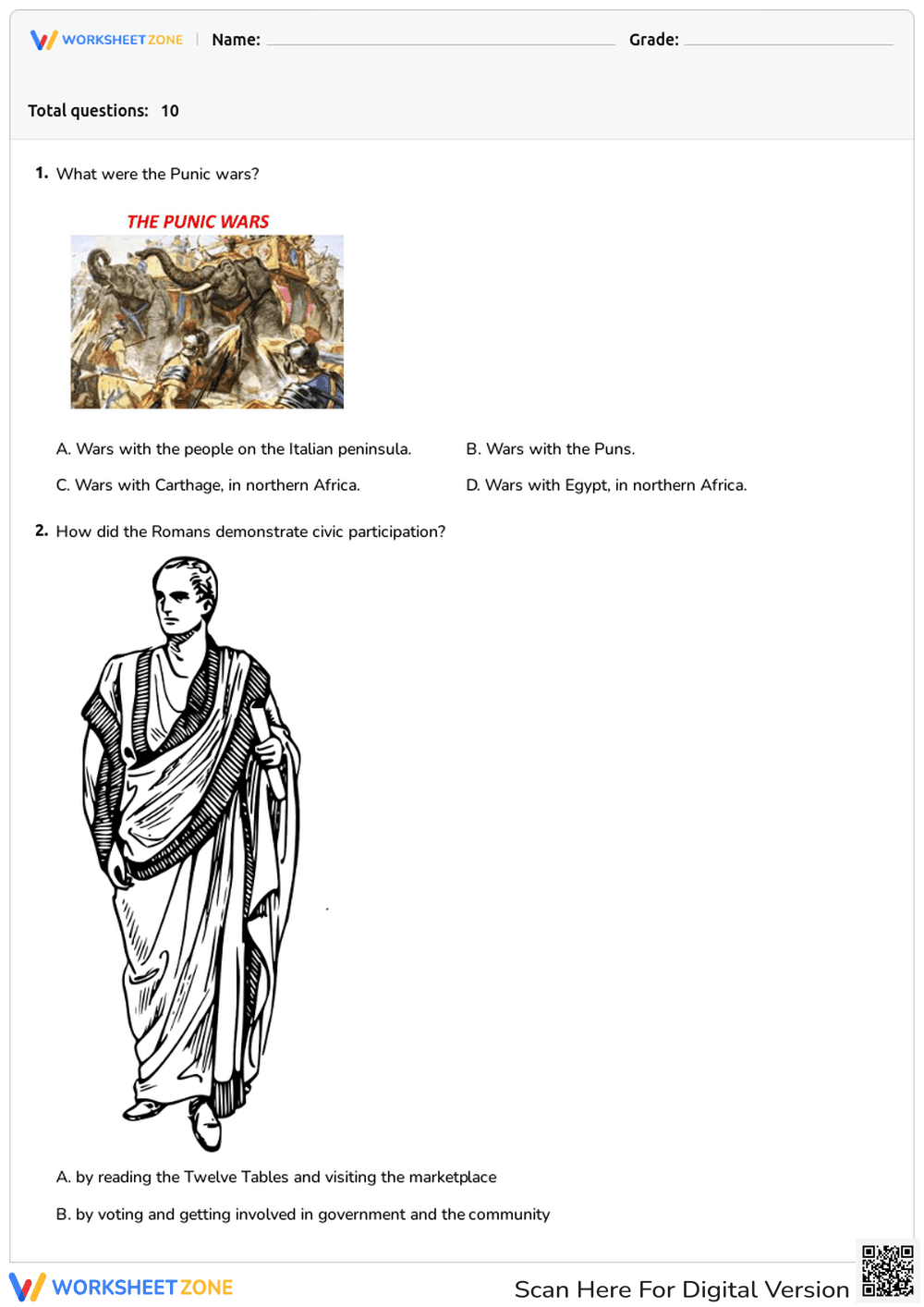



Ancient Rome Republic Worksheet | Essential Grade 6-8
Paste this activity's link or code into your existing LMS (Google Classroom, Canvas, Teams, Schoology, Moodle, etc.).
Students can open and work on the activity right away, with no student login required.
You'll still be able to track student progress and results from your teacher account.
This Ancient Rome Republic worksheet provides middle school students with 10 comprehensive multiple-choice questions to reinforce key historical concepts. Students will demonstrate their understanding of Roman social structures, government branches, and significant military conflicts. It serves as an effective tool for assessing student mastery of the transition from monarchy to a representative democracy.
At a Glance
- Grade: 6-8 · Subject: History
- Standard:
RH.6-8.4— Determine the meaning of domain-specific words like patrician, plebeian, and republic- Skill Focus: Roman Republic Government & Society
- Format: 3 pages · 10 problems · Answer key included · PDF
- Best For: Unit review or formative assessment
- Time: 15–20 minutes
The resource contains three pages of high-quality assessment material featuring 10 targeted multiple-choice questions. Each question is supported by historical illustrations, including depictions of the Punic Wars, Roman citizens, and the Twelve Tables. A full answer key is provided within the metadata to facilitate rapid grading and immediate student feedback during the lesson.
This worksheet is designed for a seamless three-step classroom workflow. First, print the three-page PDF (30 seconds). Next, distribute the copies to students for a quiet independent review or a quick check for understanding (1 minute). Finally, review the answers as a whole group using the provided key (5 minutes). Total teacher preparation time is under 2 minutes, making it an ideal sub-plan or last-minute review activity.
The primary focus is `CCSS.ELA-LITERACY.RH.6-8.4`, which requires students to determine the meaning of domain-specific vocabulary such as "republic," "tribune," and "plebeian." Additionally, it supports `RH.6-8.1` by requiring students to cite specific evidence about Roman civic participation and geography. Both standard codes can be copied directly into lesson plans, IEP goals, or district curriculum mapping tools.
Use this worksheet as a "Ticket out the Door" after a lecture on Roman social classes to gauge immediate comprehension. Alternatively, assign it as a partner activity where students must find evidence in their textbooks to support each answer choice. Expect students to complete the 10 questions within 15 to 20 minutes depending on their prior knowledge and reading speed.
This resource is tailored for Grade 6, 7, and 8 Social Studies students exploring ancient civilizations. It is particularly helpful for English Language Learners (ELLs) due to the visual aids and clear, concise definitions of complex political terms. It pairs naturally with an anchor chart detailing the branches of the Roman Republic or a primary source reading of the Twelve Tables.
According to the NAEP Social Studies Framework, understanding the evolution of democratic principles and social hierarchies is foundational for middle school historical literacy. This worksheet addresses these core competencies by focusing on the Roman Republic's structure and the Twelve Tables. Research from EdReports (2024) emphasizes that high-quality, domain-specific vocabulary practice, such as defining "patrician" and "plebeian" in context, significantly improves long-term retention of historical facts. By engaging with these 10 targeted questions, students build the analytical skills necessary to compare ancient governance with modern systems. The inclusion of visual stimuli alongside text-based questions aligns with Fisher & Frey’s (2014) gradual release of responsibility model, ensuring students move from basic identification to conceptual understanding of civic participation. This resource provides a reliable, standards-aligned method for tracking student progress toward RH.6-8.4 mastery in any secondary history classroom.


