


























Views
Downloads
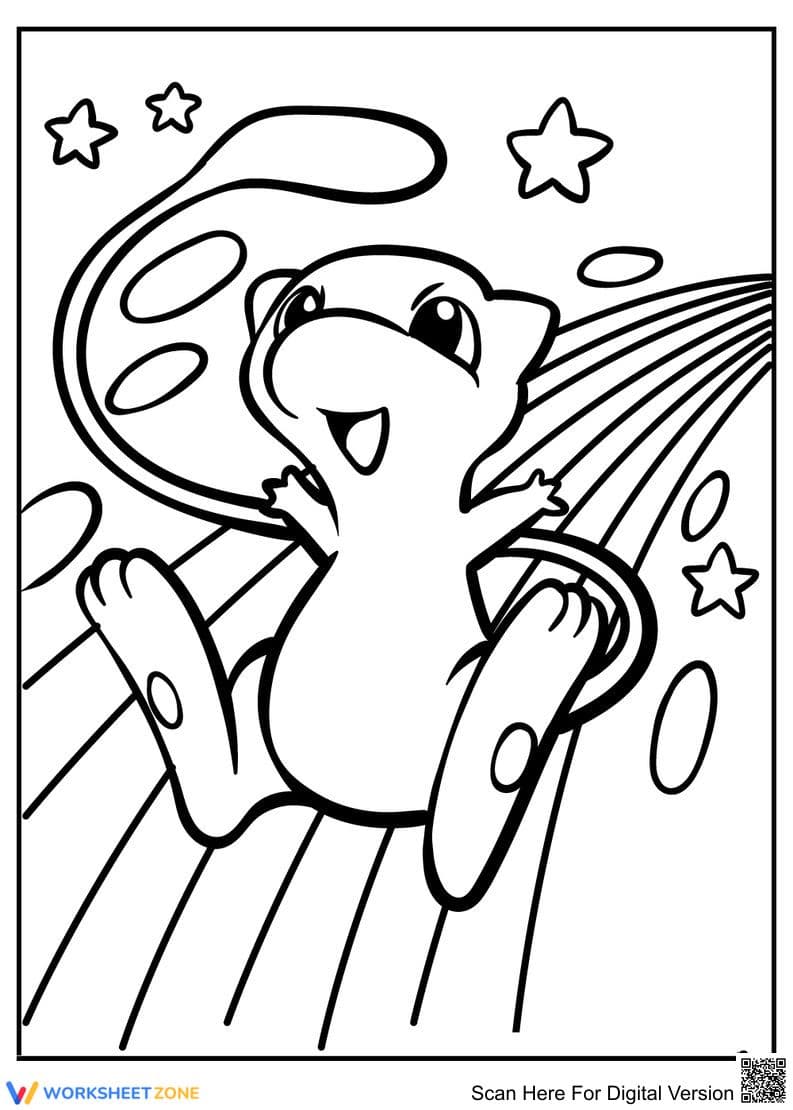

Mew Pokemon Coloring Page | Essential Printable Worksheet
Paste this activity's link or code into your existing LMS (Google Classroom, Canvas, Teams, Schoology, Moodle, etc.).
Students can open and work on the activity right away, with no student login required.
You'll still be able to track student progress and results from your teacher account.
This printable Mew coloring worksheet provides young learners with a creative outlet to practice fine motor control and artistic expression. By engaging with a familiar character, students develop the hand-eye coordination necessary for early writing tasks while exploring color theory through the rainbow and star elements. This activity transforms a simple coloring task into a meaningful developmental exercise.
At a Glance
- Grade: Kindergarten · Subject: Arts & Crafts
- Standard:
CCSS.ELA-LITERACY.SL.K.5— Add drawings or visual displays to descriptions to provide additional detail- Skill Focus: Fine motor development
- Format: 1 page · 1 task · No answer key · PDF
- Best For: Early finishers and morning work
- Time: 15–20 minutes
Inside this resource, you will find a high-quality, single-page PDF featuring the mythical Pokemon Mew. The illustration includes a dynamic rainbow trail and celestial star accents, offering multiple distinct areas for color application. The bold outlines are specifically designed to help early learners practice staying within lines, a vital precursor to successful letter formation and spatial awareness on the page.
The zero-prep workflow for this activity is designed for maximum efficiency in a busy classroom. First, print the single-page PDF in seconds. Next, distribute the sheets along with crayons or colored pencils to your students. Finally, review the completed work to provide positive reinforcement on color choice and boundary control. Total teacher preparation time is under 2 minutes, making it an ideal choice for emergency sub plans or transition periods.
This worksheet aligns with CCSS.ELA-LITERACY.SL.K.5, which encourages students to use visual displays to enhance their communication and descriptions. While primarily an artistic task, it supports the development of the small muscle groups required for the L.K.1.A standard of letter printing. Both standard codes can be copied directly into lesson plans, IEP goals, or district curriculum mapping tools.
Use this worksheet as a calming transition activity after recess or as a reward for completing primary ELA tasks. Teachers can use this as a formative assessment by observing a student's pencil grip and their ability to follow multi-step coloring directions. Expect students to spend approximately 15 to 20 minutes to complete the full scene, depending on their level of detail.
This resource is ideal for Kindergarten and Grade 1 students who are developing foundational motor skills. It serves as an excellent differentiation tool for students requiring sensory breaks or those with specific occupational therapy goals. Pair this worksheet with a short descriptive writing prompt about the character to create a complete cross-curricular lesson that bridges art and literacy.
According to the RAND AIRS 2024 report, integrating high-interest visual activities like character-based coloring can significantly increase student engagement in early childhood settings. This Mew coloring page targets the CCSS.ELA-LITERACY.SL.K.5 standard by allowing students to create visual representations that support descriptive language. Research from Fisher & Frey (2014) suggests that fine motor tasks are essential precursors to formal writing proficiency, as they strengthen the neural pathways associated with precise hand movements. By providing a structured yet creative task, educators can support the development of pre-writing skills in a low-stakes environment. This worksheet offers a practical application of these principles, ensuring that even simple coloring tasks contribute to the broader goal of literacy and motor mastery within the Kindergarten curriculum. The inclusion of 1 clear task ensures students remain focused on the objective of controlled movement and creative completion.


