


























Views
Plays
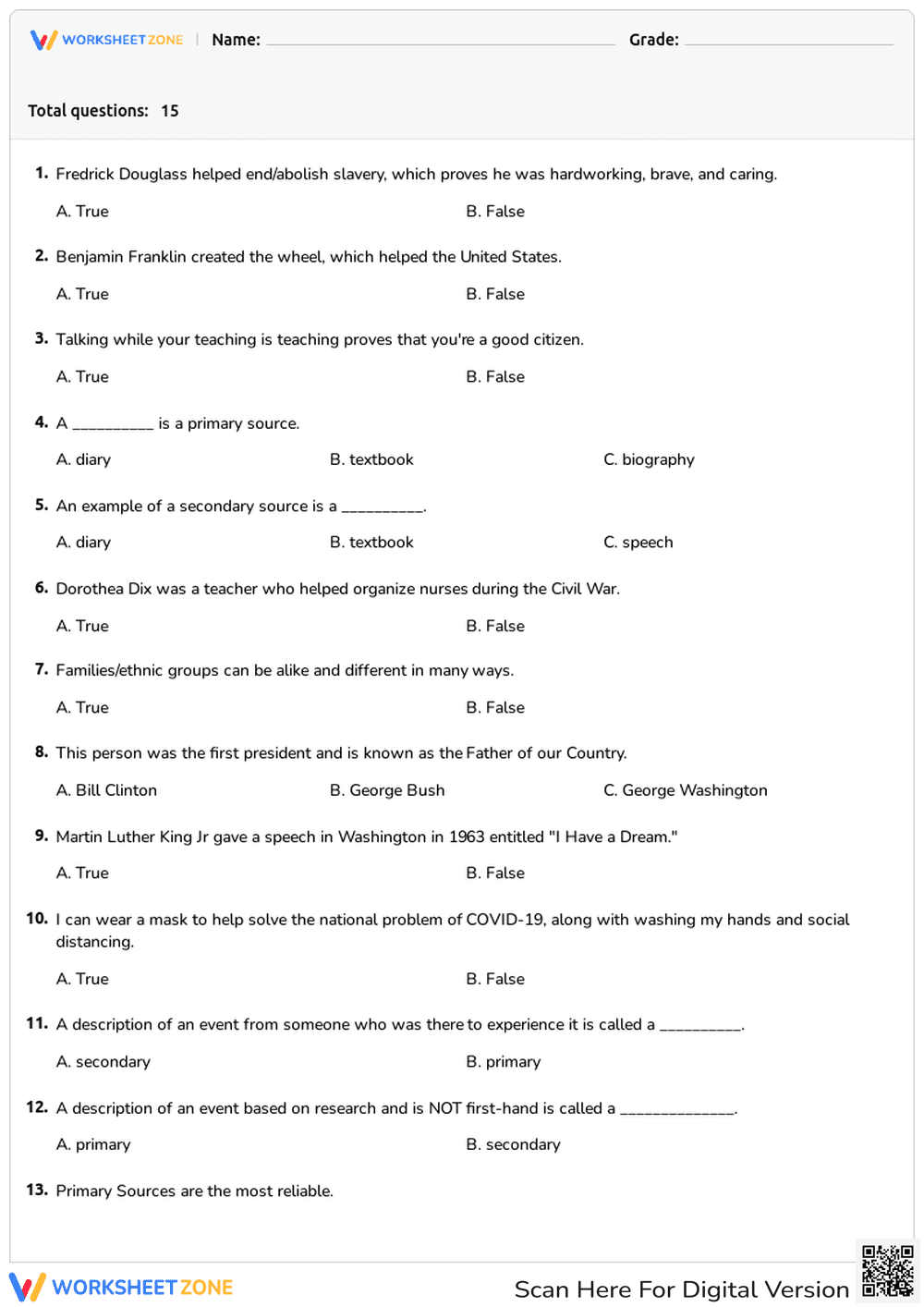


Historical Sources & Figures | Grade 4 Ready Quiz
Paste this activity's link or code into your existing LMS (Google Classroom, Canvas, Teams, Schoology, Moodle, etc.).
Students can open and work on the activity right away, with no student login required.
You'll still be able to track student progress and results from your teacher account.
This Grade 4 social studies worksheet helps students distinguish between primary and secondary sources while reviewing key historical figures. By evaluating 15 true/false and multiple-choice questions, learners will solidify their understanding of firsthand accounts, secondhand research, and significant contributions from American history leaders.
At a Glance
- Grade: 4 · Subject: Social Studies
- Standard:
CCSS.ELA-LITERACY.RI.4.6— Compare firsthand and secondhand accounts- Skill Focus: Primary and Secondary Sources
- Format: 2 pages · 15 problems · PDF
- Best For: Formative assessment or independent practice
- Time: 15–20 minutes
What's Inside
Inside this two-page resource, educators will find a straightforward 15-question quiz format. The assessment features a mix of true/false statements and multiple-choice questions. Students will identify examples of primary sources like diaries, recognize secondary sources like textbooks, and recall basic facts about influential figures such as George Washington, Martin Luther King Jr., and Dorothea Dix. The clear layout minimizes distractions and focuses directly on core social studies comprehension.
Zero-Prep Workflow
This resource is designed for immediate classroom implementation with a zero-prep workflow.
- Print (1 minute): Simply download the PDF and print double-sided to save paper.
- Distribute (1 minute): Hand out to students as a quick morning work assignment or end-of-unit review.
- Review (5 minutes): Go over the answers together as a class to reinforce the differences between source types.
Total teacher preparation requires under two minutes, making this an excellent option for emergency sub plans or spontaneous review sessions.
Standards Alignment
This worksheet is aligned to primary standard CCSS.ELA-LITERACY.RI.4.6: Compare and contrast a firsthand and secondhand account of the same event or topic; describe the differences in focus and the information provided. It also supports general social studies frameworks for recognizing significant historical figures and their contributions. Both standard codes can be copied directly into lesson plans, IEP goals, or district curriculum mapping tools.
How to Use It
Teachers can utilize this worksheet as a formative assessment after direct instruction on historical sources. It works perfectly as an independent practice activity where students can demonstrate their ability to categorize diaries, speeches, and textbooks correctly. For a formative observation tip, walk around the room while students work and ask them to explain why they chose "primary" or "secondary" for specific questions, ensuring they grasp the underlying concept rather than just guessing. Expected completion time is 15 to 20 minutes.
Who It's For
This resource is ideal for third and fourth-grade general education students building foundational historical literacy skills. The simple sentence structures and familiar vocabulary make it accessible for English Language Learners and students needing reading accommodations. It pairs naturally with an anchor chart detailing the differences between primary and secondary sources, or alongside a direct instruction lesson on evaluating historical evidence.
Developing the ability to evaluate historical evidence is a critical component of elementary social studies education. When students master CCSS.ELA-LITERACY.RI.4.6 to compare firsthand and secondhand accounts, they build essential critical thinking skills required for advanced historical analysis. According to a RAND AIRS 2024 report, early exposure to primary source evaluation significantly improves students' long-term reading comprehension and media literacy capabilities. By practicing with concrete examples like diaries and textbooks, young learners begin to understand how history is recorded and interpreted. This foundational knowledge not only supports academic achievement in social studies but also fosters a more analytical approach to consuming information in their daily lives, ensuring they become informed and thoughtful citizens.


