


























Views
Downloads


Essential Oval Shape Worksheet | Printable Preschool Math
Paste this activity's link or code into your existing LMS (Google Classroom, Canvas, Teams, Schoology, Moodle, etc.).
Students can open and work on the activity right away, with no student login required.
You'll still be able to track student progress and results from your teacher account.
Mastering shape recognition is a foundational milestone in early childhood development. This preschool math worksheet provides a comprehensive introduction to ovals through identification, fine motor tracing, and real-world observation. Students will distinguish ovals from other geometric figures and practice drawing them independently to build spatial awareness and pre-writing strength.
At a Glance
- Grade: Preschool · Subject: Math
- Standard:
CCSS.MATH.CONTENT.K.G.A.2— Correctly name shapes regardless of their orientations or overall size- Skill Focus: Oval identification, tracing, and drawing
- Format: 2 pages · 12 tasks · Answer key included · PDF
- Best For: Independent shape practice and centers
- Time: 15–20 minutes
What's Inside
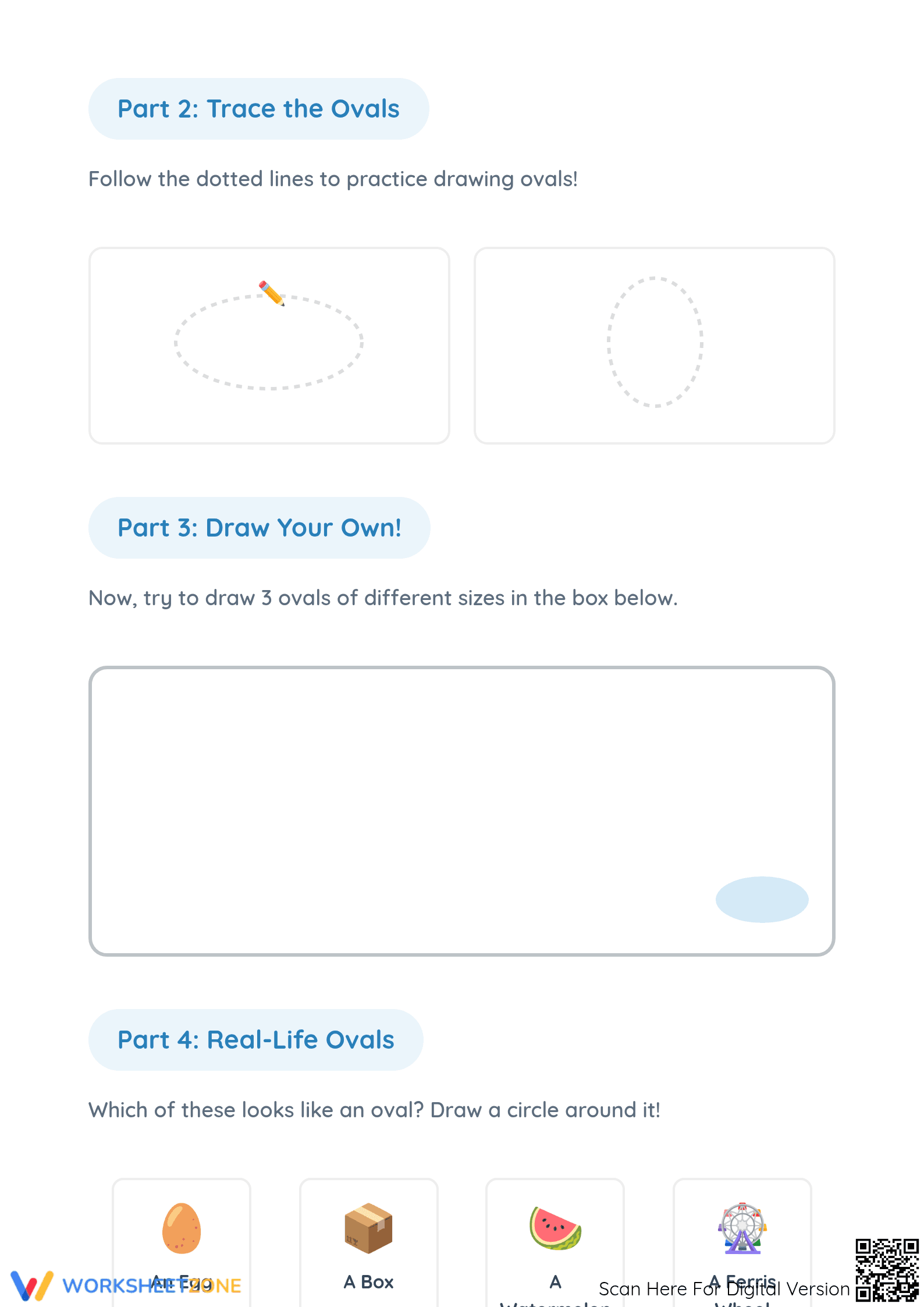
This two-page PDF includes four distinct activity zones designed to maintain high engagement for young learners. The first page features "The Great Oval Hunt," where children locate five ovals among a variety of distractors. The second page transitions into skill development with two large tracing templates, a creative drawing box for freehand practice, and a real-life application section to connect geometry to everyday objects like eggs and watermelons.
Zero-Prep Workflow
Teachers can implement this resource in under two minutes with three simple steps. First, print the two-page document (30 seconds). Second, distribute the sheets with crayons or markers to students during math centers or morning work (60 seconds). Finally, review the real-life oval section as a whole-group closing activity to check for understanding. This efficient design makes it an ideal candidate for emergency substitute plans.
Standards Alignment
This resource is aligned with `CCSS.MATH.CONTENT.K.G.A.2`, which requires students to correctly name shapes regardless of their orientation or overall size. By including ovals in various positions and comparing them to circles and rectangles, the worksheet helps students refine their conceptual boundaries for non-circular curved shapes. This standard code can be copied directly into lesson plans, IEP goals, or district curriculum mapping tools.
How to Use It
Use this worksheet during the final phase of a geometry lesson after introducing the oval shape using physical manipulatives or anchor charts. It serves as a formative assessment tool; observe students during Part 1 to see if they can distinguish between circles and ovals, which is a common point of confusion for preschool learners. The expected completion time for both pages is approximately 20 minutes for most students.
Who It's For
This activity is tailored for preschool and Pre-K students who are beginning their journey with geometric shapes. It provides essential scaffolding for students needing fine motor support through the tracing section and offers extension for advanced learners through the freehand drawing task. It pairs naturally with real-life shape sorting bins or "The Shape of Things" by Dayle Ann Dodds for a complete instructional unit.
According to the RAND AIRS 2024 analysis of early childhood mathematics, structured shape identification activities like this `CCSS.MATH.CONTENT.K.G.A.2` worksheet are vital for developing the visual-spatial processing skills required for later literacy and numeracy. The multi-modal approach—combining visual discrimination in "The Great Oval Hunt" with kinesthetic tracing and drawing—aligns with research suggesting that children retain geometric concepts more effectively when they engage in tactile and expressive tasks. By connecting abstract shapes to tangible real-world objects, such as eggs and watermelons, this resource reinforces the plain-English skill of recognizing and naming ovals in diverse contexts. This worksheet offers 12 specific tasks that bridge the gap between basic recognition and applied geometry, providing a research-backed foundation for Kindergarten readiness and long-term academic success in primary mathematics and beyond.


