


























Views
Plays


Grade 1 Addition Within 20 — Printable No-Prep Worksheet
Paste this activity's link or code into your existing LMS (Google Classroom, Canvas, Teams, Schoology, Moodle, etc.).
Students can open and work on the activity right away, with no student login required.
You'll still be able to track student progress and results from your teacher account.
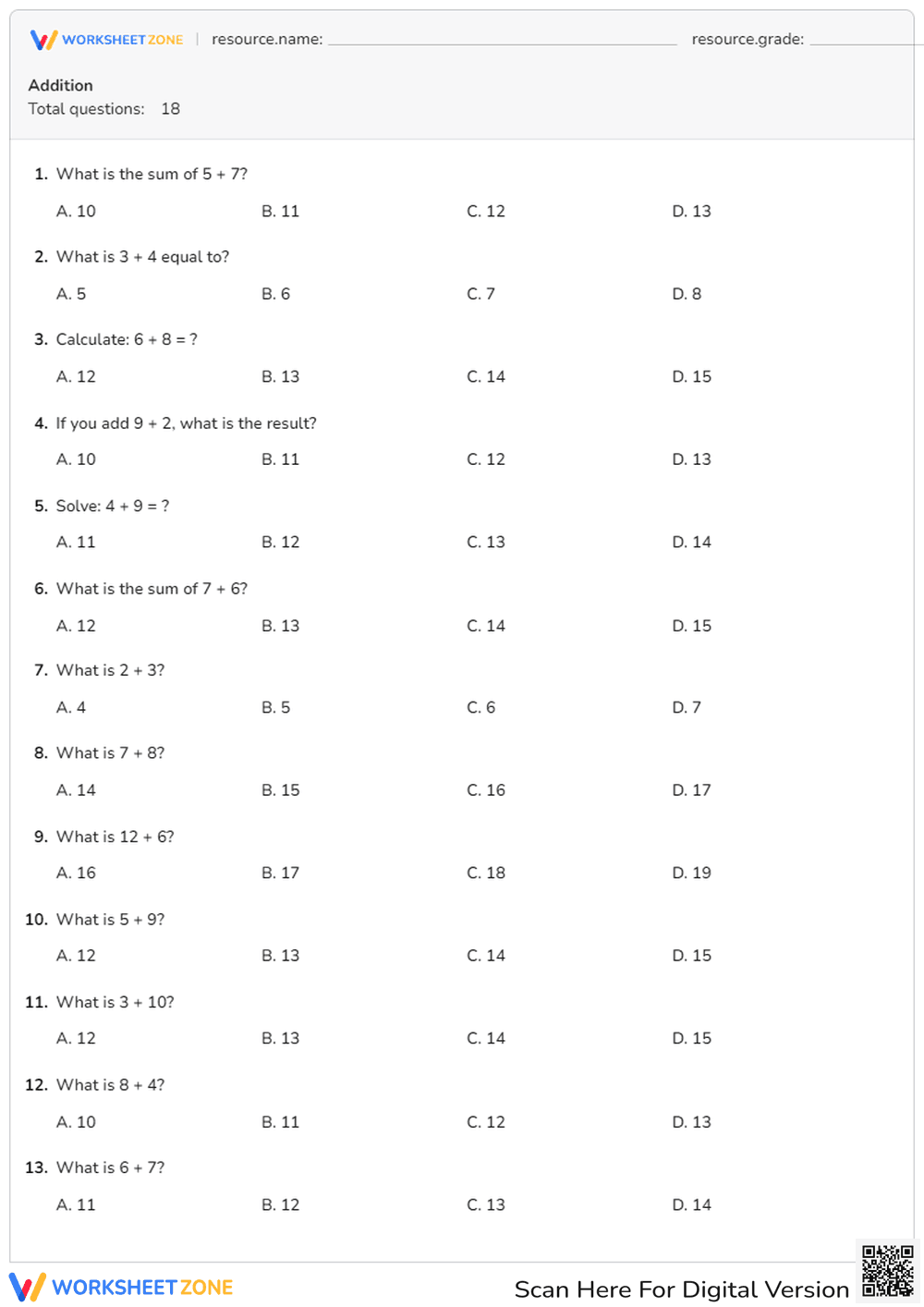
This ready-to-use math worksheet provides focused practice on addition within 20. By completing these multiple-choice questions, young learners build essential fact fluency. The straightforward format allows students to independently demonstrate their understanding of basic addition concepts.
At a Glance
- Grade: 1 · Subject: Math
- Standard:
CCSS.MATH.CONTENT.1.OA.C.6— Add and subtract within 20 fluently- Skill Focus: Addition within 20
- Format: 2 pages · 18 problems · Answer key included · PDF
- Best For: Independent practice and assessment
- Time: 10–15 minutes
This resource features a two-page assessment containing 18 multiple-choice addition problems. Each question presents a simple equation alongside four distinct answer choices. The clean layout ensures early elementary students can easily track their progress. A complete answer key is included to facilitate rapid grading.
Zero-Prep Workflow
Follow these simple steps to implement the activity:
- Print (1 minute): Download the PDF and print the two-page question set. No special materials are required.
- Distribute (1 minute): Hand out the quiz during your math block. The instructions are self-explanatory.
- Review (2 minutes): Use the provided answer key to quickly score the 18 questions, or have students self-correct.
With total teacher prep time under two minutes, this resource is excellent for emergency sub plans.
Standards Alignment
This worksheet is directly aligned to CCSS.MATH.CONTENT.1.OA.C.6, which requires students to add and subtract within 20, demonstrating fluency for addition and subtraction within 10. It also supports second-grade review for fluently adding within 20 using mental strategies. Both standard codes can be copied directly into lesson plans, IEP goals, or district curriculum mapping tools.
How to Use It
Assign this quiz after direct instruction as a formative assessment to gauge mastery of addition facts. Alternatively, use it as morning work to activate mathematical thinking. While students work, observe their problem-solving methods—noting whether they count on fingers or use mental math. Most students will complete the 18 problems within 10 to 15 minutes.
Who It's For
This worksheet is designed for first-grade students developing foundational math skills, and second-graders needing a quick refresher. For students requiring accommodations, teachers can reduce answer choices or provide counting blocks. This quiz pairs perfectly with a hands-on lesson using ten frames.
Developing automaticity with basic math facts is a critical milestone in early childhood education. According to a recent EdReports 2024 analysis, instructional materials that provide frequent, low-stakes practice opportunities significantly improve long-term mathematical retention and overall student confidence. This worksheet directly supports CCSS.MATH.CONTENT.1.OA.C.6 by helping students add and subtract within 20 fluently. When learners can quickly recall addition facts without expending heavy cognitive load, they free up essential working memory to tackle more complex, multi-step word problems later in their academic journey. By utilizing structured multiple-choice formats, educators can efficiently pinpoint specific numerical misconceptions and tailor their subsequent small-group instruction. Consistent exposure to these foundational equations ensures that young mathematicians build the robust numerical fluency required for advanced algebraic thinking in upper elementary grades and beyond. This targeted approach to fact fluency ultimately creates a more equitable learning environment where all students have the foundational tools necessary to succeed.


