


























Views
Downloads



CCSS 2.NBT Worksheet: Grade 2 Aligned Math II Bimestral Exam
Paste this activity's link or code into your existing LMS (Google Classroom, Canvas, Teams, Schoology, Moodle, etc.).
Students can open and work on the activity right away, with no student login required.
You'll still be able to track student progress and results from your teacher account.
This Grade 2 math assessment evaluates foundational number sense and operations. Students demonstrate mastery of three-digit place value, multi-digit addition, and complex sequences through 20 targeted problems. By combining multiple-choice and word problems, the worksheet ensures a rigorous check of student proficiency in the base-ten system.
At a Glance
- Grade: Grade 2 · Subject: Mathematics
- Standard:
CCSS.MATH.CONTENT.2.NBT.A.1— Understand that the three digits of a three-digit number represent hundreds, tens, and ones- Skill Focus: Place Value, Operations, Number Sense
- Format: 5 pages · 20 problems · Answer key included · PDF
- Best For: Summative end-of-unit assessment or quarterly review
- Time: 45–60 minutes
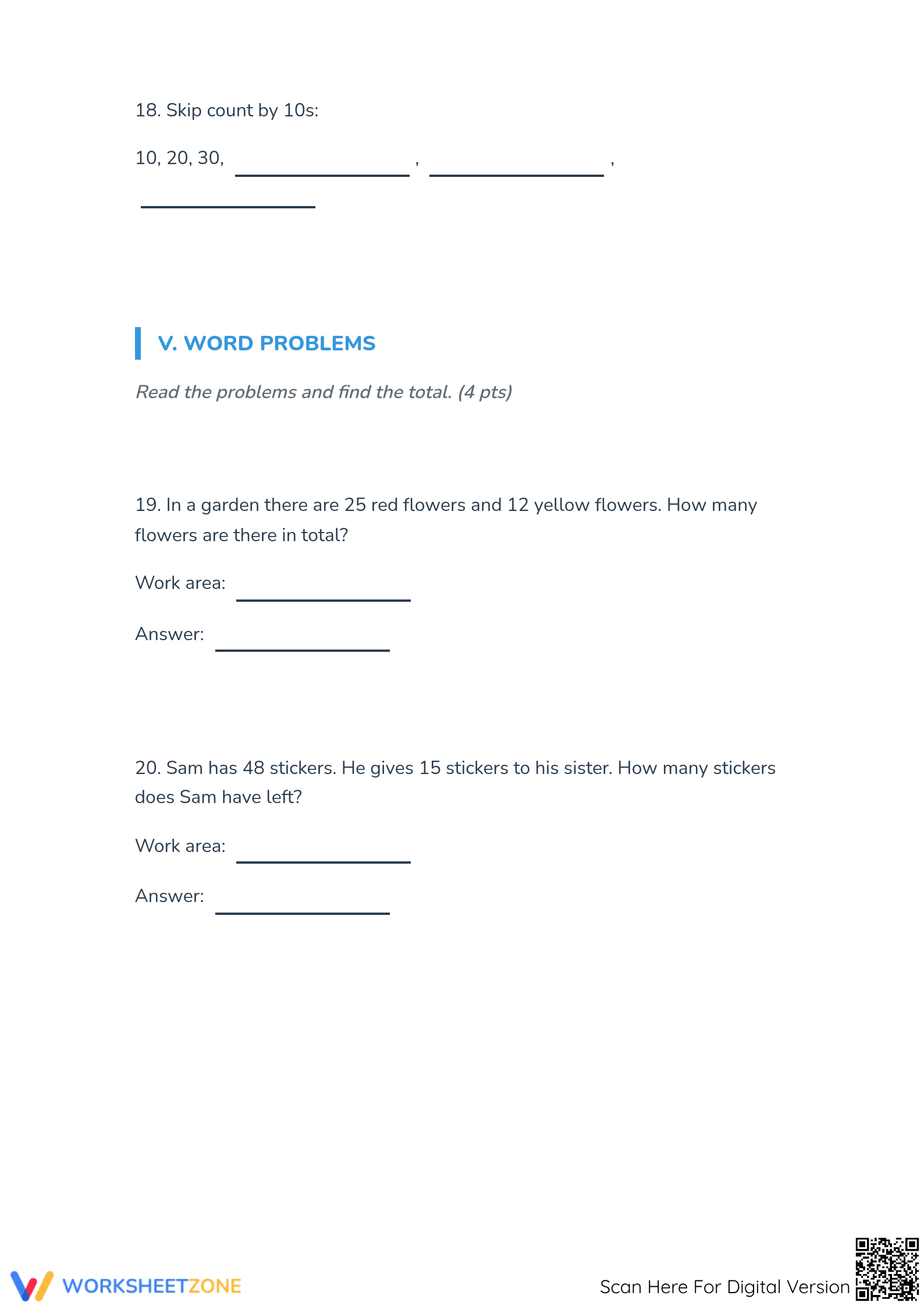
The 5-page exam features 20 tasks in five domains. Section I covers place value and comparisons. Section II introduces multi-digit addition and subtraction. Section III requires number name conversion, while Section IV evaluates skip counting. The final section presents word problems that challenge students to apply arithmetic in real-world contexts.
Each section is assigned 4-5 points, allowing for evidence-based grading. Educators can map Section I to place value mastery, while Sections II and V provide data on operational fluency. Scores of 80% indicate 'Meeting' the standard, while sequence errors in Section IV identify 'Approaching' students needing intervention.
The primary alignment is CCSS.MATH.CONTENT.2.NBT.A.1 regarding three-digit place value. This resource also supports CCSS.MATH.CONTENT.2.NBT.B.5 for addition and subtraction and CCSS.MATH.CONTENT.2.NBT.A.2 for skip-counting. These standard codes can be copied directly into lesson plans, IEP goals, or district curriculum mapping tools.
Use this as a summative exam for quarterly Number and Operations units. During administration, observe task 10 for regrouping struggles. The 20 tasks take 45-60 minutes, providing a robust snapshot of performance before moving to geometry. Use the results to group students for differentiated small-group instruction.
This assessment is for Grade 2 students but serves as a review for Grade 3. It is effective for students requiring clear, segmented sections. The worksheet pairs naturally with place value charts or base-ten blocks during review sessions to reinforce conceptual understanding and clarify common misconceptions.
According to the RAND AIRS 2024 report on mathematics instructional materials, structured assessments that bridge place value understanding with operational fluency are critical for Grade 2 learners. This worksheet aligns with CCSS.MATH.CONTENT.2.NBT.A.1 by requiring students to identify the values of digits in three-digit numbers while simultaneously applying that knowledge to vertical addition and subtraction (2.NBT.B.5). Research suggests that integrating number names and skip counting (2.NBT.A.2) within a single assessment helps educators identify specific cognitive gaps in the base-ten system. By providing 20 diverse tasks—from multiple-choice comparison to open-ended word problems—this resource facilitates a comprehensive data point for student mastery. Teachers can utilize the included answer key to quickly pivot instruction, ensuring that learners transition from procedural knowledge to conceptual understanding of number relationships, a key predictor of success in higher-level algebraic thinking and multi-step problem solving in subsequent grades.


