


























Views
Downloads

Properties of Addition Worksheet | Grade 2 Essential Math
Paste this activity's link or code into your existing LMS (Google Classroom, Canvas, Teams, Schoology, Moodle, etc.).
Students can open and work on the activity right away, with no student login required.
You'll still be able to track student progress and results from your teacher account.
Mastering the Rules of Addition
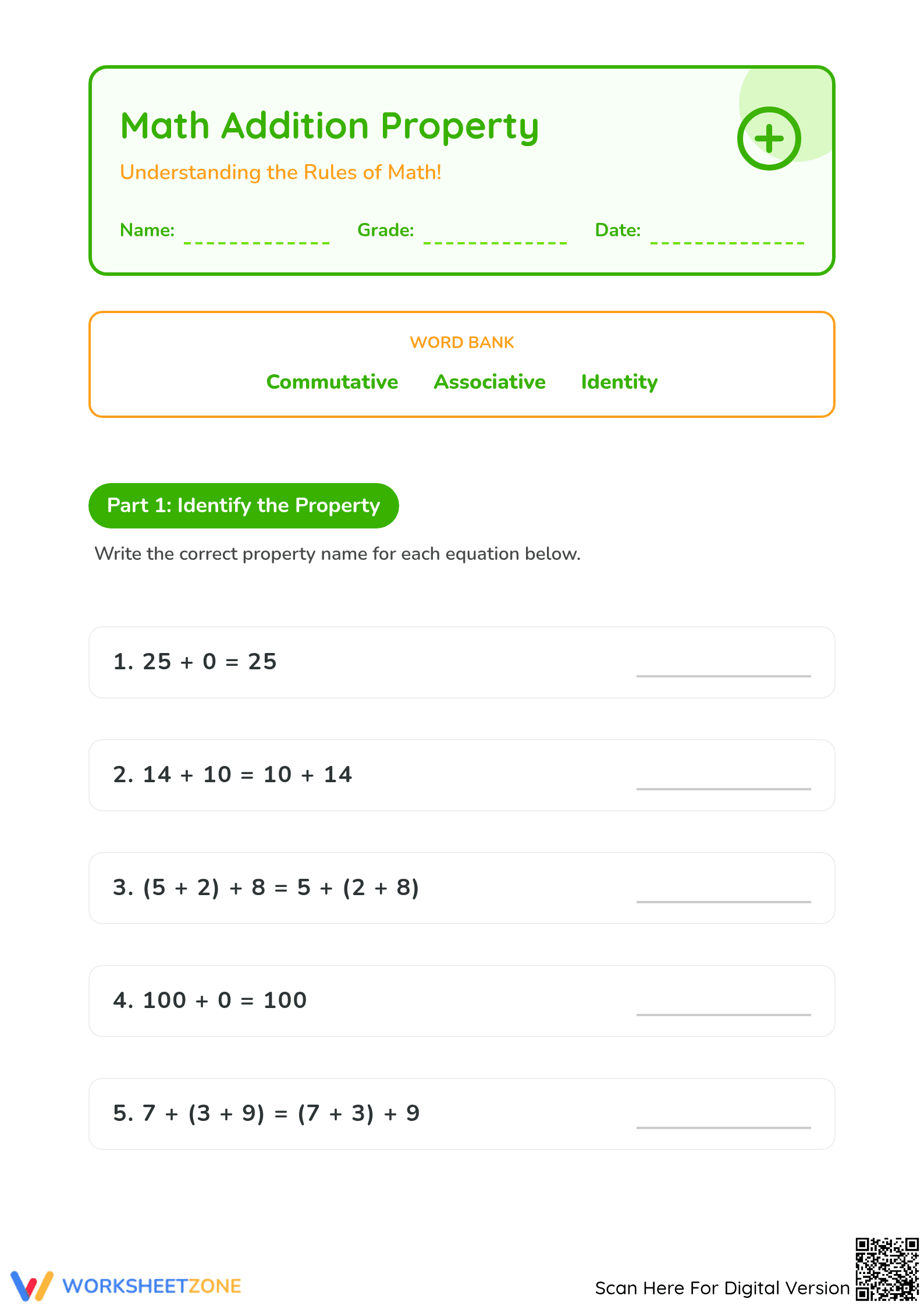
This worksheet provides focused practice on the core properties of addition for first and second-grade students. Through a series of scaffolded tasks, learners will move from identifying the commutative, associative, and identity properties to applying them in equations, solidifying their foundational understanding of arithmetic rules and preparing them for more complex operations.
At a Glance
- Grade: 1–3 · Subject: Math
- Standard:
CCSS.MATH.CONTENT.1.OA.B.3— Apply properties of operations as strategies to add.- Skill Focus: Properties of Addition (Commutative, Associative, Identity)
- Format: 4 pages · 23 problems · Answer key included · PDF
- Best For: Independent practice, skill review, math centers
- Time: 20–30 minutes
What's Inside
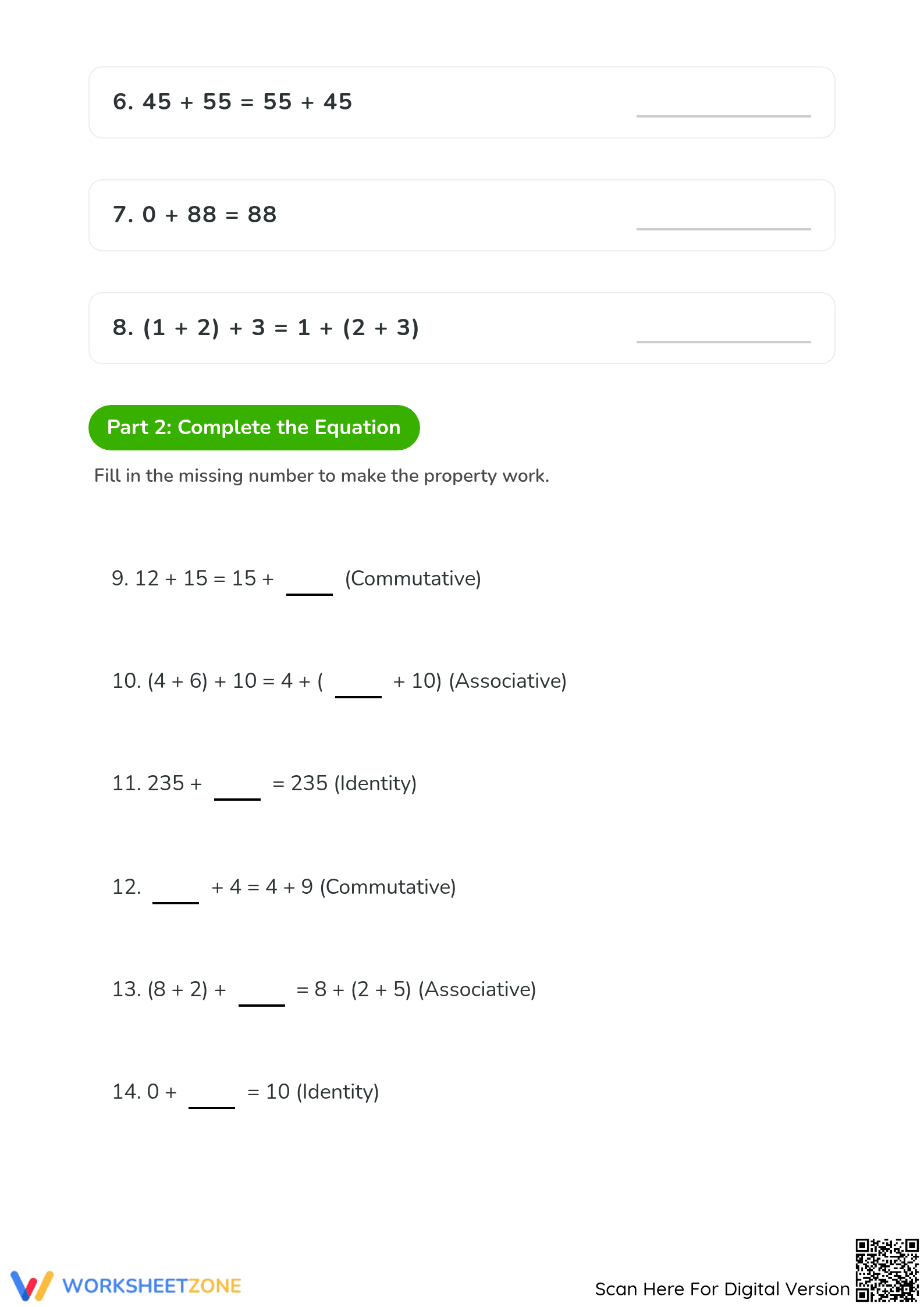
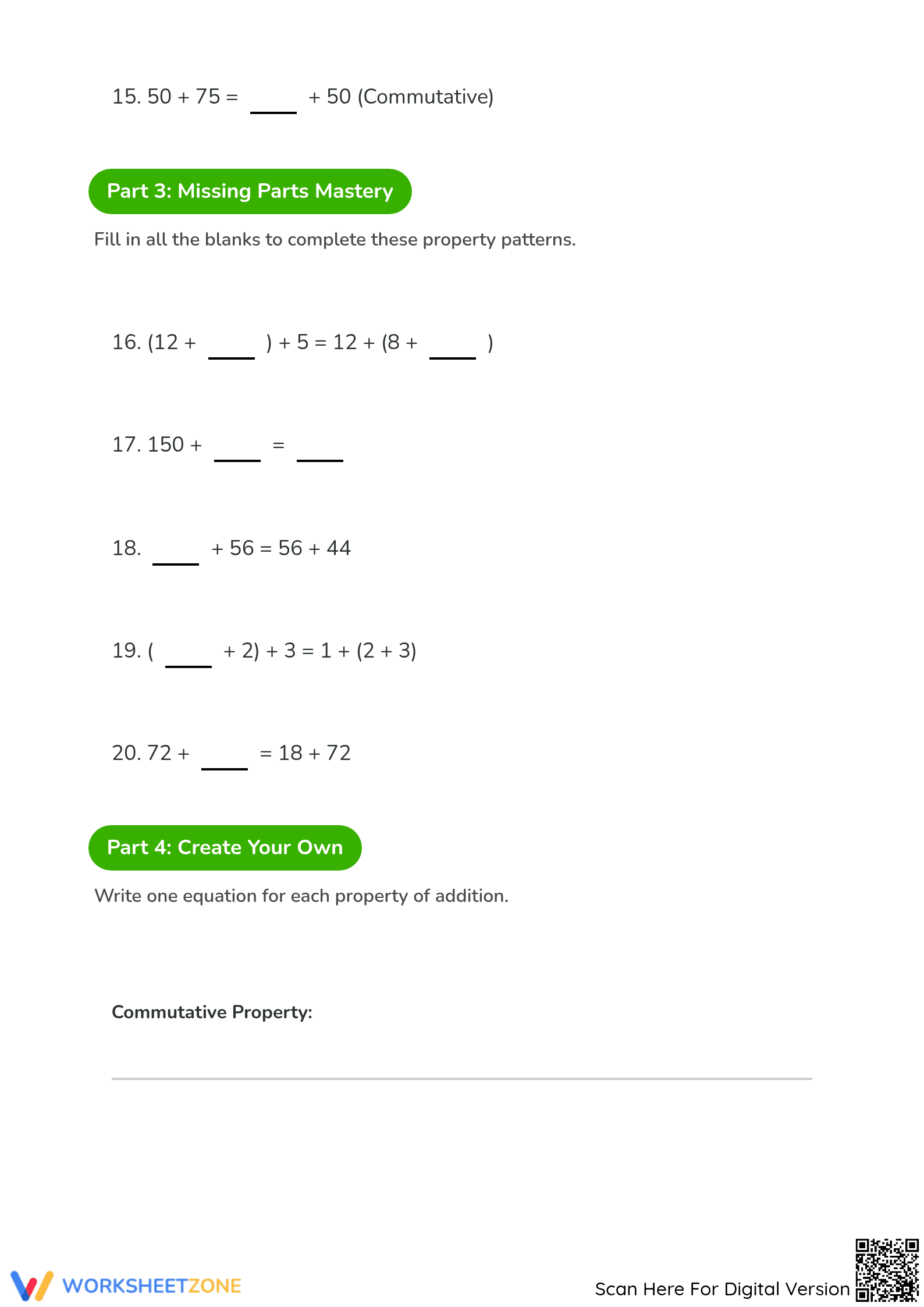
This four-page PDF includes a comprehensive worksheet and a full answer key. The student pages are structured with four distinct parts, starting with a word bank to support correct terminology. Problems progress from simple identification to completing equations and finally to creating original examples, providing a complete learning cycle on a single topic.
A Clear Path to Mastery
The worksheet is designed to follow a gradual-release model, moving students toward independent mastery. The structure includes:
- Guided practice: In Part 1, students identify the property for 8 given equations, using the provided word bank for support.
- Supported practice: In Parts 2 and 3, students apply their knowledge by completing 12 equations where the property is named or the pattern is clear.
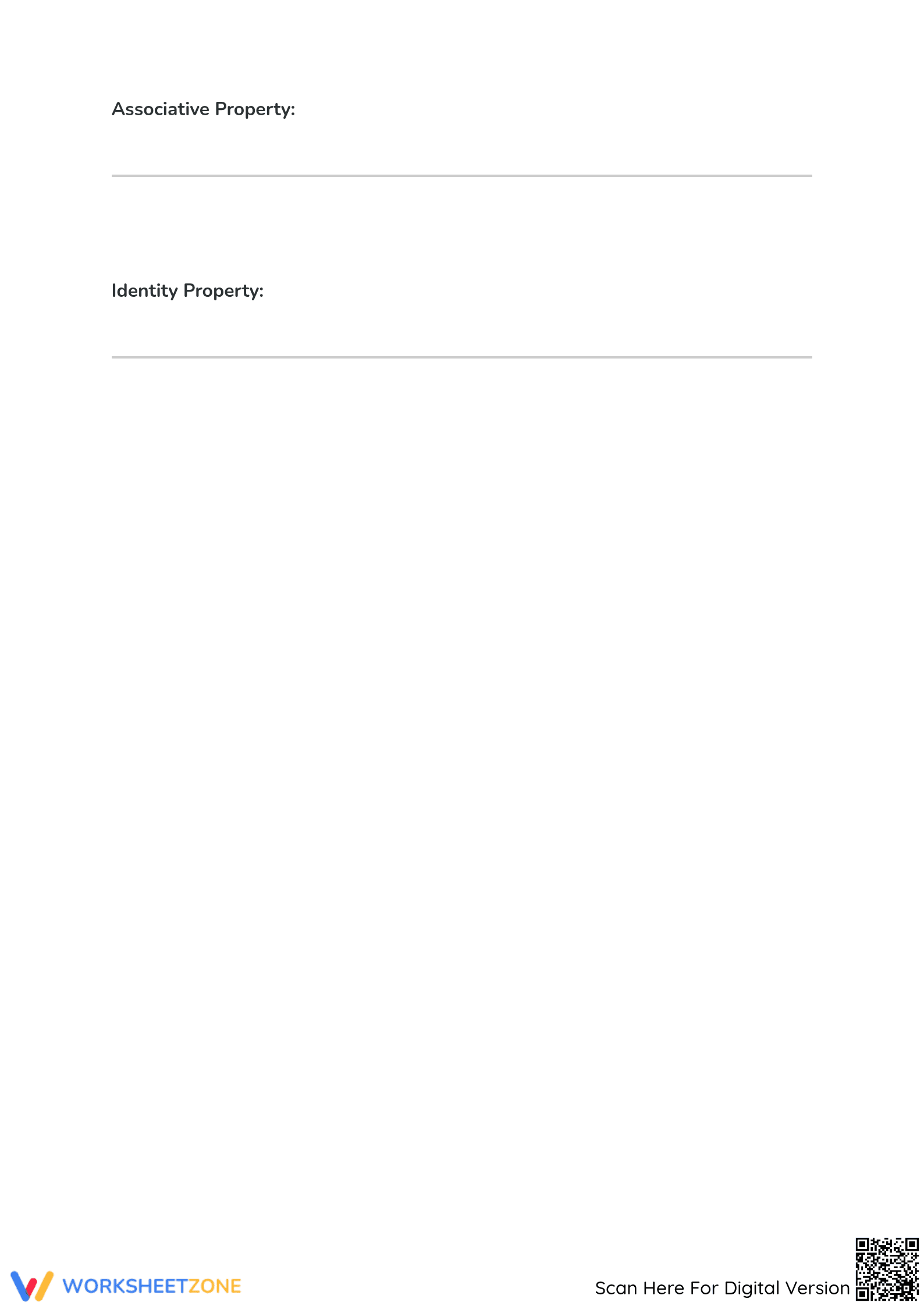
- Independent practice: In Part 4, students demonstrate mastery by writing their own unique equations for each of the three properties, a task requiring higher-order thinking.
This classic "I Do, We Do, You Do" progression ensures students build confidence and competence systematically.
Standards Alignment
This worksheet is directly aligned with CCSS.MATH.CONTENT.1.OA.B.3, which requires students to "Apply properties of operations as strategies to add and subtract." While the focus here is addition, the skill directly supports this standard's goal of using properties to make computation easier and more flexible. The activities provide concrete practice in recognizing and using the commutative and associative properties as outlined by the standard. Both standard codes can be copied directly into lesson plans, IEP goals, or district curriculum mapping tools.
How to Use It in Your Classroom
Use this worksheet after a direct instruction lesson on the properties of addition. It serves as excellent independent practice for students in a math center or as a homework assignment to reinforce the concept. For a formative assessment, observe which students can complete Part 4 ("Create Your Own") without referring back to previous examples; this indicates a deep understanding versus simple pattern matching. Most students will complete the worksheet in approximately 20-30 minutes.
Who It's For
This resource is ideal for first-grade students being introduced to addition properties and for second graders who need a thorough review. The clear structure and word bank support all learners, including English Language Learners. For students needing more support, pair this worksheet with a visual anchor chart displaying examples of each property. For those ready for a challenge, ask them to prove the associative property with three-digit numbers.


