































Printable Addition and Subtraction with Variables | Grade 4

Paste this activity's link or code into your existing LMS (Google Classroom, Canvas, Teams, Schoology, Moodle, etc.).
Students can open and work on the activity right away, with no student login required.
You'll still be able to track student progress and results from your teacher account.
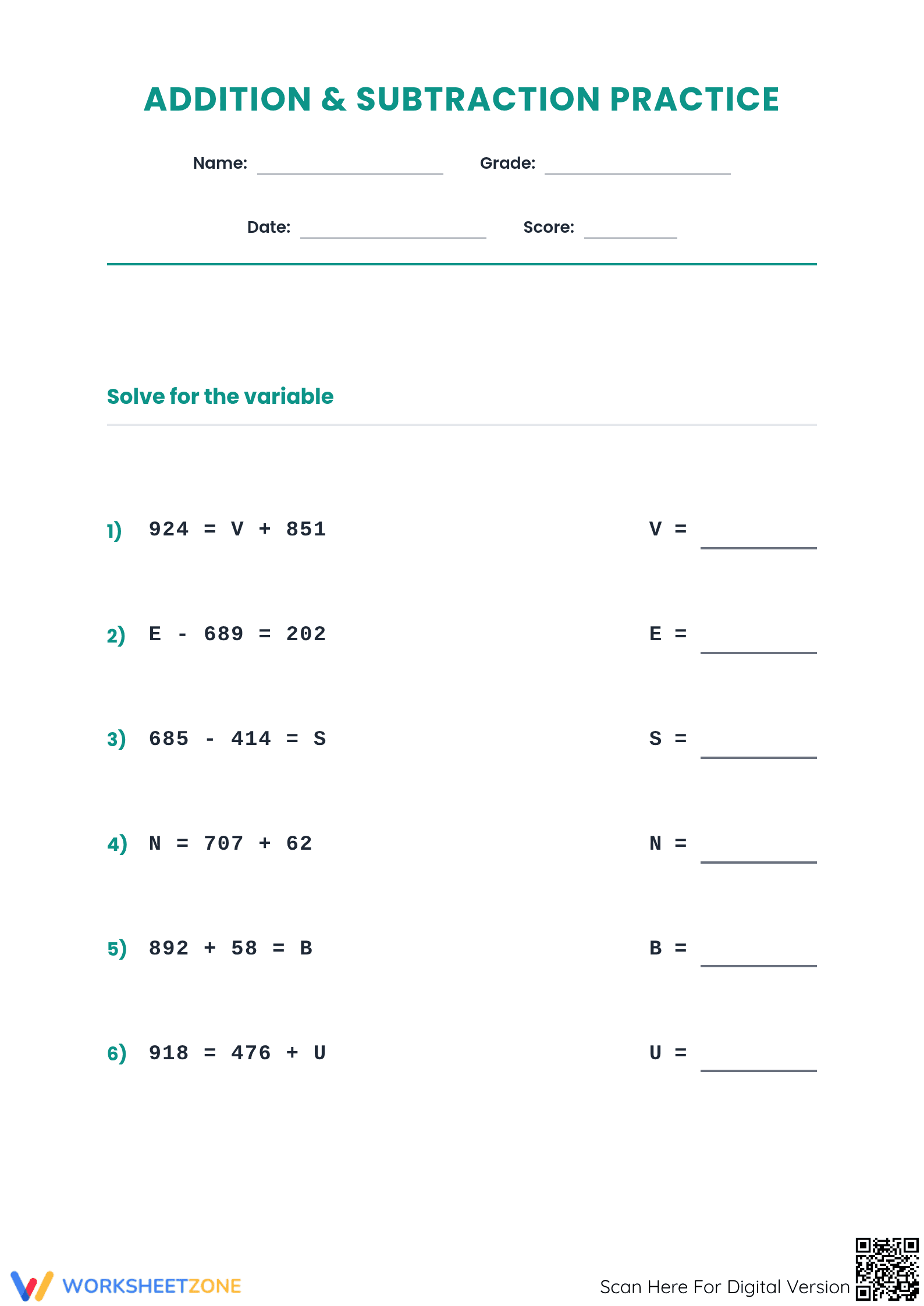
This Grade 4 worksheet provides essential practice for students learning to solve for variables in one-step algebraic equations. By bridging arithmetic and algebra, students develop the fluency needed to handle unknown quantities. This resource ensures mastery of fundamental number relationships through structured practice.
At a Glance
- Grade: 4 · Subject: Math
- Standard:
CCSS.MATH.CONTENT.4.OA.A.3— Use a letter standing for the unknown quantity in equations- Skill Focus: Solving for variables in addition and subtraction
- Format: 3 pages · 25 problems · Answer key included · PDF
- Best For: Individual practice and algebraic foundations
- Time: 20–30 minutes
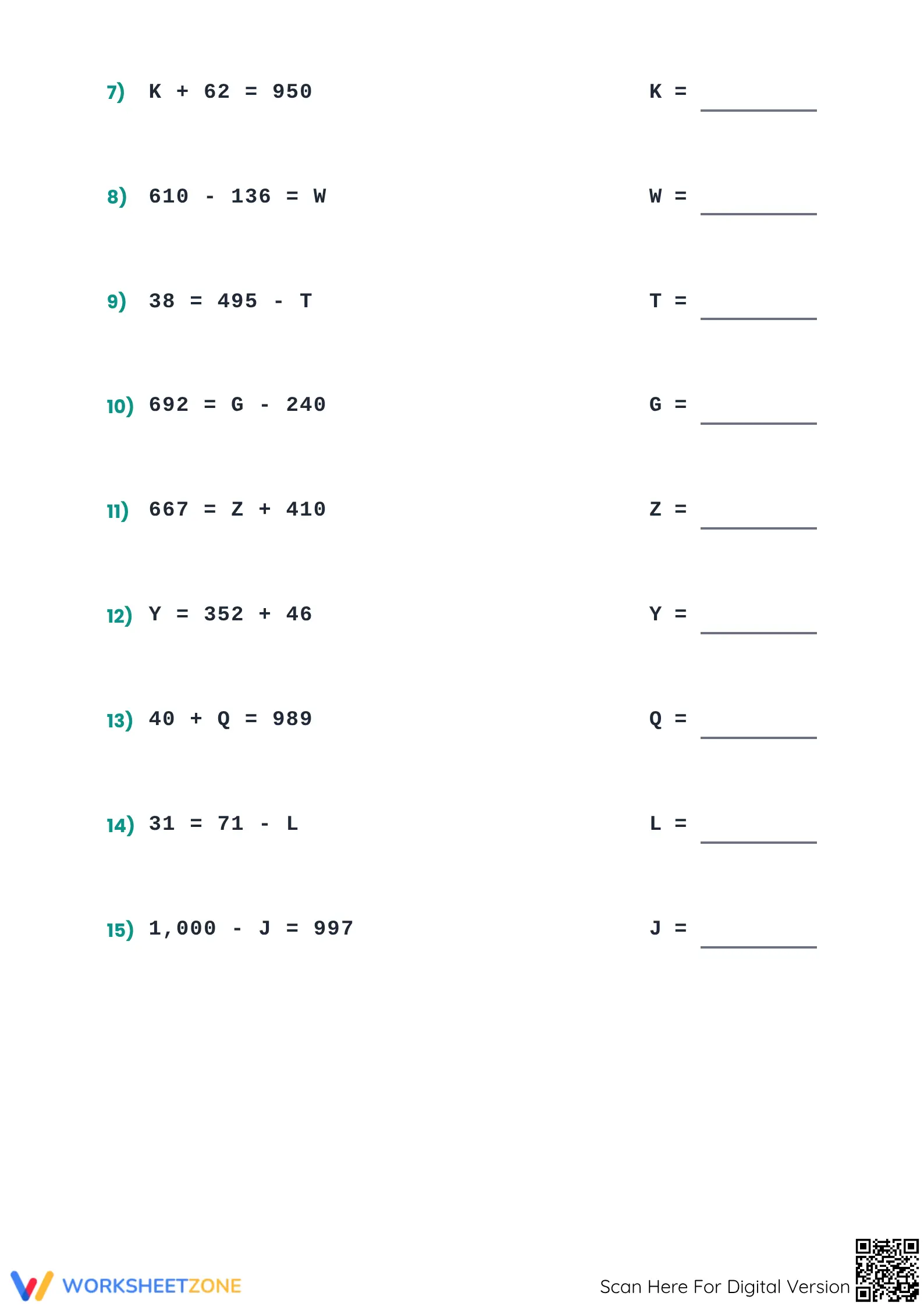
This three-page PDF contains 25 problems designed to build confidence in algebraic manipulation. Fifteen core exercises focus on solving for variables in various positions, while ten "Extra Practice" problems solidify understanding. A complete answer key is included for quick grading and immediate feedback.
Skill Progression
- Guided Practice: Simple equations where the variable is the sum or difference help students apply basic computation skills.
- Supported Practice: Problems where the variable is an addend require students to use inverse operations and number sense.
- Independent Practice: Mixed variable placements challenge students to determine the correct operation to isolate the unknown quantity.
This resource follows a gradual-release model, moving from predictable structures to varied equations that demand higher cognitive flexibility.
Standards Alignment
The primary standard addressed is CCSS.MATH.CONTENT.4.OA.A.3, which requires students to solve multi-step word problems using the four operations and represent these problems using equations with a letter standing for the unknown quantity. This worksheet focuses on the foundational skill of isolating variables in one-step equations. This standard code can be copied directly into lesson plans, IEP goals, or district curriculum mapping tools.
How to Use It
Use this as a follow-up to a lesson on inverse operations or a warm-up. For a formative assessment, observe students solving problems 7 through 10; if they struggle with inverse operations when the variable is the subtrahend, provide additional modeling with manipulatives. Completion typically takes 20 to 30 minutes.
Who It's For
Ideal for fourth-grade algebra starters or fifth-grade review, this also works for intervention groups or advanced third graders. Pair it with an anchor chart showing the relationship between addition and subtraction for the best instructional results.
Effective mathematics instruction for Grade 4 focuses on developing algebraic thinking by representing unknowns with letters. According to the NAEP framework, the ability to manipulate symbols is a critical predictor of success in middle school algebra. Fisher & Frey (2014) emphasize that the gradual release of responsibility—moving from teacher-led modeling to independent variable isolation—is essential for building student self-efficacy in STEM subjects. This worksheet aligns with these findings by providing repetitive, structured practice that reduces cognitive load while increasing procedural fluency. By using the CCSS.MATH.CONTENT.4.OA.A.3 standard, teachers can ensure students are meeting rigorous expectations for representing quantitative relationships. Research suggests that consistent exposure to variable-based equations helps bridge the gap between concrete arithmetic and abstract mathematical reasoning, which is a key component of current educational standards across the United States.


