


























Views
Downloads

Printable Types of Lines Worksheet | Grade 2 Math
Paste this activity's link or code into your existing LMS (Google Classroom, Canvas, Teams, Schoology, Moodle, etc.).
Students can open and work on the activity right away, with no student login required.
You'll still be able to track student progress and results from your teacher account.
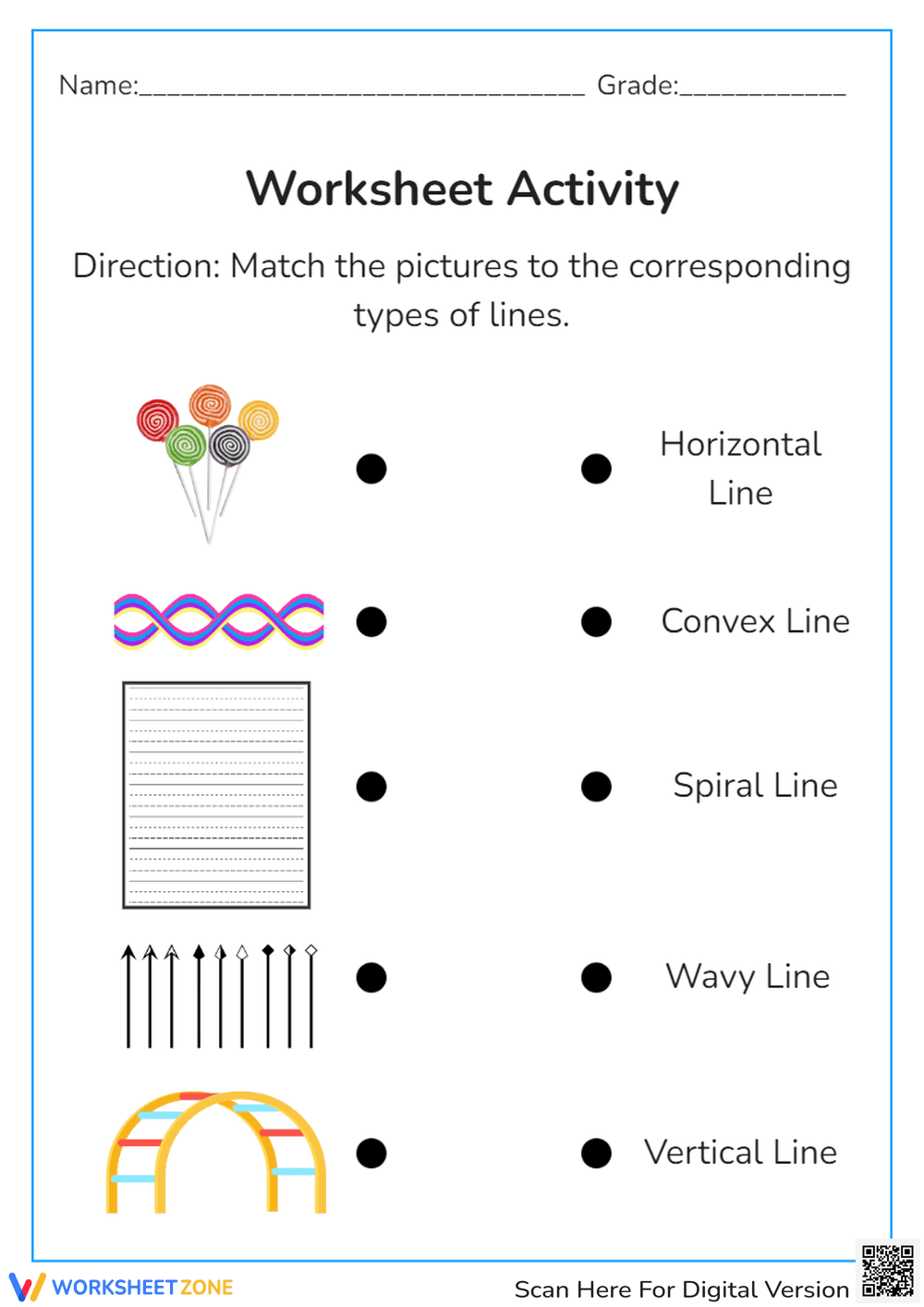
This foundational geometry worksheet helps early elementary students identify and categorize different types of lines in everyday objects. By matching real-world pictures to specific line vocabulary, learners build essential spatial reasoning skills and geometric terminology required for more advanced shape recognition and drafting tasks.
At a Glance
- Grade: 2 · Subject: Math
- Standard:
CCSS.MATH.CONTENT.2.G.A.1— Recognize and draw shapes having specified attributes- Skill Focus: Identifying types of lines
- Format: 1 page · 5 problems · Answer key included · PDF
- Best For: Independent practice or centers
- Time: 10–15 minutes
This single-page resource features a straightforward matching activity designed for young learners. Students are presented with five distinct, colorful illustrations of everyday items—such as a rainbow arch, lined paper, and lollipops—and must draw a line connecting each image to its corresponding geometric term. The vocabulary includes horizontal, vertical, wavy, spiral, and convex lines. A complete answer key is provided to ensure accurate grading and immediate feedback.
Designed for maximum efficiency, this resource follows a zero-prep workflow:
- Print (1 minute): Download the PDF and print. The clear layout ensures high-quality reproduction.
- Distribute (1 minute): Hand out during math centers or morning work. No extra manipulatives required.
- Review (2 minutes): Use the answer key to quickly check responses or project it for self-correction.
With total prep time under two minutes, it is perfect for sub plans.
This activity aligns with CCSS.MATH.CONTENT.2.G.A.1, requiring students to recognize and draw shapes having specified attributes, such as a given number of angles or a given number of equal faces. By identifying the foundational components of shapes—specific line types—students prepare for deeper geometric analysis. Both standard codes can be copied directly into lesson plans, IEP goals, or district curriculum mapping tools.
Deploy this matching activity during independent practice, immediately following direct instruction on line types. It serves as an excellent task while the teacher pulls small groups. Alternatively, use it as a quick formative assessment. While students work, observe whether they trace the lines in the pictures with their fingers; this tactile strategy indicates developing spatial orientation. Expect completion within 10 to 15 minutes.
This worksheet is primarily designed for first and second-grade students mastering basic geometry concepts. The visual nature of the matching task makes it highly accessible for English Language Learners (ELLs) and students who benefit from visual scaffolds. For differentiation, teachers can provide a vocabulary anchor chart displaying each line type to support students who need extra guidance. It pairs perfectly with an introductory lesson on 2D shapes and their defining attributes.
Mastering foundational geometric vocabulary is a critical step in early mathematics education. This resource directly supports CCSS.MATH.CONTENT.2.G.A.1 by helping students recognize and draw shapes having specified attributes. According to a 2024 report by EdReports, early exposure to precise mathematical language and visual representations significantly improves long-term spatial reasoning and problem-solving capabilities. When students practice connecting abstract terms like "horizontal" or "convex" to concrete, real-world imagery, they build stronger cognitive schemas for future geometry units. This matching activity provides exactly that type of targeted, visually supported practice. By isolating the specific skill of line identification, educators can accurately assess student understanding and address misconceptions before moving on to complex polygon construction. Incorporating this targeted practice ensures a robust foundation for subsequent mathematical achievement.


