


























Views
Downloads
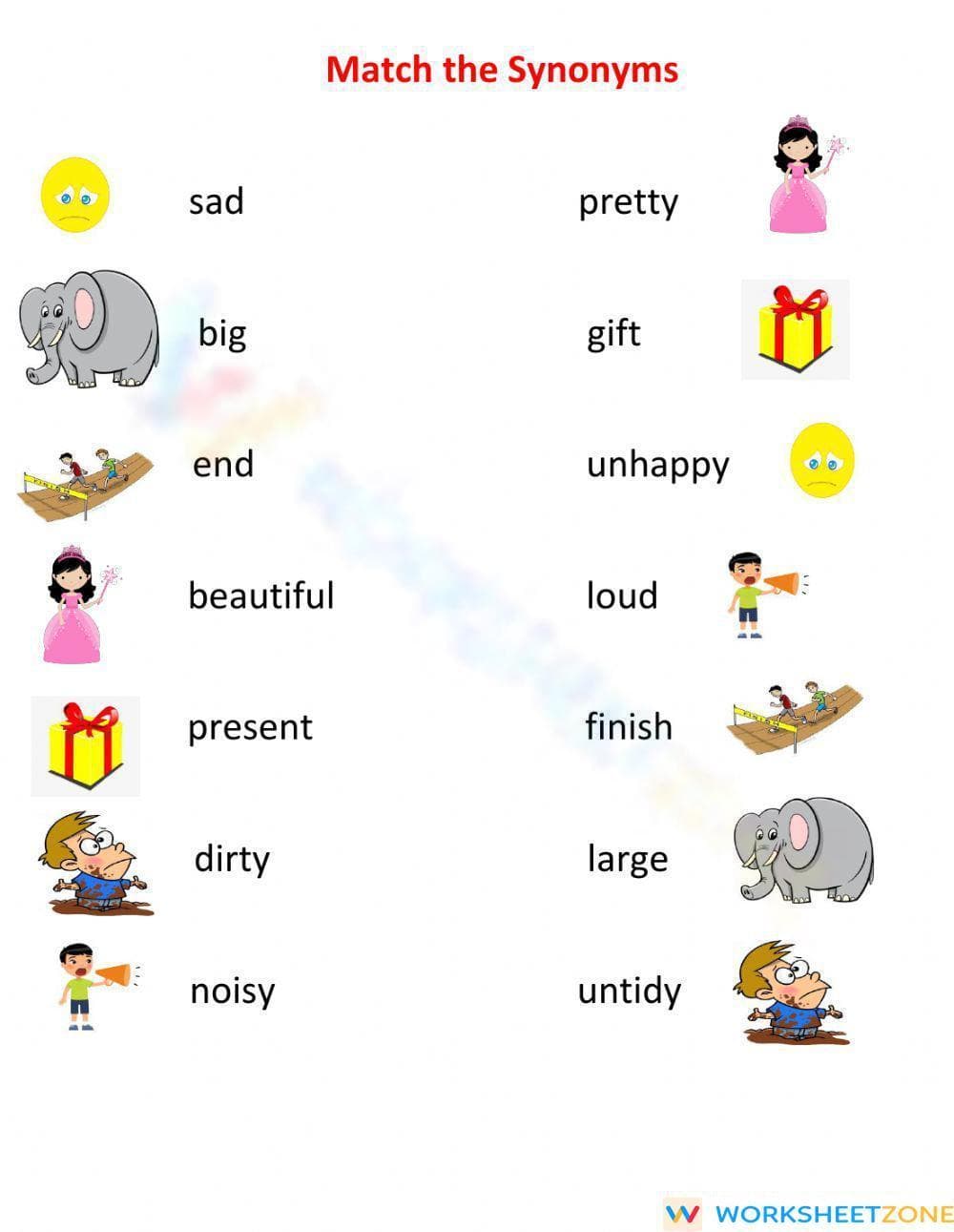


Printable Match the Synonyms Worksheet | Grade 1-2 ELA
Paste this activity's link or code into your existing LMS (Google Classroom, Canvas, Teams, Schoology, Moodle, etc.).
Students can open and work on the activity right away, with no student login required.
You'll still be able to track student progress and results from your teacher account.
Expand Vocabulary with Synonym Matching
This Match the Synonyms worksheet provides a targeted, visual way for young learners to master foundational vocabulary. By pairing common adjectives and verbs with their linguistic equals, students strengthen semantic networks. It is a practical resource designed to bridge the gap between word recognition and nuanced expression.
At a Glance
- Grade: 1–2 · Subject: ELA
- Standard:
CCSS.ELA-LITERACY.L.2.5— Identify real-life connections between words and their use to understand meanings- Skill Focus: Synonyms & Vocabulary Expansion
- Format: 1 page · 7 problems · Answer key included · PDF
- Best For: Independent practice and quick literacy centers
- Time: 10–15 minutes
What's Inside
This single-page PDF features seven high-frequency word pairs, including "sad/unhappy," "big/large," and "noisy/loud." Each word is accompanied by a vibrant illustration that provides a contextual anchor for the meaning, helping visual learners and early readers make immediate connections. The layout uses a classic matching format with clear paths for drawing lines, ensuring the task is physically accessible for developing motor skills. A comprehensive answer key is provided for rapid grading.
Zero-Prep Workflow
Teachers can implement this resource with total preparation time under two minutes. Simply print the master copy and run duplicates. Distribution takes sixty seconds, and students begin immediately without complex instructions. Reviewing is streamlined by visual patterns, allowing for quick checks during transitions or as a standalone formative assessment at the end of a lesson block.
Standards Alignment
This resource is explicitly aligned to CCSS.ELA-LITERACY.L.2.5, which requires students to demonstrate understanding of word relationships and nuances in word meanings. By identifying words with similar meanings, students fulfill the sub-standard of recognizing how vocabulary choices impact tone and clarity. This standard code can be copied directly into lesson plans, IEP goals, or district curriculum mapping tools to ensure instructional compliance and tracking.
How to Use It
Use this worksheet as a "bridge" activity immediately following direct instruction on word relationships. For a formative assessment tip, walk around while students draw their matching lines and ask them to use one of the synonym pairs in a complete sentence. This verifies both recognition and application. The task typically takes 10 to 15 minutes, making it an ideal choice for morning work or a literacy station rotation.
Who It's For
This worksheet is designed for Grade 1 and Grade 2 students, though it serves as an excellent challenge for Kindergarteners or a review for older learners with language processing delays. It pairs naturally with an anchor chart on "Juicy Words" or a short passage where students can swap out basic words for the synonyms found here.
Synonym instruction is vital for vocabulary acquisition, as highlighted in Fisher & Frey (2014), where the gradual release of responsibility model emphasizes the importance of supported practice in developing a rich lexicon. This worksheet targets the CCSS.ELA-LITERACY.L.2.5 standard by requiring students to recognize semantic equivalence across seven distinct pairs. Research from the NAEP consistently shows that students who identify and apply varied vocabulary demonstrate higher reading comprehension scores in later grades. By utilizing visual scaffolds alongside textual cues, this resource ensures the cognitive load remains focused on word relationships rather than decoding alone. This evidence-based approach provides a reliable tool for assessing a student's ability to master English language nuances. This summary is intended for professional portfolios, district curriculum audits, or evidence-based instructional reports where validated resources are required. It serves as a standalone citation for the effectiveness of visual-textual vocabulary reinforcement in early childhood literacy settings.


