


























Views
Downloads

Number 5 Counting and Writing Worksheet | Grade K Essential
Paste this activity's link or code into your existing LMS (Google Classroom, Canvas, Teams, Schoology, Moodle, etc.).
Students can open and work on the activity right away, with no student login required.
You'll still be able to track student progress and results from your teacher account.
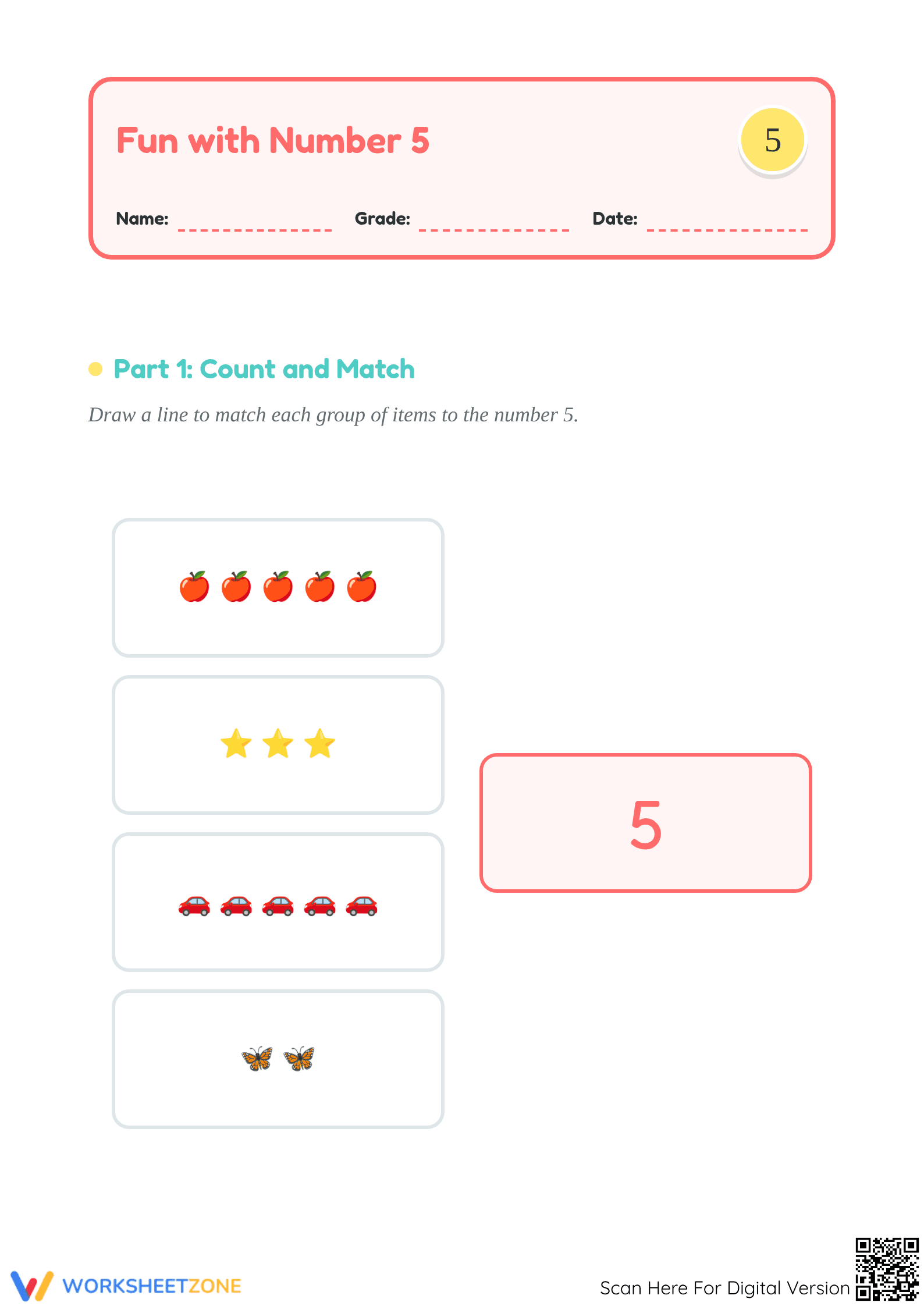
This Kindergarten math worksheet provides comprehensive practice for the number five, helping students connect the numeral to its quantity. Through matching, identifying, and writing, learners build a solid foundation in early cardinality and fine motor skills. It ensures students can confidently recognize and represent the number five in multiple formats.
At a Glance
- Grade: Kindergarten · Subject: Math
- Standard:
CCSS.MATH.CONTENT.K.CC.B.4— Understand the relationship between numbers and quantities; connect counting to cardinality.- Skill Focus: Number 5 recognition and representation
- Format: 3 pages · 12 problems · Answer key included · PDF
- Best For: Early numeracy centers and independent practice
- Time: 15–20 minutes
What's Inside
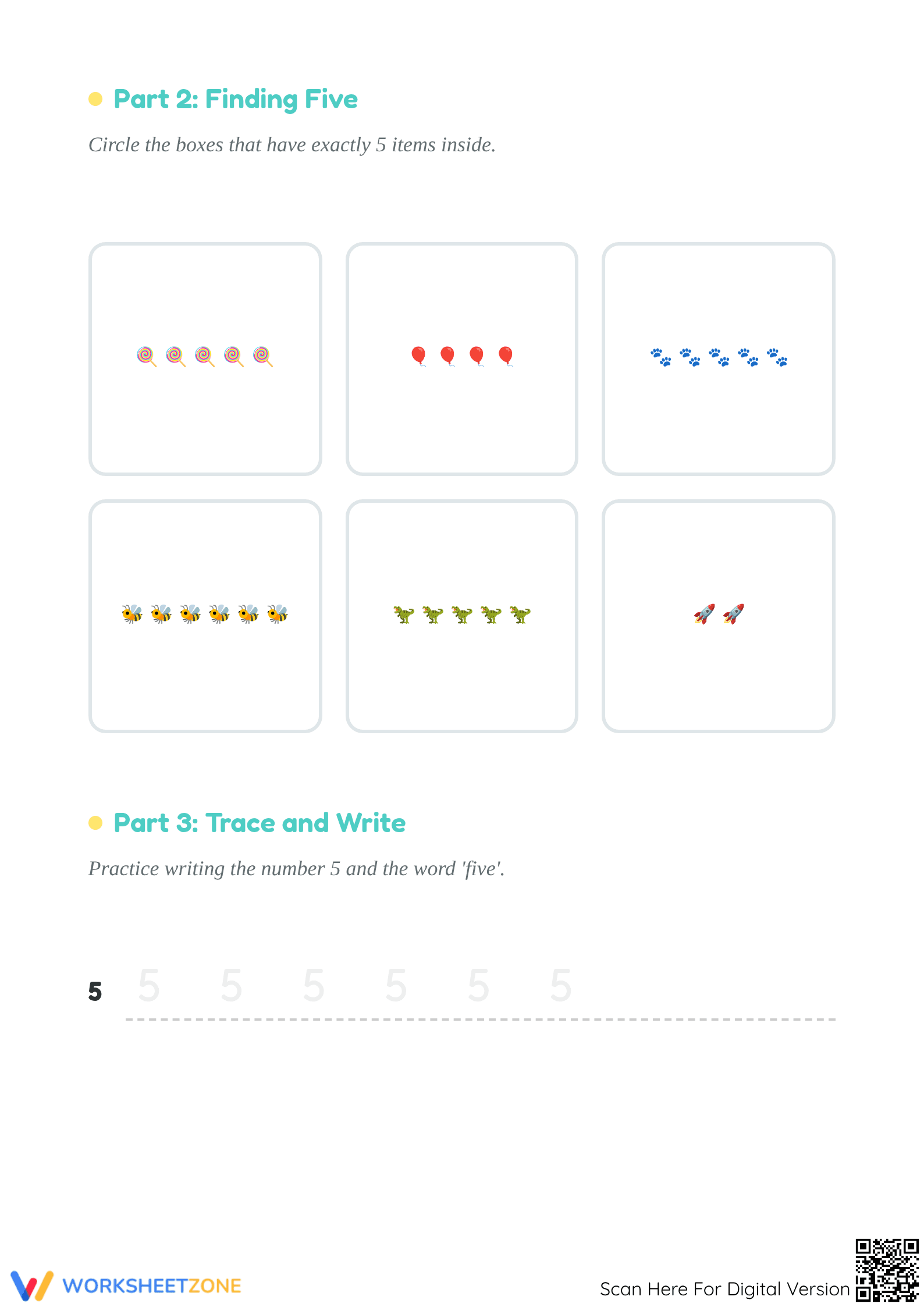
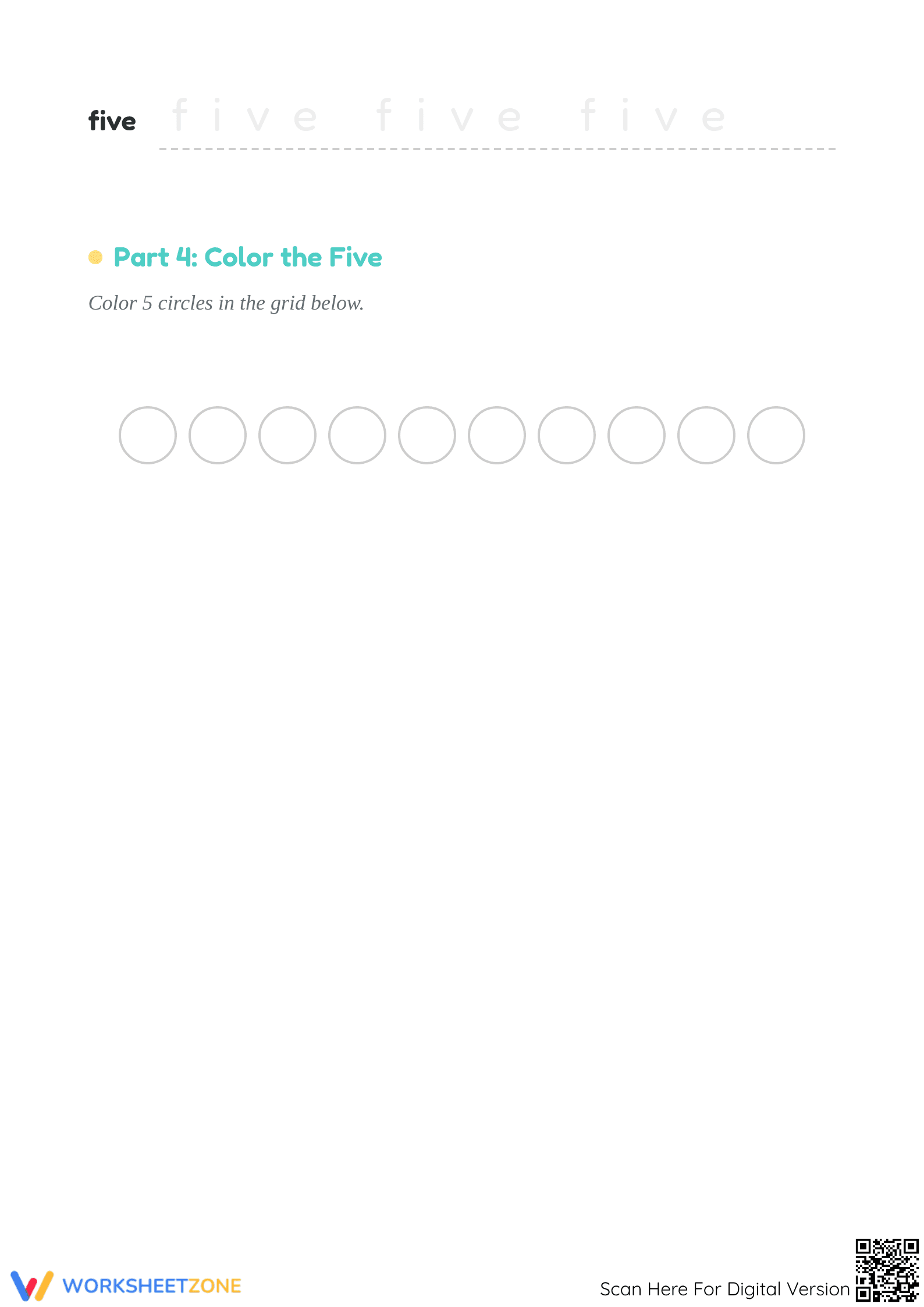
This three-page PDF includes four distinct activity sections. Students begin with a matching task, followed by a visual discrimination exercise to find groups of five. The resource also features dedicated tracing lines for both the numeral "5" and the word "five," concluding with a coloring activity to reinforce one-to-one correspondence. A full answer key is provided for quick grading.
Zero-Prep Workflow
- Print: Generate the three-page set in less than 30 seconds.
- Distribute: Hand out materials to students in approximately one minute.
- Review: Use the included answer key to check for accuracy in under two minutes.
This resource is designed for immediate classroom implementation and is highly suitable for emergency sub plans or morning work routines.
Standards Alignment
The primary focus is CCSS.MATH.CONTENT.K.CC.B.4, which requires students to understand that the last number name said tells the number of objects counted. It also supports CCSS.MATH.CONTENT.K.CC.A.3 by providing structured tracing for number writing. Both standard codes can be copied directly into lesson plans, IEP goals, or district curriculum mapping tools.
How to Use It
Use this as a formative assessment after introducing the number five during circle time. It also works well as a quiet-time activity for students who finish other tasks early. Observe students during the "Finding Five" section to check for subitizing skills or counting accuracy. Expected completion time ranges from 15 to 20 minutes depending on student writing speed.
Who It's For
This is ideal for Kindergarten students or preschool learners ready for formal number writing. It provides necessary scaffolding for students developing fine motor control or one-to-one correspondence. Pair this with physical manipulatives like counting bears or a classroom anchor chart showing the number five for a complete instructional experience.
Early childhood numeracy depends on the integration of visual, motor, and cognitive tasks to solidify number sense. According to Fisher & Frey (2014), the gradual release of responsibility is most effective when students move from guided identification to independent production. This worksheet facilitates that transition by moving from simple matching to independent writing and quantity selection. By aligning with CCSS.MATH.CONTENT.K.CC.B.4, the resource ensures that students are not just memorizing a symbol but are understanding the underlying cardinality of the number five. Research from the NAEP suggests that early mastery of these foundational counting principles is a strong predictor of later mathematical achievement in elementary school. This 3-page resource provides the structured repetition necessary for students to achieve mastery in number recognition and formation, making it a reliable tool for any early childhood mathematics curriculum or intervention program.


