




























Views
Downloads
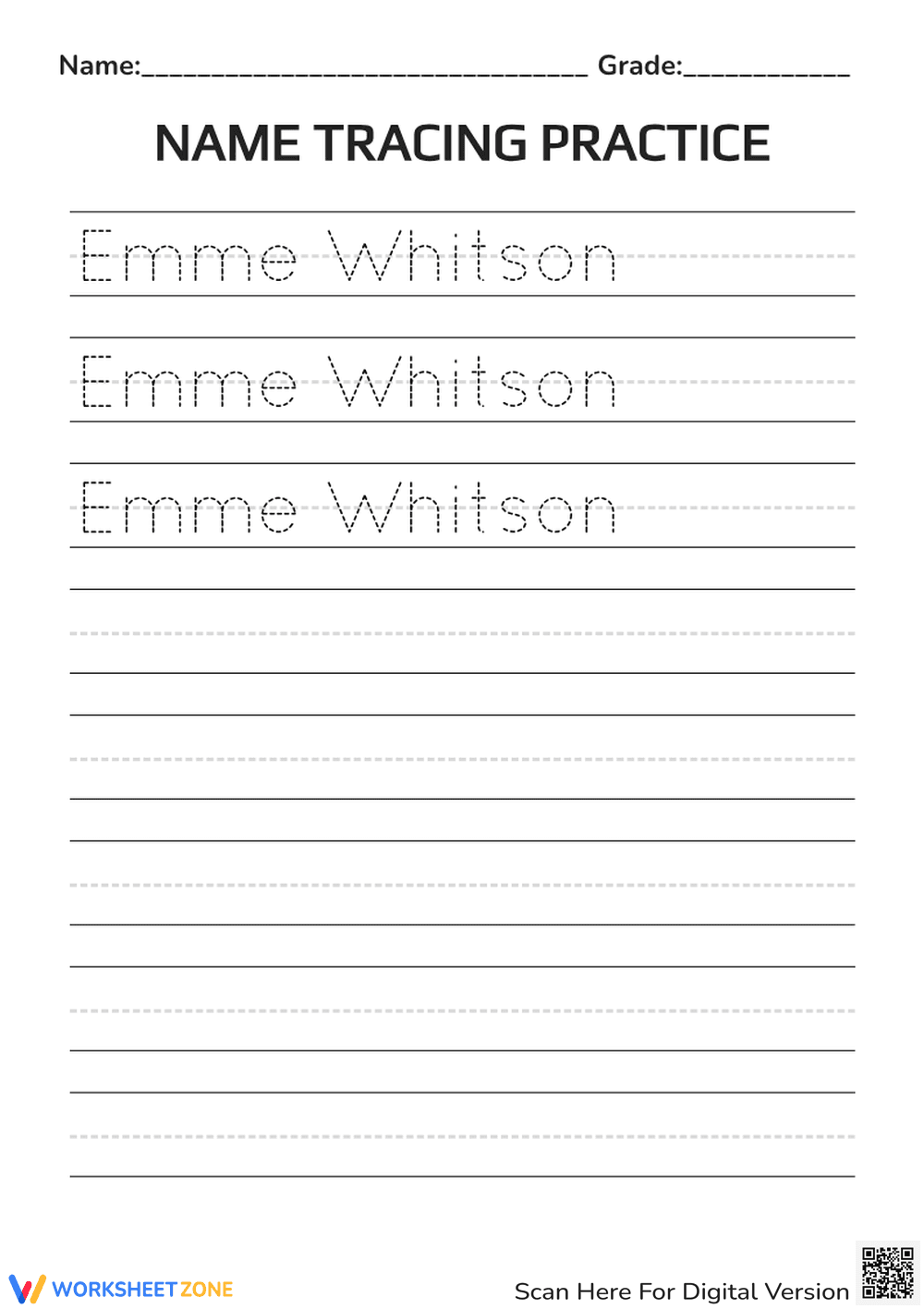

Grade K Name Tracing — Printable No-Prep Worksheet

Paste this activity's link or code into your existing LMS (Google Classroom, Canvas, Teams, Schoology, Moodle, etc.).
Students can open and work on the activity right away, with no student login required.
You'll still be able to track student progress and results from your teacher account.
This printable handwriting worksheet provides early learners with structured name tracing practice to build essential fine motor skills. By transitioning from guided dotted lines to independent writing spaces, students develop proper letter formation and spatial awareness on primary lined paper.
At a Glance
- Grade: K · Subject: Handwriting
- Standard:
CCSS.ELA-LITERACY.L.K.1.A— Print many upper- and lowercase letters- Skill Focus: Name Tracing and Letter Formation
- Format: 1 page · 8 practice lines · No answer key · PDF
- Best For: Morning work or literacy centers
- Time: 10–15 minutes
This single-page resource features a clear layout designed for early writers. The top section includes three rows of dotted-line text for the name 'Emme Whitson,' allowing students to trace the exact strokes required. Below the tracing section, five blank primary writing lines—complete with solid top and bottom guidelines and a dashed midline—provide ample space for students to attempt writing independently without tracing support.
This resource follows a highly efficient zero-prep workflow for busy educators:
- Print (1 minute): Simply download the PDF and print the required number of copies. The black-and-white design saves ink.
- Distribute (1 minute): Hand out the sheets during morning routines or center rotations. The instructions are self-evident, requiring minimal teacher setup.
- Review (1 minute): Quickly scan student work to check for proper pencil grip, stroke direction, and adherence to the dashed midline.
With a total teacher prep time of under two minutes, this sheet is an excellent addition to any emergency sub plan or daily warm-up routine.
This activity aligns directly with CCSS.ELA-LITERACY.L.K.1.A, requiring students to print many upper- and lowercase letters. By practicing a specific proper noun, students also reinforce early capitalization rules. Both standard codes can be copied directly into lesson plans, IEP goals, or district curriculum mapping tools.
Teachers can utilize this tracing sheet as a daily morning work activity as students settle into the classroom. It also serves as an effective independent station during literacy centers. While students work, teachers should conduct formative assessments by observing pencil grip and stroke sequence, ensuring children start their letters at the top line rather than the bottom. Expected completion time ranges from ten to fifteen minutes depending on the student's fine motor development.
This resource is primarily designed for kindergarten and first-grade students mastering basic handwriting skills. It serves as an excellent intervention tool for occupational therapy sessions or for students requiring additional fine motor scaffolding. Pair this worksheet with a tactile letter-formation activity, such as tracing letters in sand or using playdough mats, to reinforce muscle memory before moving to pencil and paper.
Developing automaticity in letter formation is a critical precursor to expressive writing. According to a 2024 report by EdReports, early handwriting fluency significantly reduces cognitive load, allowing young learners to focus on content generation rather than the physical mechanics of writing. This worksheet targets CCSS.ELA-LITERACY.L.K.1.A, helping students print many upper- and lowercase letters through repetitive, structured practice. By combining guided tracing with independent application on primary lines, the activity builds the exact muscle memory required for legible handwriting. Consistent practice with proper nouns also reinforces early capitalization concepts in a highly personalized context. Educators can rely on this targeted fine motor exercise to establish foundational literacy skills that support broader reading and writing achievement across the primary grades.


