


























Views
Downloads
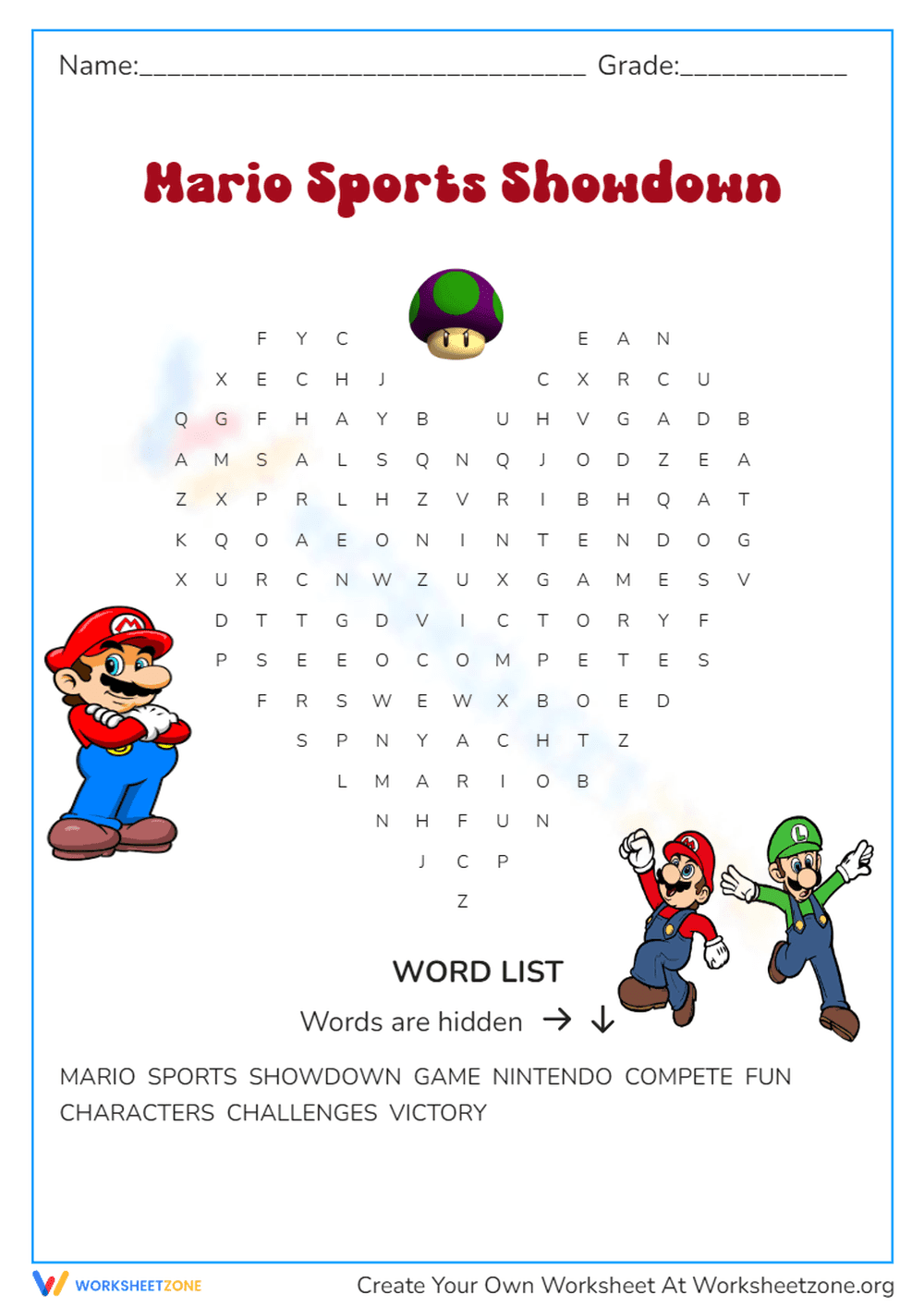

Mario Sports Word Search | Grade 3 Printable
Paste this activity's link or code into your existing LMS (Google Classroom, Canvas, Teams, Schoology, Moodle, etc.).
Students can open and work on the activity right away, with no student login required.
You'll still be able to track student progress and results from your teacher account.
This engaging Mario Sports Showdown word search helps students build visual scanning and spelling skills while searching for ten themed vocabulary words. By locating terms horizontally and vertically, learners reinforce letter recognition and word patterns in a fun, familiar context. Perfect for morning work or early finishers.
At a Glance
- Grade: 3 · Subject: ELA
- Standard:
CCSS.ELA-LITERACY.L.3.2— Spell grade-appropriate words correctly- Skill Focus: Vocabulary and Spelling
- Format: 1 page · 10 problems · Answer key included · PDF
- Best For: Early finishers and morning work
- Time: 10–15 minutes
This single-page printable features a uniquely shaped word search grid surrounded by popular video game characters. Students are tasked with finding ten specific vocabulary words related to sports and gaming, such as "victory," "compete," and "challenges." The words are hidden in two directions—left to right and top to bottom—making it accessible for younger readers. A complete answer key is provided to ensure quick grading and easy reference.
Designed for a zero-prep workflow, this is ideal for any sub plan.
- Print (1 min): Download the PDF and print copies.
- Distribute (1 min): Hand out with highlighters. Instructions are self-explanatory, requiring no teacher setup.
- Review (1 min): Use the answer key to quickly check work.
Total teacher prep time is under two minutes.
This activity aligns with CCSS.ELA-LITERACY.L.3.2, which requires students to demonstrate command of the conventions of standard English capitalization, punctuation, and spelling when writing. By repeatedly exposing students to the correct spelling of these ten vocabulary words, the puzzle reinforces orthographic mapping. Both standard codes can be copied directly into lesson plans, IEP goals, or district curriculum mapping tools.
This worksheet serves as an excellent transition activity after direct instruction in spelling or vocabulary. Teachers can assign it as independent practice while pulling small groups for targeted reading interventions. Alternatively, it works perfectly as a Friday afternoon reward activity that still maintains academic value. While students work, observe their visual tracking strategies—note whether they scan row by row or look for specific starting letters, which can inform future reading fluency instruction. Expected completion time ranges from ten to fifteen minutes.
This resource is primarily designed for elementary students in grades one through six who benefit from engaging, character-themed practice. The straightforward horizontal and vertical word placement provides built-in differentiation, making it accessible for students who might struggle with diagonal or backward words. Pair this worksheet with a short reading passage about sportsmanship or a direct instruction lesson on cooperative games to create a comprehensive thematic unit.
Integrating thematic vocabulary activities like this Mario-themed puzzle supports foundational literacy development by reinforcing orthographic patterns. According to a recent EdReports 2024 analysis of effective supplemental materials, providing students with high-interest, low-stakes practice opportunities significantly improves their engagement and time on task. When students interact with words like "compete" and "victory" in a familiar context, they are more likely to internalize the correct spelling structures required by CCSS.ELA-LITERACY.L.3.2. The standard emphasizes the need for students to spell grade-appropriate words correctly, a skill directly supported by the visual scanning and letter-matching required in word searches. By isolating the task to horizontal and vertical orientations, this specific worksheet reduces cognitive overload, allowing learners to focus purely on word recognition and spelling accuracy. This targeted approach ensures that fun activities remain academically rigorous and aligned with core educational objectives.


