


























Views
Downloads
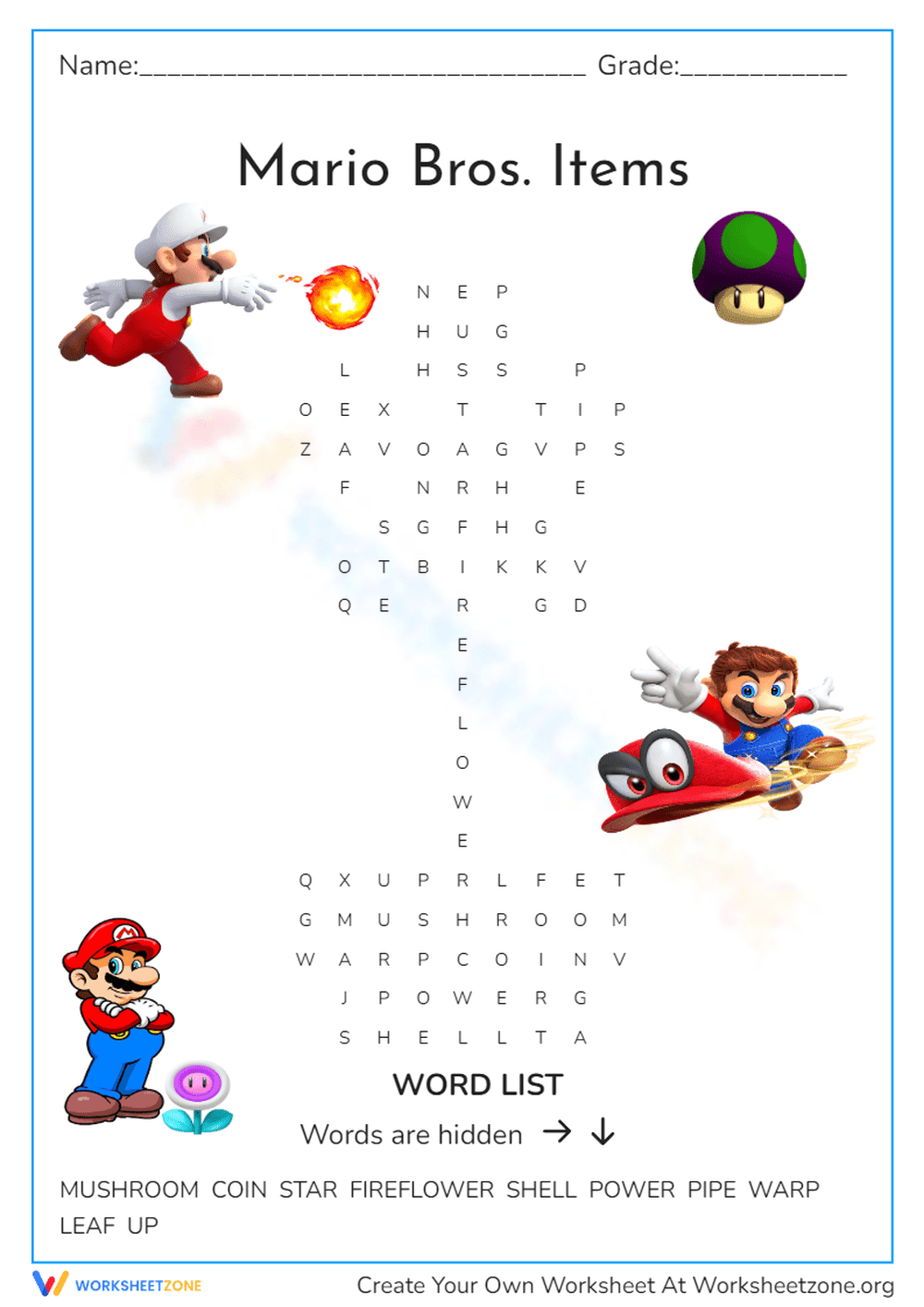

Mario Word Search — Printable Grade 3 Activity
Paste this activity's link or code into your existing LMS (Google Classroom, Canvas, Teams, Schoology, Moodle, etc.).
Students can open and work on the activity right away, with no student login required.
You'll still be able to track student progress and results from your teacher account.
This engaging Mario word search worksheet helps students build visual scanning and spelling skills while searching for iconic video game items. By locating ten specific vocabulary words within the puzzle grid, learners reinforce letter recognition and word formation in a highly motivating, familiar context.
At a Glance
- Grade: 3 · Subject: ELA
- Standard:
CCSS.ELA-LITERACY.L.3.2— Use conventional spelling for studied words- Skill Focus: Visual scanning and spelling
- Format: 1 page · 10 problems · Answer key included · PDF
- Best For: Early finishers and sub plans
- Time: 10–15 minutes
This single-page printable features a letter grid surrounded by popular Mario characters. Students must find ten hidden words listed in the bottom word bank, including mushroom, coin, and star. Words are hidden horizontally and vertically. A complete answer key is provided for quick grading or independent self-checking.
Zero-Prep Workflow
This resource is designed for immediate classroom implementation with absolutely no teacher setup required.
- Print (1 minute): Simply print the PDF file. The black-and-white text and colorful character accents print beautifully on standard letter paper.
- Distribute (1 minute): Hand out the puzzle to students during transitions, morning work, or literacy centers.
- Review (1 minute): Use the included answer key to quickly verify completed puzzles or project it on the smartboard for self-correction.
With a total prep time of under two minutes, this activity is an ideal addition to any emergency sub plan folder.
Standards Alignment
This activity aligns with CCSS.ELA-LITERACY.L.3.2, requiring students to demonstrate command of the conventions of standard English spelling. By repeatedly scanning for correct letter sequences, students reinforce their orthographic mapping of these specific terms. Both standard codes can be copied directly into lesson plans, IEP goals, or district curriculum mapping tools.
How to Use It
This worksheet serves as an excellent independent activity for early finishers. It keeps them quietly engaged while reinforcing spelling patterns. Additionally, it functions perfectly as a morning work assignment to help students settle into the classroom routine. While students work, teachers can observe their visual tracking strategies—noting whether they scan row by row or look for specific starting letters. Most students will complete this puzzle within a 10 to 15-minute timeframe.
Who It's For
This resource is primarily designed for third-grade students, though it appeals broadly to learners in grades one through five who enjoy video games. For students needing extra support, teachers can highlight the first letter of each hidden word in the grid to reduce visual fatigue. This puzzle pairs naturally with creative writing prompts where students invent their own video game levels using the vocabulary words they just found.
Integrating high-interest themes into foundational literacy practice significantly boosts student engagement and task persistence across elementary classrooms. This worksheet targets CCSS.ELA-LITERACY.L.3.2, helping students use conventional spelling for studied words through active visual scanning and letter recognition. According to a recent EdReports 2024 analysis, incorporating culturally relevant and familiar media properties into routine academic tasks reduces cognitive friction and dramatically increases the likelihood of independent task completion. When students search for terms associated with their favorite video game characters, they are far more willing to sustain attention on orthographic mapping exercises that might otherwise feel repetitive or tedious. This targeted practice strengthens their ability to recognize correct letter sequences rapidly, which is a critical component of fluent reading and writing development. By utilizing this structured word search, educators provide a low-stakes, highly motivating environment for students to consolidate their spelling knowledge while genuinely enjoying the learning process.


