


























Views
Downloads
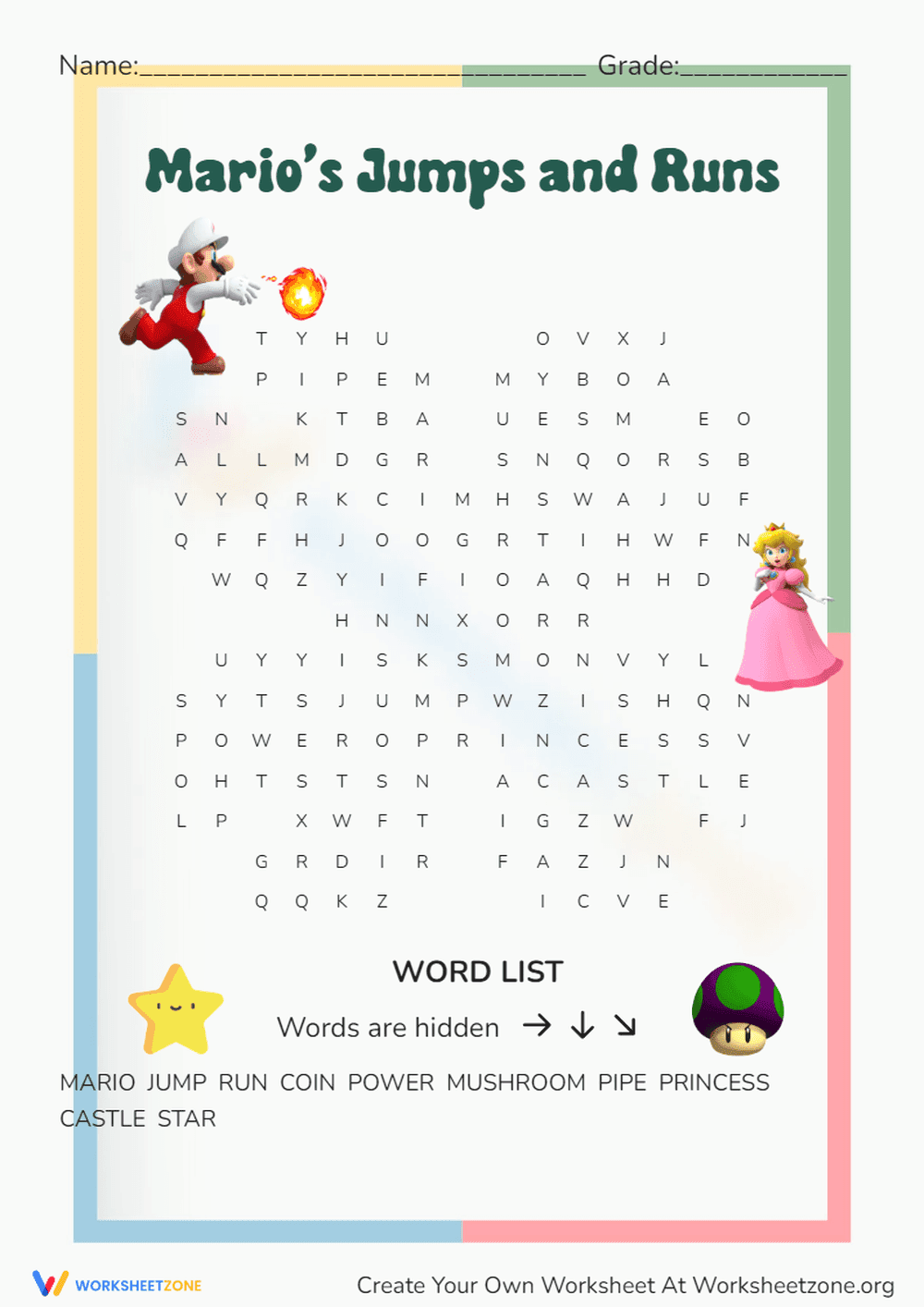

Mario Word Search Worksheet | Grade 1-5 Printable
Paste this activity's link or code into your existing LMS (Google Classroom, Canvas, Teams, Schoology, Moodle, etc.).
Students can open and work on the activity right away, with no student login required.
You'll still be able to track student progress and results from your teacher account.
This Mario-themed word search worksheet provides elementary students with an engaging way to practice word recognition and pattern identification. By searching for 10 specific terms related to the iconic video game series, learners strengthen their visual scanning skills and reinforce thematic vocabulary. It is an ideal tool for boosting literacy engagement through familiar pop-culture characters.
At a Glance
- Grade: 1-5 · Subject: ELA
- Standard:
CCSS.ELA-LITERACY.L.1.4— Determine or clarify the meaning of unknown and multiple-meaning words and phrases- Skill Focus: Vocabulary recognition & visual scanning
- Format: 1 page · 10 problems · Answer key included · PDF
- Best For: Early finishers and morning work
- Time: 10–15 minutes
Inside this resource, you will find a single-page activity featuring a word grid populated with letters and a clear word list at the bottom. The 10 hidden words include "Mario," "Princess," "Castle," and "Mushroom." The layout includes directional cues showing that words are hidden horizontally, vertically, and diagonally, providing a structured challenge for young readers.
This worksheet is designed for a zero-prep workflow. First, print the single-page PDF (30 seconds). Second, distribute the sheets to students as they enter the room or finish a primary task (30 seconds). Finally, review the found words as a group or use the included answer key for self-correction (1 minute). Total teacher preparation time is under two minutes, making it a perfect sub-plan addition.
This activity aligns with CCSS.ELA-LITERACY.L.1.4, which focuses on helping students determine or clarify the meaning of words and phrases. While the primary task is identification, the thematic context supports vocabulary acquisition. This standard code can be copied directly into lesson plans, IEP goals, or district curriculum mapping tools to document supplemental literacy practice.
Use this worksheet as a hook before a creative writing lesson where students describe a Mario level, or as a quiet formative assessment of visual processing speed. It is best utilized during transition periods or as a reward for completing core curriculum tasks. Most students in grades 1 through 5 will complete the search within 10 to 15 minutes.
This resource is for elementary students who benefit from high-interest, low-stakes literacy activities. It is particularly effective for reluctant readers who are motivated by gaming themes. Pair this worksheet with a short reading passage about video game history or an anchor chart detailing common nouns and verbs found in the word list.
Word search activities serve as a foundational tool for developing orthographic processing, which is the ability to recognize and remember letter patterns in words. According to Fisher & Frey (2014), engaging students with familiar, high-interest content—such as the Mario universe—increases time-on-task and improves the retention of thematic vocabulary. This worksheet specifically targets CCSS.ELA-LITERACY.L.1.4 by requiring students to isolate and identify 10 specific terms within a complex letter grid. Research indicates that these types of visual scanning tasks support the development of "word consciousness," an awareness of and interest in words that is critical for long-term literacy success. By integrating popular culture into the classroom, educators can bridge the gap between recreational interests and academic skill-building. This printable PDF provides a structured, low-anxiety environment for students to practice letter-string recognition, which is a prerequisite for fluent reading and accurate spelling across all elementary grade levels.


