




























Views
Downloads
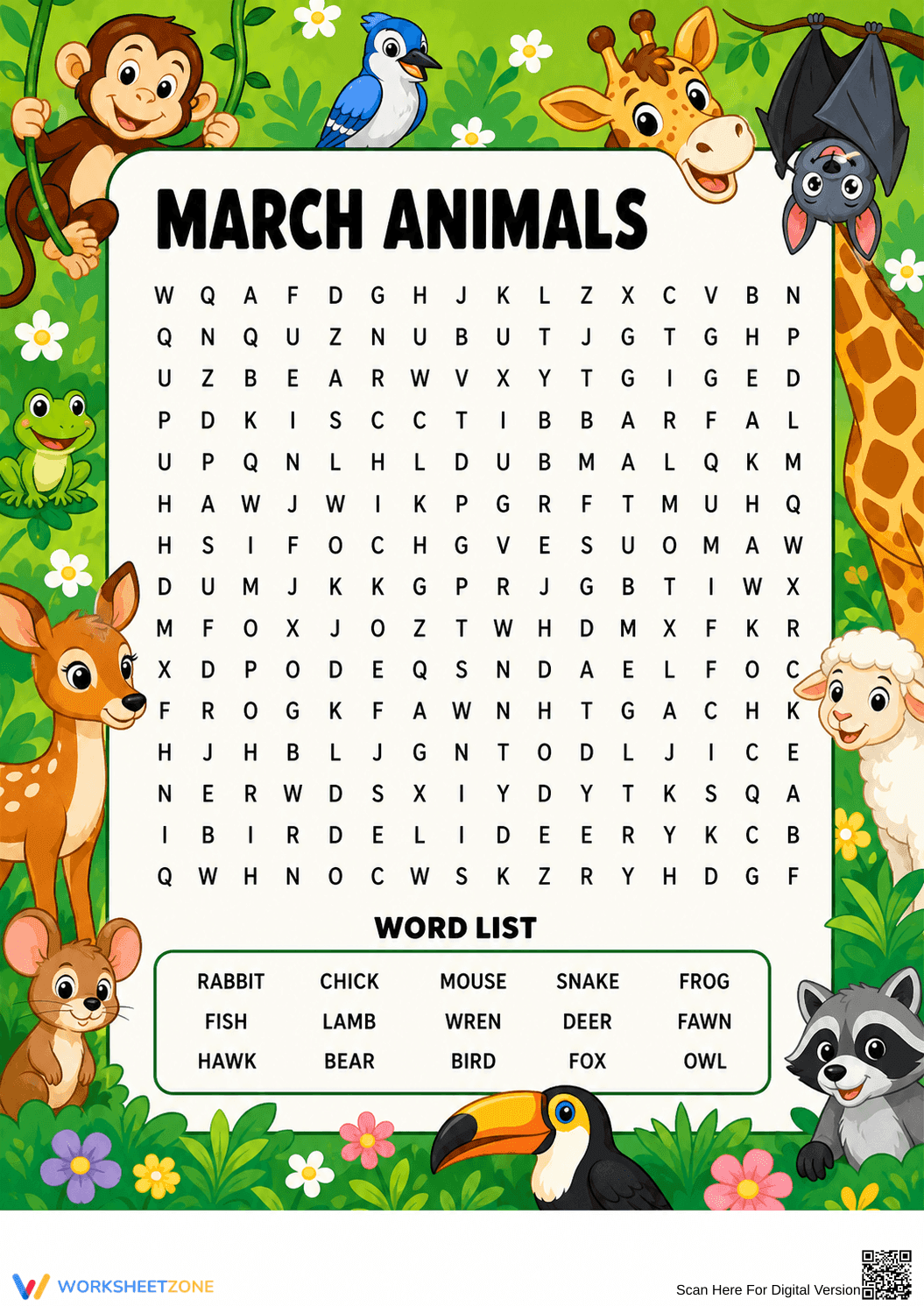

Essential March Animals Word Search | Grade 3-4 ELA

Paste this activity's link or code into your existing LMS (Google Classroom, Canvas, Teams, Schoology, Moodle, etc.).
Students can open and work on the activity right away, with no student login required.
You'll still be able to track student progress and results from your teacher account.
This Grade 3-4 animal vocabulary worksheet uses a word search format to reinforce spelling and recognition of 15 common animals. Students identify and locate terms like fawn, wren, and hawk, strengthening their visual scanning abilities and lexical retention. It provides an engaging way to bridge science and literacy during spring-themed lessons.
At a Glance
- Grade: 3-4 · Subject: ELA & Science
- Standard:
CCSS.ELA-LITERACY.L.3.4— Determine or clarify the meaning of unknown and multiple-meaning words and phrases- Skill Focus: Animal vocabulary and spelling
- Format: 1 page · 15 problems · Answer key included · PDF
- Best For: Morning work or early finisher activity
- Time: 15–20 minutes
The resource consists of a single-page PDF featuring a high-density letter grid and a clear word list at the bottom. The 15 target words include a variety of mammals, birds, and amphibians, providing a broad overview of common wildlife. A full answer key is provided, allowing for quick self-correction or rapid teacher grading.
This worksheet is designed for immediate classroom implementation with a total teacher prep time of under 2 minutes. First, print the single-page PDF for your class (30 seconds). Next, distribute the sheets as students enter or transition between subjects (30 seconds). Finally, use the included answer key for a 1-minute group review or individual check. It is an ideal sub-plan component.
The primary alignment is `CCSS.ELA-LITERACY.L.3.4`, which focuses on vocabulary acquisition and use. By identifying specific animal names in a grid, students reinforce their orthographic mapping of these terms. Both standard codes can be copied directly into lesson plans, IEP goals, or district curriculum mapping tools.
Use this as a formative assessment during a science unit on animal habitats to gauge student familiarity with specific species. Alternatively, assign it as a quiet transition activity after recess to help students refocus on literacy tasks. Completion typically takes 15 to 20 minutes depending on the student's scanning speed.
This is designed for third and fourth-grade students, but it also serves as an excellent resource for English Language Learners (ELL) who need visual reinforcement of animal names. It pairs naturally with an anchor chart depicting the animals listed to provide additional scaffolding for struggling readers.
Word search puzzles serve as more than just entertainment; they are effective tools for developing pattern recognition and orthographic processing. According to Fisher & Frey (2014), purposeful word play and vocabulary puzzles help solidify the word consciousness necessary for reading fluency. This worksheet aligns with CCSS.ELA-LITERACY.L.3.4 by requiring students to recognize and process 15 distinct animal terms within a complex visual field. Research from the RAND AIRS 2024 report suggests that supplemental literacy activities that combine thematic content (like zoology) with word recognition tasks can improve student engagement and retention of academic language. By integrating these 15 tasks into a daily routine, educators provide low-stakes practice that builds the visual scanning skills essential for navigating more complex informational texts. This resource provides a structured, evidence-based approach to vocabulary reinforcement that fits easily into any elementary ELA or science curriculum.


