




























Views
Downloads
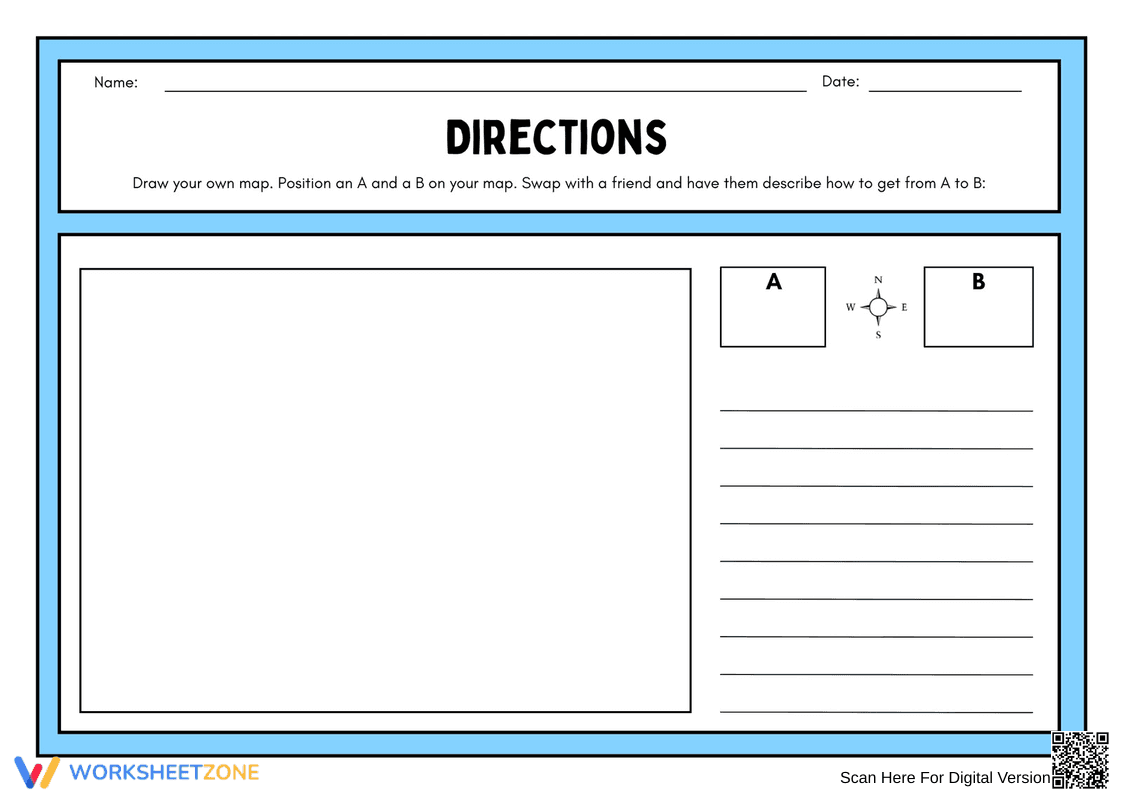

Grade 2 Map Directions — Printable No-Prep Worksheet

Paste this activity's link or code into your existing LMS (Google Classroom, Canvas, Teams, Schoology, Moodle, etc.).
Students can open and work on the activity right away, with no student login required.
You'll still be able to track student progress and results from your teacher account.
This interactive map directions worksheet empowers second-grade students to apply spatial reasoning and explanatory writing skills. By drawing their own map and writing step-by-step cardinal directions from point A to point B, learners actively demonstrate their understanding of geography and clear communication.
At a Glance
- Grade: 2 · Subject: Social Studies
- Standard:
CCSS.ELA-LITERACY.W.2.2— Write informative texts to convey ideas clearly- Skill Focus: Map skills and cardinal directions
- Format: 1 page · 1 interactive task · No answer key · PDF
- Best For: Partner activities and centers
- Time: 15–20 minutes
This single-page resource features a large, open drawing space where students can design a custom map layout. It includes a built-in compass rose to reinforce north, south, east, and west orientations. Two designated boxes for points A and B help anchor the activity, while clearly lined sections provide ample room for students to write out their sequential directions. Because the map creation is entirely student-driven, an answer key is not required, allowing for endless creative variations.
Zero-Prep Workflow
- Print (1 minute): Simply download the PDF and print a class set. No special materials or cutting required.
- Distribute (1 minute): Hand out the worksheets and pair students up for the interactive exchange component.
- Review (3 minutes): Briefly model how to use the compass rose to write a directional sentence before releasing students to work independently.
With under two minutes of total teacher prep time, this activity is an ideal, stress-free addition to your geography unit or an engaging emergency sub plan.
Standards Alignment
This resource aligns with CCSS.ELA-LITERACY.W.2.2, requiring students to write informative or explanatory texts in which they introduce a topic, use facts and definitions to develop points, and provide a concluding statement. By writing clear, sequential directions based on a visual map, students practice conveying spatial information accurately. Both standard codes can be copied directly into lesson plans, IEP goals, or district curriculum mapping tools.
How to Use It
Deploy this worksheet during a social studies center after direct instruction on reading a compass rose. Students can spend the first ten minutes drawing their map and placing points A and B. For the remaining time, they swap papers with a partner and write the directions to navigate the custom terrain. As a formative assessment tip, observe whether students correctly use cardinal direction vocabulary (north, south, east, west) rather than relative terms (up, down, left, right) during the partner exchange. Expected completion time ranges from 15 to 20 minutes.
Who It's For
This activity is primarily designed for second-grade students developing foundational geography and explanatory writing skills. It naturally differentiates itself, as advanced learners can draw highly complex maps with obstacles, while students needing support can create simple, direct paths. Pair this worksheet with a whole-class anchor chart detailing cardinal directions and transitional words to maximize student success.
Mastering spatial reasoning and clear communication is a critical developmental milestone for early elementary learners. This resource targets CCSS.ELA-LITERACY.W.2.2 by having students write informative texts to convey ideas clearly through map directions. According to Fisher & Frey (2014), integrating peer collaboration into structured tasks significantly increases student engagement and content retention. By requiring students to swap maps and write directions for a partner's unique drawing, this worksheet transforms a standard geography lesson into an interactive, high-yield learning experience. The physical act of drawing combined with the cognitive demand of sequential writing ensures that learners are actively processing the material. Educators can rely on this evidence-based approach to build both geographic literacy and essential writing competencies in a single, streamlined activity.


