




























Views
Downloads
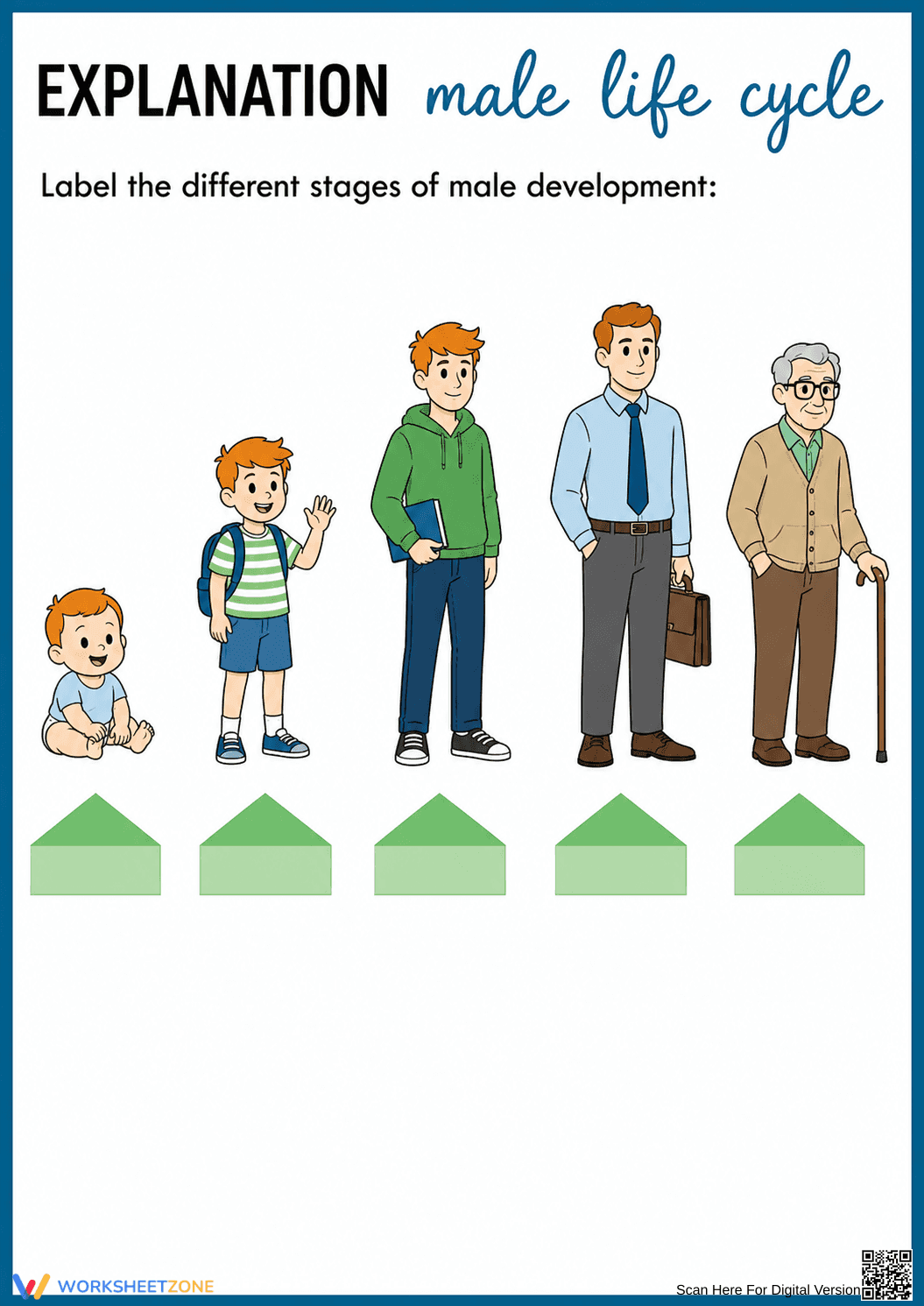

Male Life Cycle Worksheet | Grade 6 Essential Science

Paste this activity's link or code into your existing LMS (Google Classroom, Canvas, Teams, Schoology, Moodle, etc.).
Students can open and work on the activity right away, with no student login required.
You'll still be able to track student progress and results from your teacher account.
This Grade 6 male life cycle worksheet provides a clear visual framework for students to identify and label the primary stages of human development. By connecting biological milestones to specific life phases, learners develop a foundational understanding of how organisms grow and change over time. This activity ensures students can distinguish between developmental periods using observable physical characteristics.
At a Glance
- Grade: 6 · Subject: Science
- Standard:
MS-LS1-4— Use evidence to support how growth and development affect organisms- Skill Focus: Human life cycle stages
- Format: 1 page · 5 problems · Answer key included · PDF
- Best For: Introductory biology and human growth lessons
- Time: 10–15 minutes
The worksheet features a high-quality 1-page layout with five distinct illustrations representing the male life cycle from infancy to late adulthood. Below each illustration is a dedicated labeling area designed for student responses. The clean design ensures that the focus remains on the biological progression, and a comprehensive answer key is provided for quick grading or student self-correction.
This resource is designed for a zero-prep classroom environment. Teachers can print the PDF in less than 30 seconds, distribute it to the class in under a minute, and review the correct labels together in a 5-minute wrap-up session. Total teacher preparation time is approximately 2 minutes, making it an ideal choice for bell-ringers, exit tickets, or emergency sub plans where clarity is paramount.
Aligned to `MS-LS1-4`, this activity supports the study of how organisms grow and develop throughout their lifespan. Students must observe physical changes to categorize stages correctly, such as identifying the transition from childhood to adolescence. This standard focuses on the characteristic growth patterns of organisms. Both standard codes can be copied directly into lesson plans, IEP goals, or district curriculum mapping tools.
Use this worksheet during the "Explain" phase of a 5E lesson cycle to solidify vocabulary after a lecture on human biology. It also serves as an effective formative assessment tool; observe if students can distinguish between the adolescent and adult stages based on visual cues like height and attire. Expected completion time for most middle school students is 10 to 15 minutes.
This resource is tailored for Grade 6 students but is accessible for diverse learners requiring visual supports. It pairs naturally with a human development anchor chart or a short reading passage about biological aging. The clear illustrations provide necessary scaffolding for English Language Learners and students with IEPs who benefit from non-linguistic representations of scientific concepts.
According to research by Fisher & Frey (2014), visual labeling tasks are essential for vocabulary acquisition in the sciences, as they bridge the gap between abstract concepts and concrete representations. This worksheet aligns with the MS-LS1-4 standard, which requires students to understand the growth and development of organisms. By identifying the five stages of the male life cycle, students engage in evidence-based observation, a core competency in middle school science. The structured format of this 1-page PDF ensures that learners can quickly master the terminology associated with human development without cognitive overload. Data from EdReports 2024 suggests that high-quality, focused practice materials like this one significantly improve student retention of biological milestones. This resource provides a reliable, research-backed method for introducing the complexities of the human life cycle within a standard-aligned curriculum framework.


