


























Views
Plays

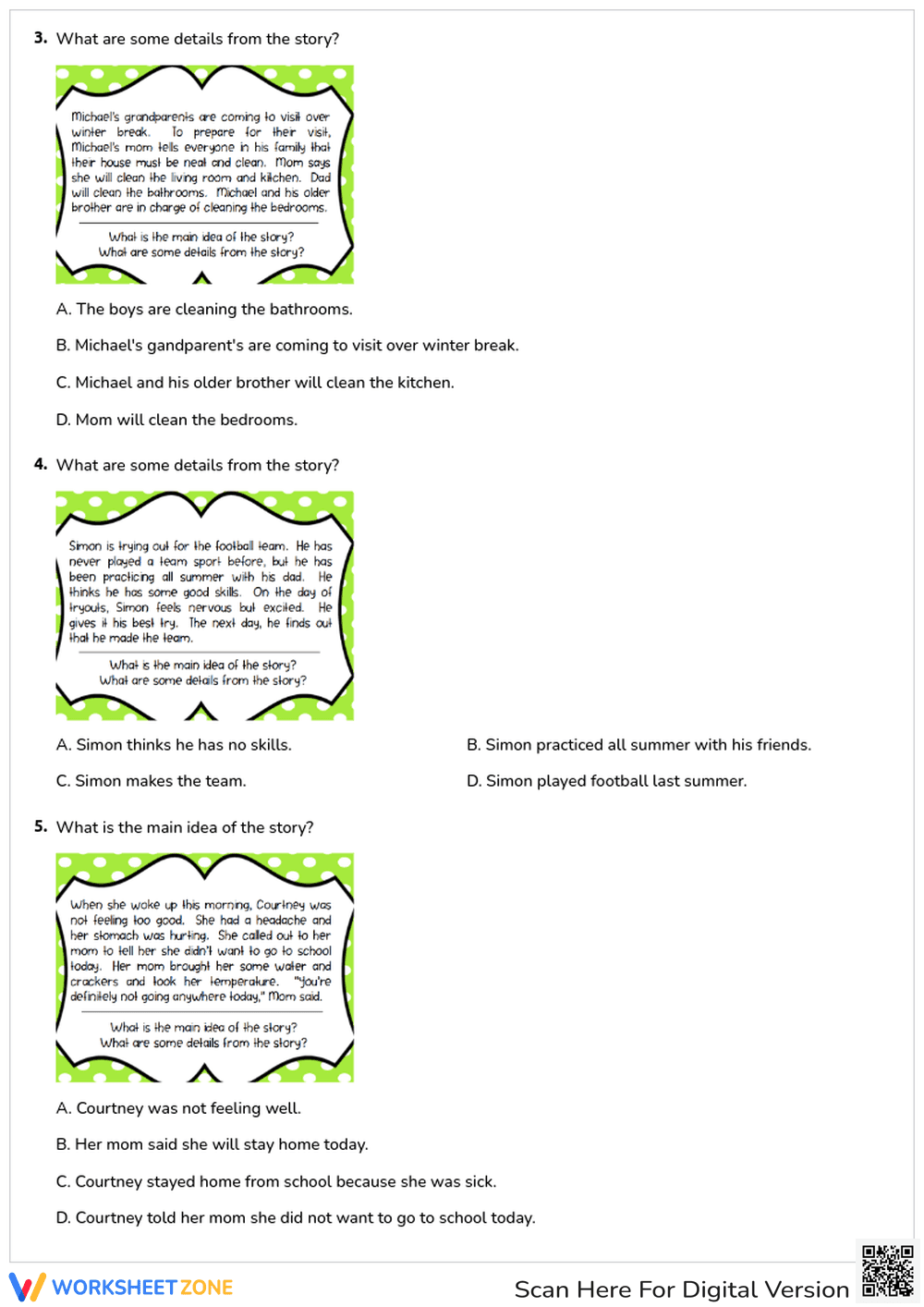



Printable Main Idea & Details Worksheet | Grade 2 ELA
Paste this activity's link or code into your existing LMS (Google Classroom, Canvas, Teams, Schoology, Moodle, etc.).
Students can open and work on the activity right away, with no student login required.
You'll still be able to track student progress and results from your teacher account.
This Grade 2 reading comprehension worksheet helps students master the crucial skill of distinguishing between a story's main idea and its supporting details. By reading short, engaging passages and answering targeted multiple-choice questions, learners will build the analytical skills needed to understand text structure and improve overall reading proficiency.
At a Glance
- Grade: 2 · Subject: ELA
- Standard:
CCSS.ELA-LITERACY.RL.2.2— Determine the central message or main idea of a story.- Skill Focus: Main Idea and Key Details
- Format: 9 pages · 24 problems · Answer key included · PDF
- Best For: Independent practice and assessment
- Time: 25–35 minutes
This comprehensive nine-page resource features 24 multiple-choice problems centered around short, relatable narrative passages. Each text is paired with alternating questions that ask students to either identify the overarching main idea or pinpoint specific supporting details from the story. The clear, uncluttered layout minimizes distractions, while the included answer key ensures quick and accurate grading for educators.
Skill Progression
- Guided practice: Begin by reading the first passage together as a class, modeling how to highlight key details and synthesize them into a main idea.
- Supported practice: Have students complete the next few passages in pairs, discussing their reasoning for selecting either a main idea or a detail option.
- Independent practice: Assign the remaining problems for individual work to assess mastery. This gradual-release approach ensures students confidently transition from "I Do" to "You Do."
Standards Alignment
Aligned to primary standard CCSS.ELA-LITERACY.RL.2.2: Recount stories, including fables and folktales from diverse cultures, and determine their central message, lesson, or moral. It also supports identifying who, what, where, when, why, and how to demonstrate understanding of key details. Both standard codes can be copied directly into lesson plans, IEP goals, or district curriculum mapping tools.
How to Use It
This worksheet is highly versatile and can be used during independent reading centers or as a formal formative assessment after direct instruction on text structure. While students work, observe whether they are confusing specific details with the broader main idea—a common misconception that can be addressed with immediate feedback. Expected completion time is 25 to 35 minutes depending on reading fluency.
Who It's For
Designed primarily for second and third-grade students, this resource is also excellent for older students needing foundational reading intervention. To differentiate, teachers can read the passages aloud for students struggling with decoding, allowing them to focus purely on comprehension. Pair this activity with a visual anchor chart illustrating the "umbrella" concept of main ideas and details.
Integrating targeted practice on the main idea and key details is essential for developing strong reading comprehension. According to Fisher & Frey (2014), explicit instruction in identifying text structure and central themes significantly improves a student's ability to synthesize information and retain content. By aligning with CCSS.ELA-LITERACY.RL.2.2, this resource ensures students can accurately determine the central message or main idea of a story. Regular engagement with short passages and focused questioning builds the cognitive stamina required for more complex literary analysis in later grades.


