




























Views
Downloads
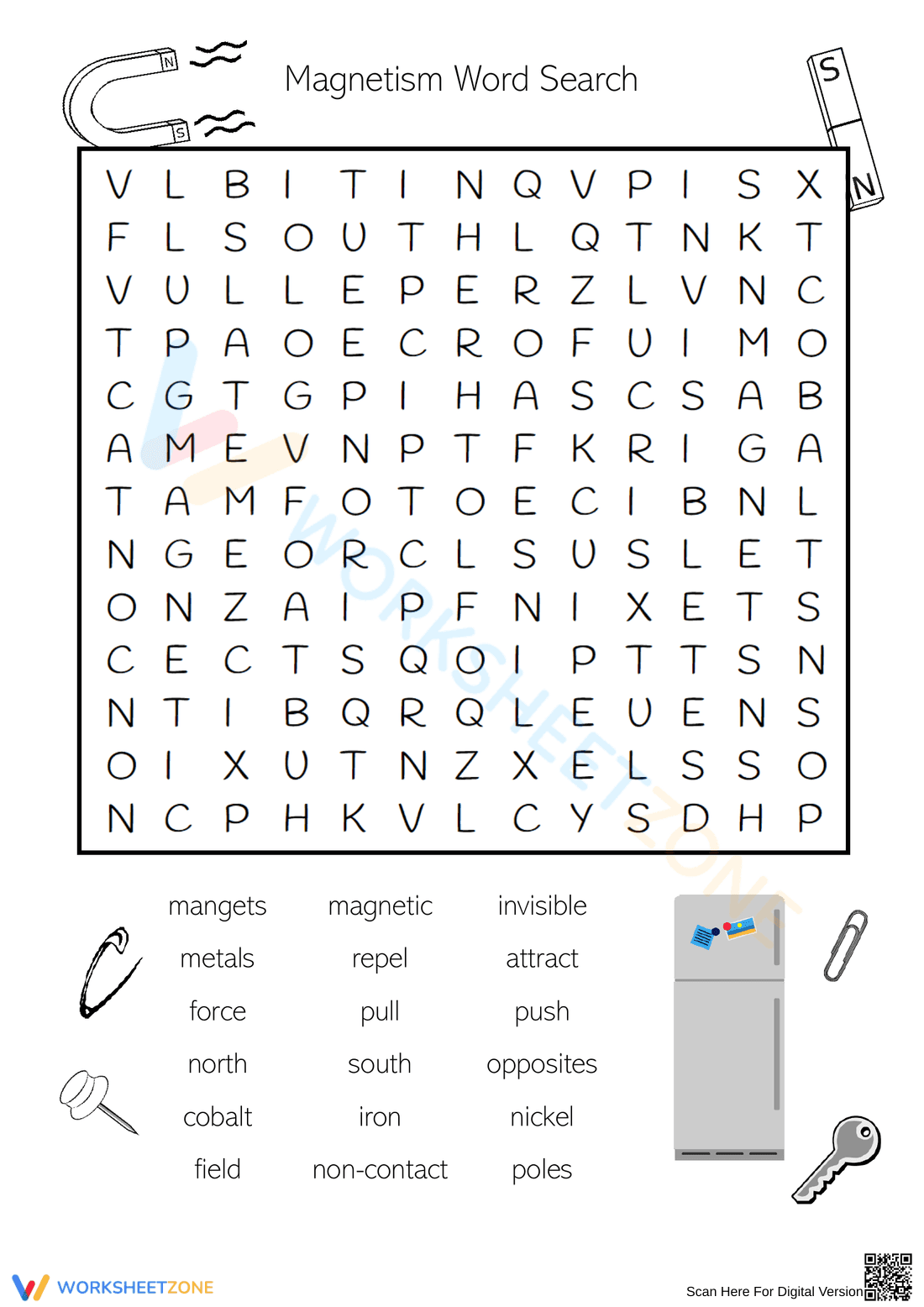

Magnetism Word Search | Printable Grade 3 Science

Paste this activity's link or code into your existing LMS (Google Classroom, Canvas, Teams, Schoology, Moodle, etc.).
Students can open and work on the activity right away, with no student login required.
You'll still be able to track student progress and results from your teacher account.
This magnetism word search introduces essential physics vocabulary to elementary students. By actively seeking out terms like "attract," "repel," and "magnetic field," learners reinforce their spelling and word recognition skills while building a foundational understanding of non-contact forces. It serves as an engaging entry point for physical science units.
At a Glance
- Grade: 3 · Subject: Science
- Standard:
3-PS2-3— Identify magnetic interactions between objects not in contact- Skill Focus: Magnetism vocabulary recognition
- Format: 1 page · 18 problems · Answer key included · PDF
- Best For: Morning work or sub plans
- Time: 10–15 minutes
Inside this resource, educators will find a single-page puzzle featuring a letter grid. Students are tasked with locating 18 magnetism-related terms hidden horizontally, vertically, and diagonally. The worksheet includes a clear word bank with terms ranging from basic concepts like "push" to specific materials such as "cobalt," "iron," and "nickel." A complete answer key is provided for quick grading.
This resource is designed for a highly efficient classroom workflow. Print (1 minute): Simply download the PDF and print a class set; no special cutting or laminating is required. Distribute (1 minute): Hand out the sheets as students enter the room or transition between subjects. Review (2 minutes): Display the answer key on the smartboard for immediate self-correction. With under two minutes of total teacher prep time, this activity is an excellent, reliable option for emergency sub plans or unexpected schedule changes.
This activity aligns with 3-PS2-3: Ask questions to determine cause and effect relationships of electric or magnetic interactions between two objects not in contact with each other. By familiarizing students with the precise terminology of these interactions, it supports broader scientific literacy. Both standard codes can be copied directly into lesson plans, IEP goals, or district curriculum mapping tools.
Deploy this word search before direct instruction to pre-teach vocabulary, giving students exposure to complex words before they encounter them in a textbook. Alternatively, use it during independent work stations while the teacher conducts small group experiments. As a formative assessment observation tip, watch which students struggle to locate longer words; this indicates a need for spelling support. Expected completion time ranges from 10 to 15 minutes.
This worksheet is primarily designed for third-grade science students, though it functions well for fourth and fifth graders reviewing physical science concepts. For differentiation, teachers can highlight the first letter of each word on the grid for students requiring accommodations, or challenge advanced learners to write a sentence using five of the vocabulary words on the back of the page. It pairs perfectly with a hands-on sorting activity where students test classroom objects to see if they are magnetic.
Integrating targeted vocabulary practice into science instruction significantly improves student comprehension of abstract physical concepts. According to a recent EdReports 2024 review of elementary science curricula, explicit vocabulary instruction combined with engaging repetition activities increases long-term retention of domain-specific terms. This resource directly supports 3-PS2-3 by helping students identify magnetic interactions between objects not in contact through foundational terminology. When students confidently recognize words like "repel," "attract," and "poles," they can more accurately describe the phenomena they observe during hands-on experiments. Providing structured, low-stakes practice opportunities like word searches reduces cognitive load during subsequent complex reading tasks. This ensures that learners spend their mental energy understanding the physics principles rather than decoding unfamiliar text, ultimately leading to deeper scientific inquiry and stronger academic outcomes across the physical science curriculum.


