




























Views
Downloads
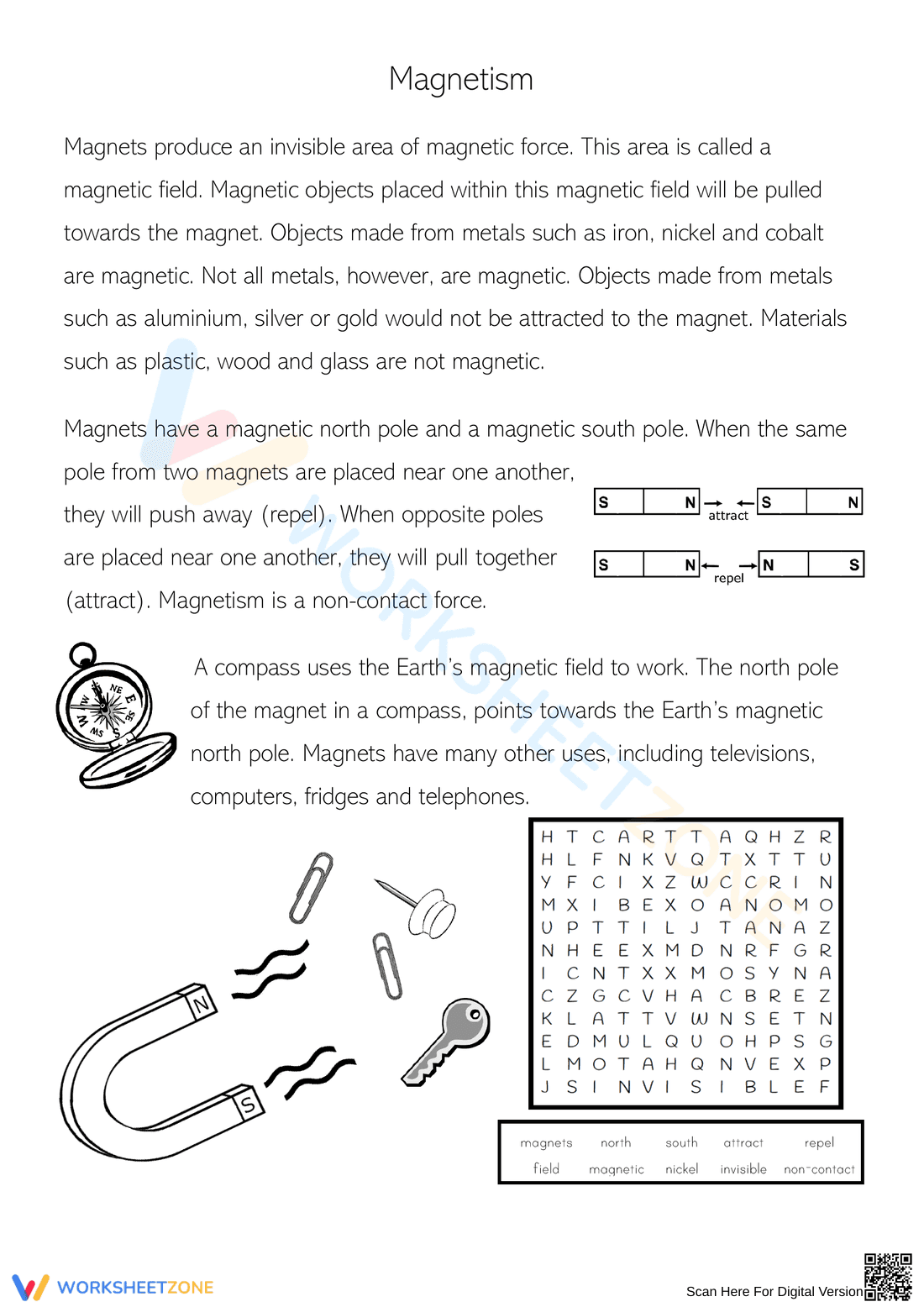

Magnetism Reading Worksheet | Grade 3 Printable

Paste this activity's link or code into your existing LMS (Google Classroom, Canvas, Teams, Schoology, Moodle, etc.).
Students can open and work on the activity right away, with no student login required.
You'll still be able to track student progress and results from your teacher account.
This Grade 3 science worksheet introduces students to the fundamentals of magnetism through an engaging reading passage and vocabulary activity. Students read about magnetic fields, poles, and non-contact forces, then reinforce their learning by locating ten domain-specific terms in a word search puzzle.
At a Glance
- Grade: 3 · Subject: Science
- Standard:
3-PS2-3— Understand magnetic interactions and non-contact forces- Skill Focus: Science vocabulary and reading comprehension
- Format: 1 page · 10 problems · Answer key included · PDF
- Best For: Independent practice or science centers
- Time: 15–20 minutes
This single-page resource features a concise informational text explaining how magnets work, including concepts like attraction, repulsion, and the Earth's magnetic field. Below the reading passage, a ten-word search puzzle challenges students to find key vocabulary terms such as "invisible," "nickel," and "repel." A complete answer key is provided to make grading quick and straightforward for teachers.
Zero-Prep Workflow
This resource is designed for immediate classroom use.
- Print (1 minute): Simply download the PDF and print the required number of copies. The design ensures ink-friendly reproduction.
- Distribute (1 minute): Hand out the worksheet during your science block or place it in a designated center folder.
- Review (3 minutes): Use the included answer key to quickly check student work or project it on the board for self-correction.
Total teacher prep time is under two minutes, making this an excellent option for emergency sub plans or unexpected schedule changes.
Standards Alignment
This worksheet aligns with primary standard 3-PS2-3, which asks students to determine cause and effect relationships of electric or magnetic interactions between two objects not in contact with each other. It also supports cross-curricular literacy goals by helping students determine the meaning of domain-specific science words. Both standard codes can be copied directly into lesson plans, IEP goals, or district curriculum mapping tools.
How to Use It
Introduce this worksheet after a brief direct instruction session on magnets or as a standalone reading activity during science centers. As students read the text, encourage them to highlight the vocabulary words they will later find in the puzzle. For a quick formative assessment, observe whether students can correctly explain the difference between "attract" and "repel" using the diagrams provided on the page. Expect completion within 15 to 20 minutes.
Who It's For
Designed for third-grade students, this resource also serves as an excellent review for fourth and fifth graders. The clear typography and visual diagrams provide built-in differentiation for visual learners and students who benefit from contextual clues. Pair this worksheet with hands-on magnet stations or a whole-class demonstration using bar magnets to solidify the concepts introduced in the text.
Integrating literacy into science instruction builds foundational knowledge. According to EdReports 2024, providing domain-specific reading materials significantly improves students' ability to grasp complex physical science concepts. This worksheet directly supports standard 3-PS2-3 by helping students understand magnetic interactions and non-contact forces through targeted vocabulary practice. When students actively engage with terms like "attract" and "repel" in both a reading passage and a reinforcement puzzle, they develop a stronger conceptual framework for future scientific inquiry. By combining informational text with a low-stakes word search, educators can lower the affective filter and make rigorous science vocabulary accessible. This dual approach ensures that learners not only memorize terms but also comprehend their application within the context of magnetic fields and everyday objects.


