


























Views
Downloads
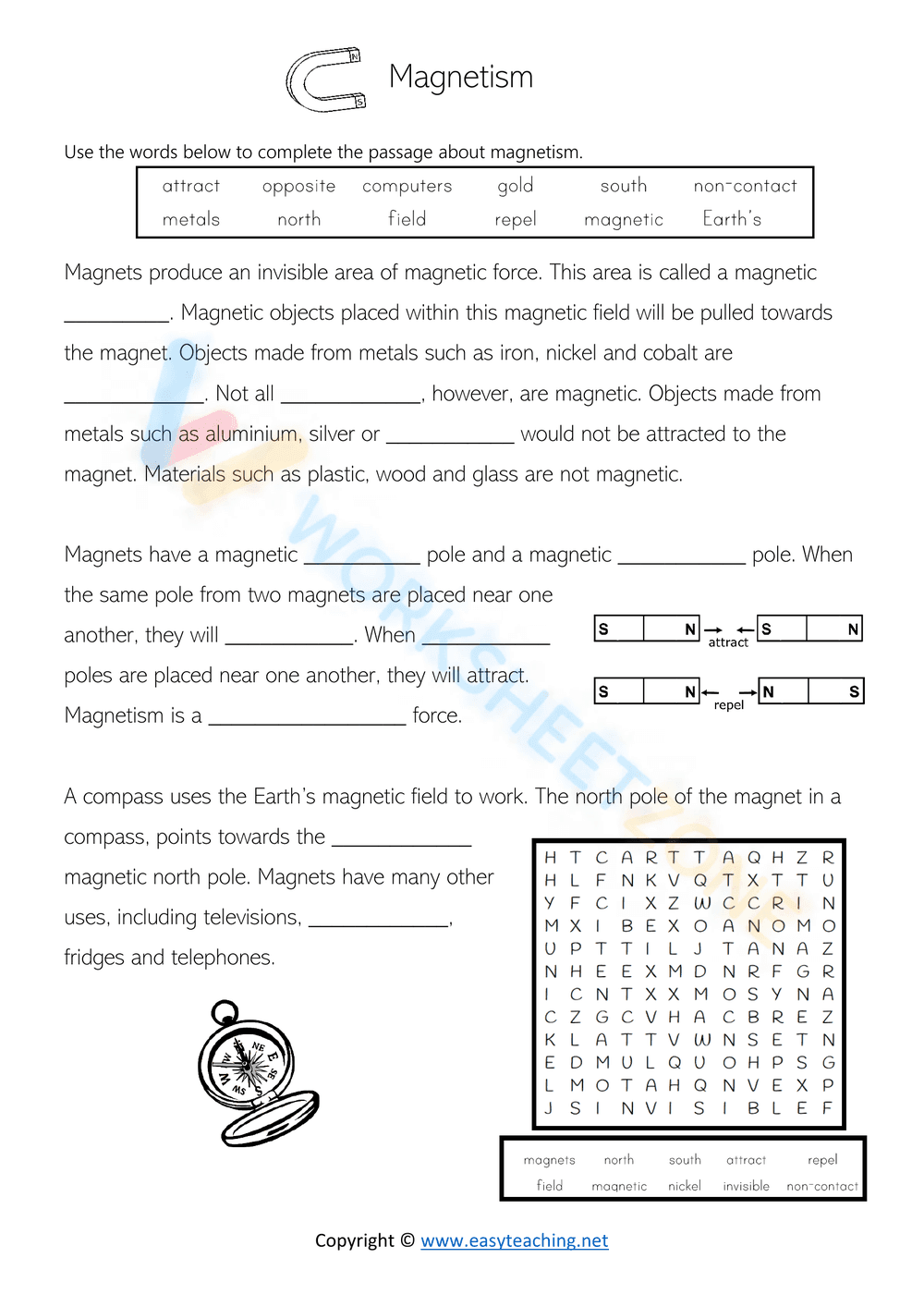


Magnetism Cloze Activity | Grade 3-5 Essential Science
Paste this activity's link or code into your existing LMS (Google Classroom, Canvas, Teams, Schoology, Moodle, etc.).
Students can open and work on the activity right away, with no student login required.
You'll still be able to track student progress and results from your teacher account.
This Grade 3-5 magnetism worksheet provides students with a structured cloze activity and word search to master key physical science vocabulary. Students will identify how magnetic fields, poles, and forces interact in the natural world. It is an ideal resource for reinforcing core concepts after a hands-on lab or introductory lesson.
At a Glance
- Grade: 3-5 · Subject: Science
- Standard:
3-PS2-3— Determine cause and effect relationships of magnetic interactions between two objects- Skill Focus: Magnetism Vocabulary & Properties
- Format: 1 page · 22 tasks · Answer key included · PDF
- Best For: Independent practice or science centers
- Time: 15–20 minutes
The resource features a comprehensive 12-blank cloze passage that covers magnetic fields, poles (north and south), attraction, repulsion, and non-contact forces. A word bank is provided to support student success. Additionally, the page includes a 10-word thematic word search and a clear, color-coded answer key for rapid grading or student self-correction.
This worksheet is designed for immediate classroom implementation with a total teacher prep time of under 2 minutes. Simply print the single-page PDF and distribute it to students. Because the instructions are self-explanatory and a word bank is included, it functions perfectly as a high-quality sub plan or a quiet-time activity during science rotations.
The primary focus is `3-PS2-3`: "Ask questions to determine cause and effect relationships of electric or magnetic interactions between two objects not in contact with each other." It also supports vocabulary development for 4-PS3-2 regarding energy transfer. Both standard codes can be copied directly into lesson plans, IEP goals, or district curriculum mapping tools.
Use this activity as a formative assessment after a direct instruction lesson on magnetic poles. It allows teachers to observe if students can distinguish between materials that are attracted to magnets (iron, nickel) versus those that are not (gold, aluminum). Expect students to complete the full page in approximately 15 to 20 minutes.
This worksheet is tailored for upper elementary students in Grades 3 through 5. It provides excellent scaffolding for English Language Learners (ELLs) through the use of the word bank and visual diagrams of magnets. It pairs naturally with a hands-on exploration of bar magnets or a compass-building activity.
According to the RAND AIRS 2024 report, structured vocabulary reinforcement in science significantly improves long-term retention of abstract physical concepts. This worksheet aligns with NGSS 3-PS2-3 by requiring students to identify the "invisible area of magnetic force" and the specific behaviors of poles. By integrating a cloze passage with a word search, the resource addresses multiple cognitive pathways for learning technical terminology. Research from Fisher & Frey (2014) suggests that such scaffolded literacy tasks in content areas help bridge the gap between hands-on experimentation and formal scientific explanation. This 22-task activity ensures that Grade 3-5 students can accurately describe non-contact forces and the properties of magnetic materials. The inclusion of a full answer key supports immediate feedback, a critical component for mastery in elementary science education.


