


























Views
Downloads
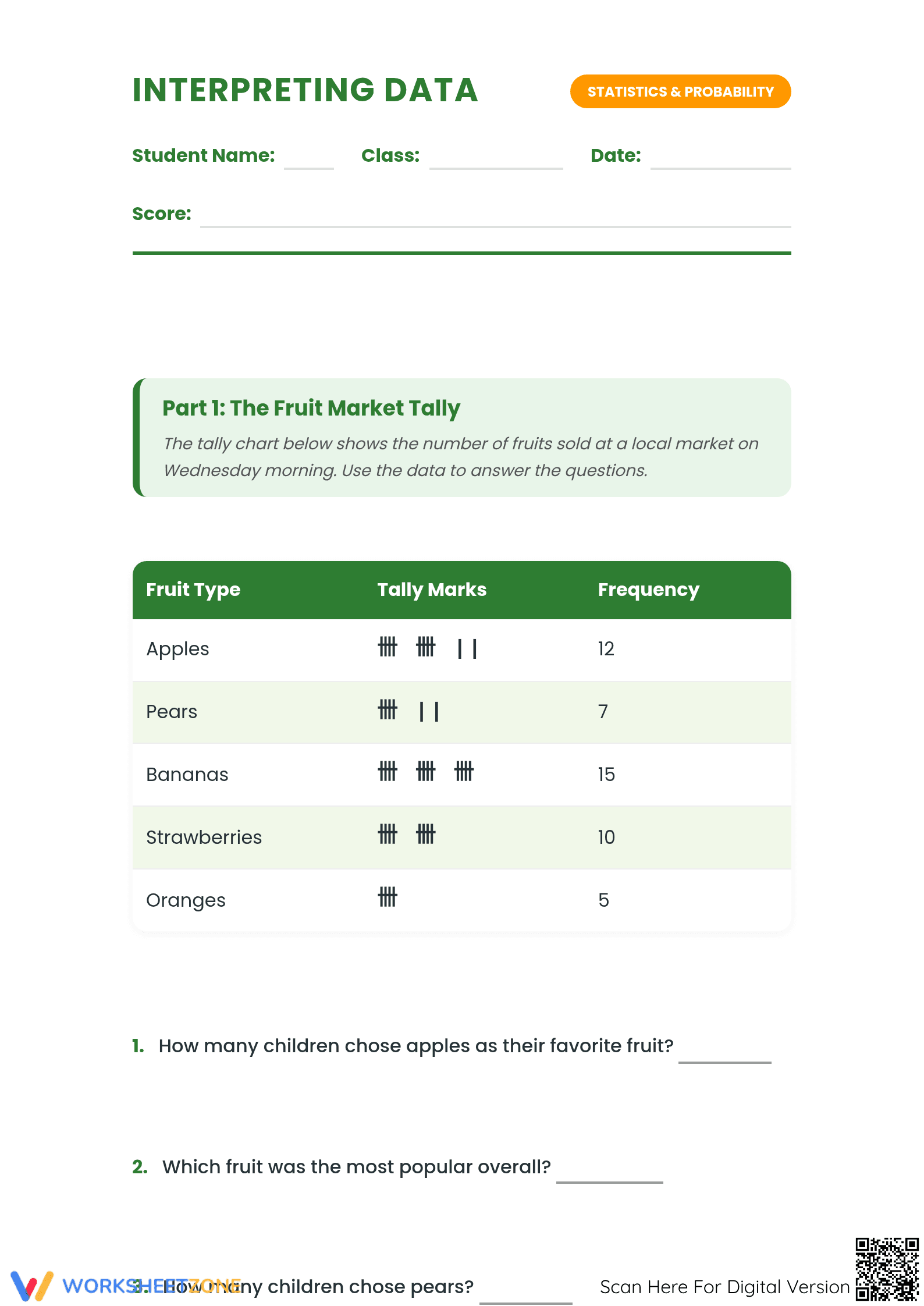



Essential Tally Chart Data Analysis Worksheet | Grade 4-8
Paste this activity's link or code into your existing LMS (Google Classroom, Canvas, Teams, Schoology, Moodle, etc.).
Students can open and work on the activity right away, with no student login required.
You'll still be able to track student progress and results from your teacher account.
This comprehensive Interpreting Data worksheet empowers students to master reading, creating, and analyzing tally charts. By working through realistic scenarios like market sales and school surveys, learners develop a robust understanding of how raw information translates into statistical insights. Students practice frequency counting and data scaling across four structured parts.
At a Glance
- Grade: 4–8 · Subject: Math · Graphing
- Standard:
CCSS.MATH.CONTENT.6.SP.B.5— Summarize numerical data sets in relation to their context through various visual representations- Skill Focus: Tally chart interpretation, frequency analysis, and data scaling
- Format: 5 pages · 19 problems · Answer key included · PDF
- Best For: Independent practice or formative assessment
- Time: 30–45 minutes
Inside this 5-page resource, teachers find four parts that scaffold learning from basic recognition to complex application. The worksheet includes two pre-filled frequency tables, one raw data set for student-led construction, and a final "Data Challenge" section. A full answer key is provided to facilitate rapid grading and immediate feedback cycles.
The curriculum follows a logical gradual-release model.
- Guided practice: Students begin with direct frequency table reads to identify categories.
- Supported practice: The second stage requires completing missing frequencies and calculating totals.
- Independent practice: Final tasks involve creating charts from scratch and solving scaling problems.
Aligned to CCSS.MATH.CONTENT.6.SP.B.5, this resource focuses on summarizing numerical data sets. It also supports CCSS.MATH.CONTENT.4.MD.B.4 by requiring students to solve problems involving information in charts. Both standard codes can be copied directly into lesson plans, IEP goals, or district curriculum mapping tools.
Use this worksheet as a mid-unit assessment to gauge comfort with data visualization. It works well during the independent practice phase or as a sub-plan. A formative tip: check if students correctly group tally marks by fives, as this visual organization prevents errors in larger data sets.
Designed for Grade 4 through 8, this resource refines statistical literacy. It is effective for learners who benefit from concrete, real-world examples. Pair this worksheet with a class-wide survey to bridge the gap between static practice and dynamic data collection.
Statistical literacy is a foundational pillar of modern mathematical education, as identified by Fisher & Frey (2014) in their research on the gradual release of responsibility. This worksheet directly addresses the cognitive demand of CCSS.MATH.CONTENT.6.SP.B.5 by requiring students to not only extract values but to interpret the implications of data distribution and frequency scaling. By engaging with 19 structured tasks that range from simple identification to complex percentage approximation, students build the scaffolding necessary for advanced data modeling. The transition from tally marks to frequency counts reinforces the connection between iconic and symbolic representation, a key stage in numerical development. Utilizing this resource ensures that learners are prepared for the rigor of middle school statistics, providing teachers with clear evidence of mastery through the included answer key and multi-part problem structure.


