


























Views
Downloads
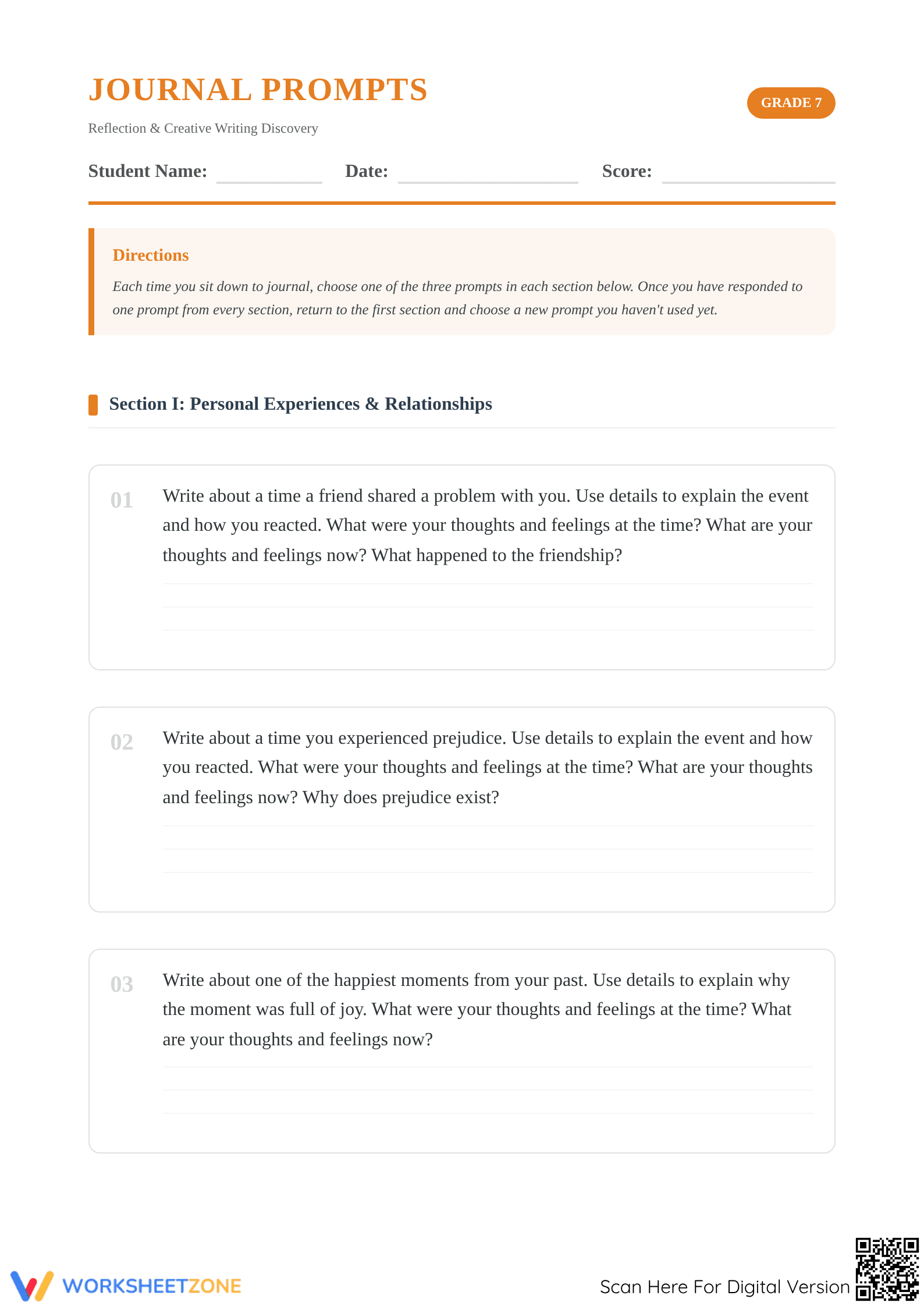


Grade 7 Journal Prompts — Printable No-Prep Worksheet
Paste this activity's link or code into your existing LMS (Google Classroom, Canvas, Teams, Schoology, Moodle, etc.).
Students can open and work on the activity right away, with no student login required.
You'll still be able to track student progress and results from your teacher account.
This Grade 7 narrative journaling worksheet provides students with 18 structured prompts to develop reflective writing skills and personal voice. By engaging with diverse themes like personal growth and courage, learners practice organizing event sequences and using descriptive details. This resource ensures students meet writing standards while building emotional intelligence through consistent creative expression.
At a Glance
- Grade: 7 · Subject: ELA
- Standard:
CCSS.ELA-W.7.3— Write narratives to develop real or imagined experiences using effective technique and descriptive details- Skill Focus: Narrative Reflection
- Format: 5 pages · 18 problems · PDF
- Best For: Daily warm-ups and sub plans
- Time: 15–20 minutes
This comprehensive 5-page PDF contains 18 unique writing prompts organized into six thematic sections: Personal Experiences, Imagination, Pride, Courage, Life Lessons, and Character Reflection. Each section offers three distinct choices, allowing for student agency. The layout includes dedicated writing lines for each prompt, ensuring a clean and organized workspace for middle school writers.
The zero-prep workflow for this resource is designed for maximum efficiency. First, print the desired pages (30 seconds). Second, distribute the prompts to students as a bell-ringer or independent task (1 minute). Third, review student entries for completion or use them as a springboard for peer sharing. Total teacher preparation time is under 2 minutes, making it an ideal solution for busy mornings.
The primary standard for this resource is `CCSS.ELA-LITERACY.W.7.3`, which requires students to write narratives to develop real or imagined experiences or events using effective technique, relevant descriptive details, and well-structured event sequences. It also supports language standards by encouraging the use of correct grammar and sentence structure in authentic writing contexts. Both standard codes can be copied directly into lesson plans, IEP goals, or district curriculum mapping tools.
Use this worksheet as a daily bell-ringer to settle the class during the first 15 minutes of the period. It serves as an excellent formative assessment tool; teachers can observe student stamina and their ability to transition from personal thought to structured prose. Alternatively, assign specific sections during a narrative writing unit to help students brainstorm topics for longer essays or personal memoirs.
This resource is ideal for general education Grade 7 ELA classrooms, but it is also highly effective for English Language Learners (ELL) who need structured prompts to practice vocabulary. It pairs naturally with a narrative writing anchor chart or a mentor text. The prompts are designed to be accessible yet challenging enough to spark deep reflection in twelve and thirteen-year-old students.
Narrative journaling in middle school is a critical component of literacy development, as it bridges the gap between personal thought and formal academic writing. According to Fisher & Frey (2014), consistent low-stakes writing opportunities like these 18 prompts allow students to build the cognitive endurance necessary for complex ELA tasks. By aligning with `CCSS.ELA-W.7.3`, this worksheet ensures that students are not just writing, but are actively practicing the organization of event sequences and the application of descriptive details. Research from the NAEP indicates that students who engage in regular reflective writing show higher proficiency in overall writing clarity and voice. This resource provides the necessary structure to facilitate that growth without adding to teacher workload. It is a reliable tool for any Grade 7 curriculum focused on narrative mastery and student self-reflection.


