


























Views
Downloads
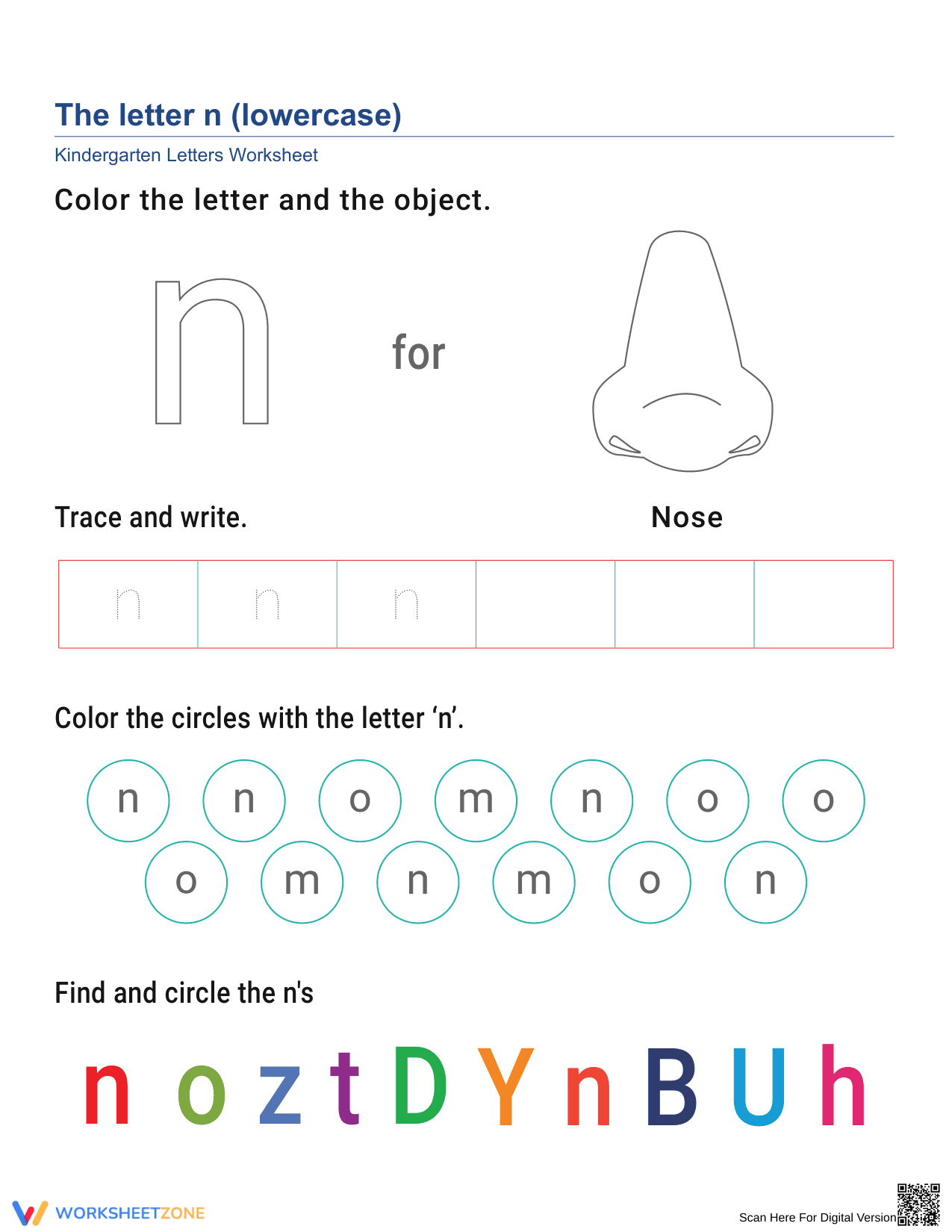

Lowercase Letter n Worksheet — Printable Grade K
Paste this activity's link or code into your existing LMS (Google Classroom, Canvas, Teams, Schoology, Moodle, etc.).
Students can open and work on the activity right away, with no student login required.
You'll still be able to track student progress and results from your teacher account.
This foundational Kindergarten ELA worksheet helps early readers master the lowercase letter n through targeted visual discrimination and handwriting practice. By isolating this specific character in multiple contexts, students build the essential alphabet recognition skills required for fluent reading and writing development.
At a Glance
- Grade: Kindergarten · Subject: ELA
- Standard:
CCSS.ELA-LITERACY.RF.K.1.D— Recognize and name all lowercase letters- Skill Focus: Lowercase letter recognition and formation
- Format: 1 page · 4 tasks · No answer key needed · PDF
- Best For: Independent practice or morning work
- Time: 10–15 minutes
This single-page resource features four distinct task types designed to reinforce letter familiarity. Students begin by coloring the letter and an associated picture (a nose) to build phonetic connections. Next, they practice fine motor skills with a trace-and-write section containing three guided tracing letters and two independent writing boxes. The bottom half challenges students with two visual discrimination activities: coloring circles containing the target letter among similar shapes, and finding the specific character within a mixed-case, multi-colored letter sequence.
Zero-Prep Workflow
- Print (1 minute): Simply download the PDF and print the exact number of copies needed. The black-and-white design is printer-friendly and requires no special materials.
- Distribute (1 minute): Hand out the pages along with crayons and pencils. The instructions are highly visual, allowing students to begin immediately.
- Review (1 minute): A quick visual scan of the completed page is all it takes to assess understanding. Total teacher prep time is under two minutes, making this an ideal, stress-free addition to any emergency sub plan.
This resource is directly aligned to CCSS.ELA-LITERACY.RF.K.1.D, requiring students to recognize and name all upper- and lowercase letters of the alphabet. It also supports early handwriting standards by encouraging proper letter formation. Both standard codes can be copied directly into lesson plans, IEP goals, or district curriculum mapping tools.
Deploy this worksheet during morning work routines to provide a quiet, focused start to the day while reinforcing recent alphabet instruction. Alternatively, use it as an independent literacy center activity after direct instruction on the letter 'n'. As a formative assessment tip, observe students during the visual discrimination tasks; if a child consistently confuses 'n' with 'm' or 'u', they may require additional tactile letter-sorting interventions. Expected completion time ranges from 10 to 15 minutes.
This printable is designed primarily for Kindergarten students, though it serves as excellent remedial practice for first graders or an advanced challenge for preschool learners. The clear, uncluttered layout provides built-in differentiation for students who become easily overwhelmed by busy pages. Pair this activity with a tactile sand-tray tracing lesson or an alphabet anchor chart to solidify the phonetic connection.
Mastering alphabet knowledge, specifically the ability to recognize and name all lowercase letters as outlined in CCSS.ELA-LITERACY.RF.K.1.D, is a critical predictor of future reading success. According to a comprehensive EdReports 2024 analysis of foundational literacy programs, explicit and isolated practice with individual letters significantly reduces letter-reversal errors and accelerates decoding automaticity. When young learners engage in multi-modal tasks—such as tracing, coloring, and visual scanning—they build stronger neural pathways associated with orthographic mapping. This targeted practice ensures that students do not merely memorize shapes, but actively distinguish the target character from visually similar distractors like 'm' or 'u'. By integrating these focused discrimination exercises into daily routines, educators provide the rigorous, evidence-based repetition necessary to transition students from effortful letter identification to fluent, automatic recognition, laying the groundwork for proficient reading comprehension.


