


























Views
Downloads

Louis Pasteur Reading & Experiment | Grade 5 Printable
Paste this activity's link or code into your existing LMS (Google Classroom, Canvas, Teams, Schoology, Moodle, etc.).
Students can open and work on the activity right away, with no student login required.
You'll still be able to track student progress and results from your teacher account.
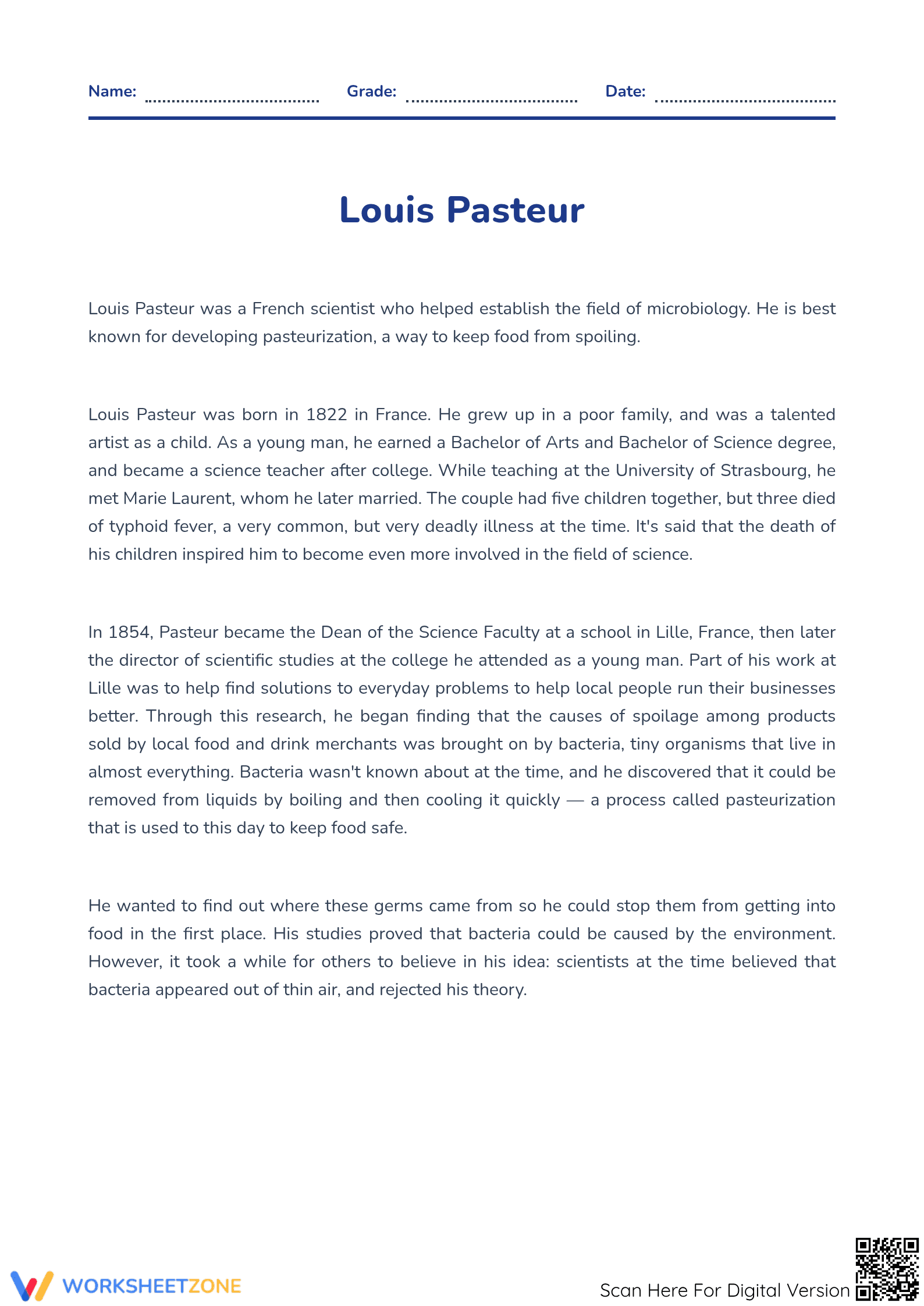
This Grade 5 cross-curricular worksheet combines reading comprehension with hands-on scientific inquiry. Students read an informational passage about microbiology pioneer Louis Pasteur, then apply their learning by conducting a four-day food spoilage experiment. This resource bridges literacy and science, helping students understand real-world applications of historical scientific discoveries.
At a Glance
- Grade: 5 · Subject: English / Science
- Standard:
CCSS.ELA-LITERACY.RI.5.10— Read and comprehend informational texts independently- Skill Focus: Reading Comprehension & Scientific Observation
- Format: 3 pages · 3 tasks · No answer key · PDF
- Best For: Cross-curricular science and reading blocks
- Time: 30–45 minutes (plus daily observation)
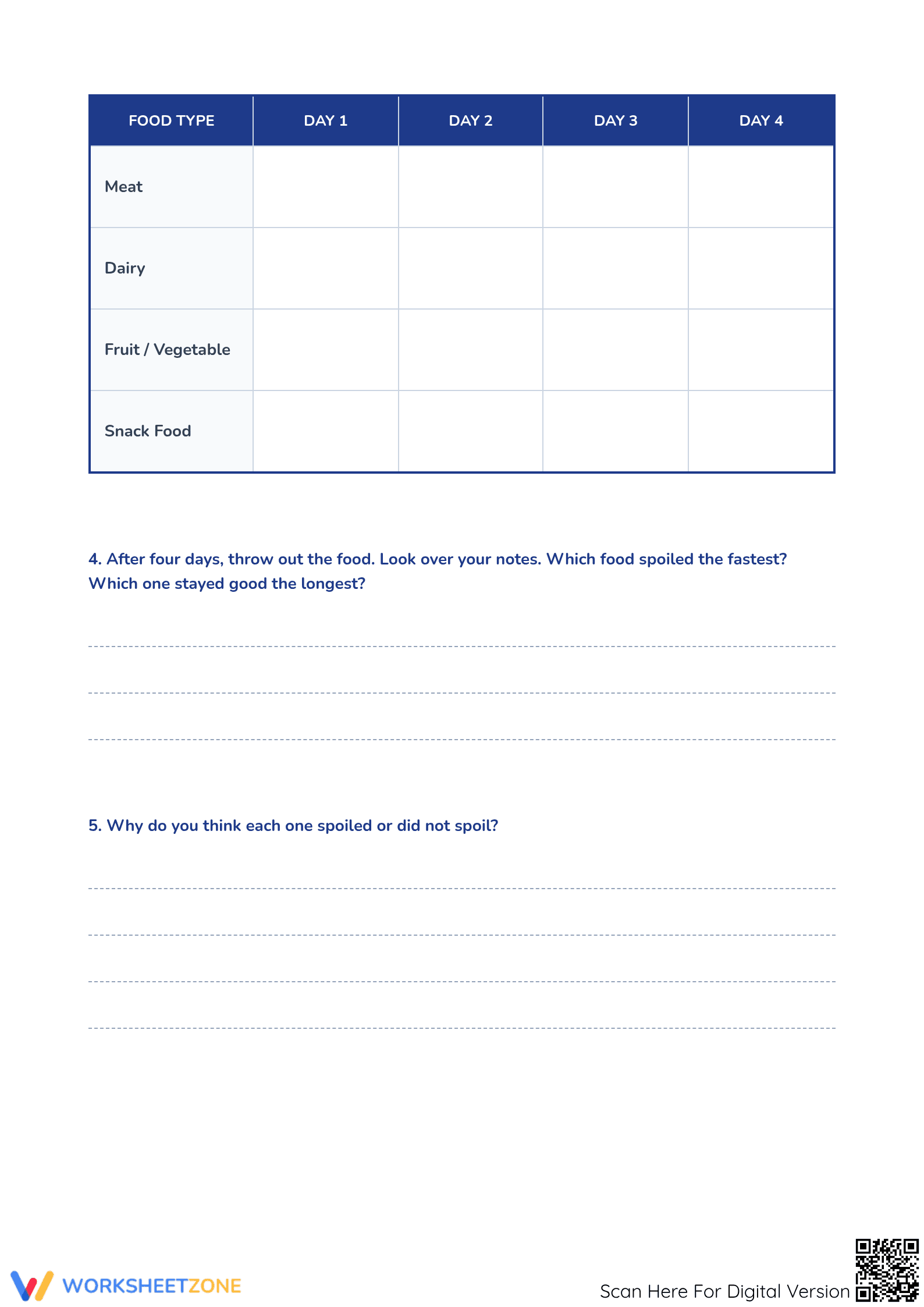
This three-page printable includes a detailed biographical text about Louis Pasteur, detailing his early life, his discovery of pasteurization, and his work with vaccines. Following the text, students will find a structured "Food Spoilage Experiment" guide. This section features step-by-step setup instructions, a four-day observation chart to track meat, dairy, produce, and starches, and two open-ended reflection questions to analyze the results.
This resource follows a clear progression from knowledge acquisition to active application:
- Guided Reading: Students read the text to build background knowledge on bacteria.
- Supported Setup: Instructions provide clear scaffolding to gather materials and establish the observation station.
- Independent Practice: Students independently record data and synthesize findings through critical thinking questions.
This gradual-release approach ensures students have context before engaging in independent inquiry.
This worksheet is aligned to primary standard CCSS.ELA-LITERACY.RI.5.10: "By the end of the year, read and comprehend informational texts, including history/social studies, science, and technical texts, at the high end of the grades 4-5 text complexity band independently and proficiently." It also supports basic scientific method practices by requiring students to observe and record data over time. Both standard codes can be copied directly into lesson plans, IEP goals, or district curriculum mapping tools.
Use this resource to anchor a science unit on microorganisms or a reading unit on historical biographies. Introduce the passage during whole-group instruction, then transition to small groups to set up the experiment. As a formative assessment, review students' daily observation logs to ensure they record descriptive data. The initial reading and setup take 30 to 45 minutes, with 5 minutes of daily observation required for four days.
This activity is designed for fifth-grade students in general education classrooms, science labs, or homeschool environments. To support diverse learners, teachers can pre-teach vocabulary words like "pasteurization" and "immunology" before reading. For an engaging lesson pairing, use this worksheet alongside a visual demonstration of yeast activating, helping students visualize how invisible microorganisms interact with their environment.
Integrating hands-on experiments with informational texts significantly enhances student retention and comprehension. When students read about a concept and immediately apply it through structured observation, they develop stronger critical thinking skills. This worksheet aligns with CCSS.ELA-LITERACY.RI.5.10, requiring students to read and comprehend informational texts independently. According to a recent ScienceDirect TpT Analysis, cross-curricular resources that blend literacy with active scientific inquiry increase student engagement by providing concrete context for abstract concepts. By reading about Louis Pasteur's historical discoveries and then conducting a parallel food spoilage experiment, students bridge the gap between theoretical knowledge and practical application. This dual approach not only reinforces reading comprehension strategies but also builds foundational skills in data collection and scientific reasoning, preparing fifth graders for more advanced academic demands.


