


























Views
Downloads


Loud or Soft Sounds Worksheet | Grade 2-3 Essential
Paste this activity's link or code into your existing LMS (Google Classroom, Canvas, Teams, Schoology, Moodle, etc.).
Students can open and work on the activity right away, with no student login required.
You'll still be able to track student progress and results from your teacher account.
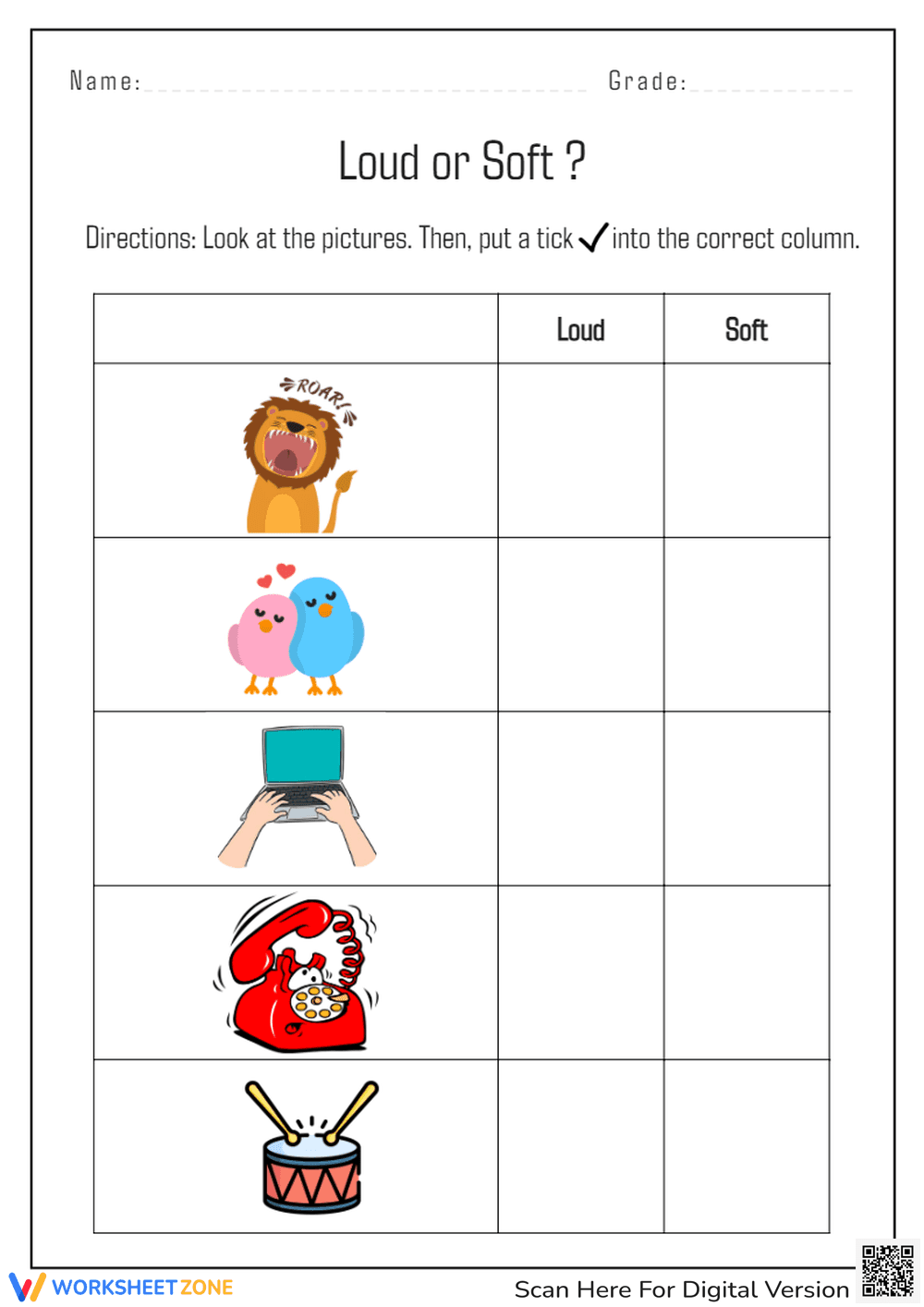
This Grade 2 and 3 science worksheet helps students distinguish between different volumes by categorizing common environmental noises. By evaluating visual representations of sound sources, learners develop a foundational understanding of acoustic properties and amplitude. This activity ensures students can accurately identify and label sounds as either loud or soft based on real-world context and prior knowledge.
At a Glance
- Grade: 2–3 · Subject: Science
- Standard:
1-PS4-1— Identify properties of sound and how they are perceived by the ear- Skill Focus: Volume Discrimination (Loud vs. Soft)
- Format: 1 page · 5 problems · Answer key included · PDF
- Best For: Quick formative assessment, science centers, or homework
- Time: 5–10 minutes
What's Inside
The worksheet features a clean, single-page layout containing five distinct illustrations: a roaring lion, chirping birds, a person typing on a laptop, a ringing telephone, and a beating drum. Each row provides a clear checkbox system for students to tick the appropriate column. The inclusion of a visual answer key allows for immediate feedback or self-grading, making it a versatile tool for various classroom settings.
Zero-Prep Workflow
This resource is designed for a zero-prep workflow. First, print the PDF in under 30 seconds. Second, distribute the sheets; the intuitive design requires minimal explanation. Finally, review answers as a group. Total prep time is under 2 minutes, making it ideal for substitute plans.
Standards Alignment
This activity aligns with `1-PS4-1`, which focuses on the properties of sound. While the standard emphasizes vibration, understanding volume is a prerequisite skill for describing how sounds differ. Students must analyze the intensity of the sound source to make their selection. This standard code can be copied directly into lesson plans, IEP goals, or district curriculum mapping tools.
How to Use It
Use this worksheet as a ticket out the door after a lesson on the five senses or sound energy. Teachers can observe students as they work to identify those who struggle with the concept of relative volume. It also functions well as a quiet independent activity during science rotations. Expect most students to complete the sorting task within 5 to 7 minutes.
Who It's For
This resource is tailored for Grade 2 and Grade 3 students, including English Language Learners (ELLs) who benefit from the high-quality visual prompts. It pairs naturally with a classroom Sound Walk where students listen for real-world examples of the items pictured. It is also an excellent supplemental resource for students requiring simplified tasks to meet IEP goals related to basic science concepts.
Research by Fisher & Frey (2014) emphasizes visual scaffolds in early science to bridge abstract concepts and concrete understanding. This worksheet utilizes that principle by providing illustrations representing acoustic intensities, allowing students to practice volume discrimination. According to the NAEP science framework, early mastery of physical properties, such as sound amplitude, is a critical building block for later physics. By engaging with these 5 tasks, students demonstrate their ability to categorize data based on observable evidence. The inclusion of an answer key supports the gradual release of responsibility model, ensuring learners receive feedback necessary to solidify their understanding of `1-PS4-1`. This resource provides a structured approach to teaching the fundamental differences between loud and soft sounds in a primary classroom.


