


























Views
Downloads

Loud and Soft Sounds Worksheet | Grade 1 Essential
Paste this activity's link or code into your existing LMS (Google Classroom, Canvas, Teams, Schoology, Moodle, etc.).
Students can open and work on the activity right away, with no student login required.
You'll still be able to track student progress and results from your teacher account.
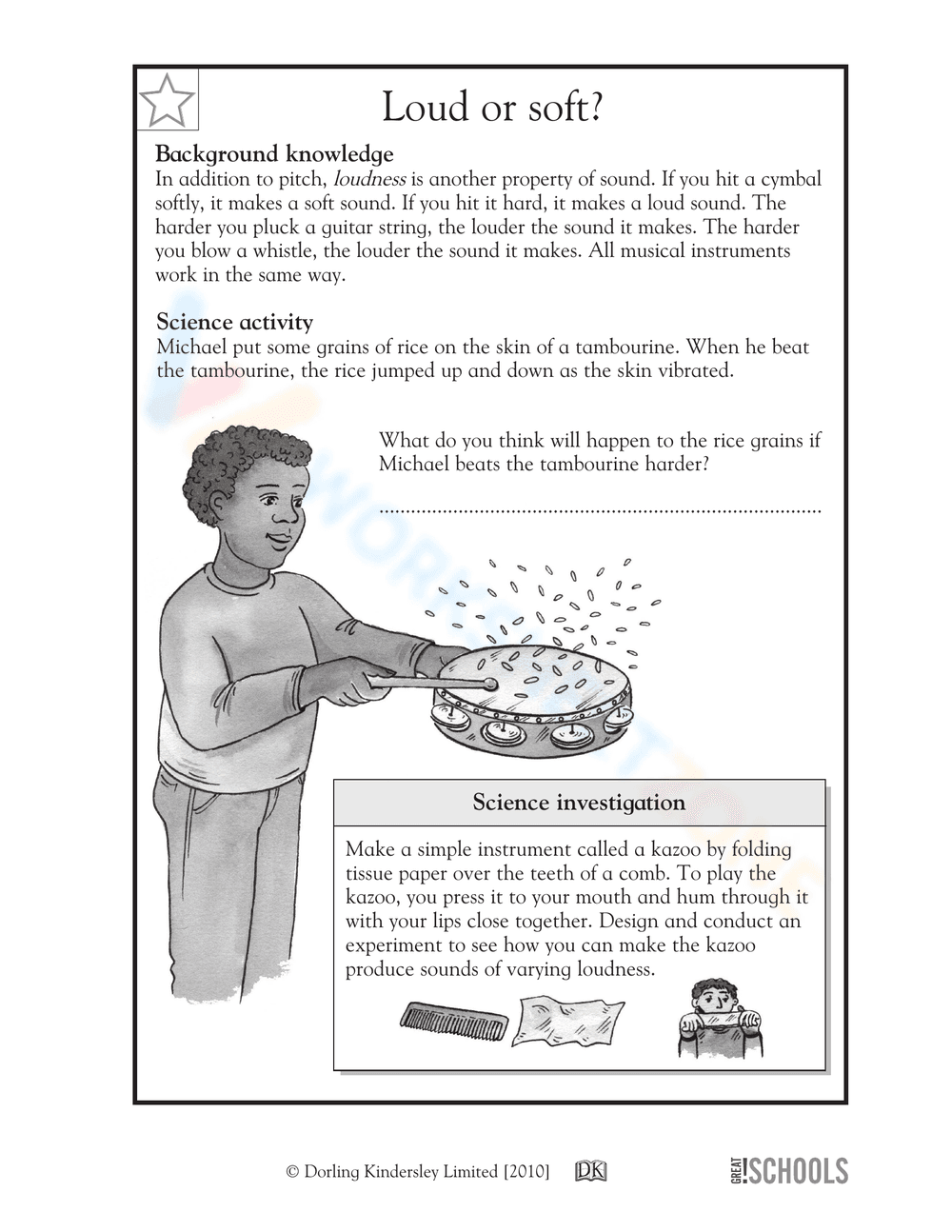
This Grade 1 science worksheet introduces students to the fundamental properties of sound, specifically focusing on the relationship between force and loudness. By engaging with background text and a practical investigation, learners discover how vibrations change when sounds get louder. It provides a clear path for young scientists to observe physical phenomena.
At a Glance
- Grade: 1 · Subject: Science
- Standard:
1-PS4-1— Plan and conduct investigations to show vibrating materials make sound- Skill Focus: Loudness and vibrations
- Format: 2 pages · 2 tasks · Answer key included · PDF
- Best For: Introductory physical science lessons
- Time: 20–30 minutes
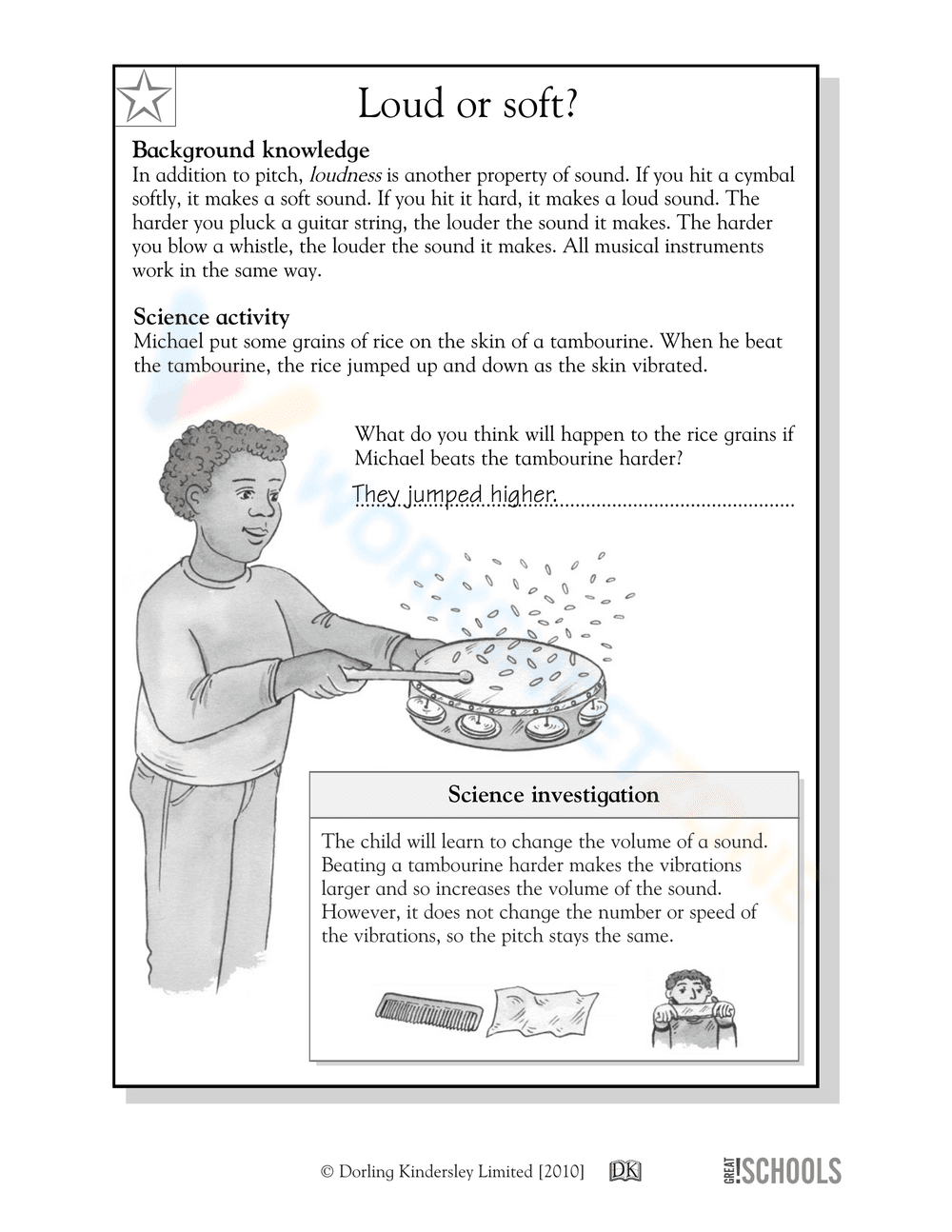
The resource features a structured layout including a "Background Knowledge" section that defines loudness and force. It contains one predictive science activity involving a tambourine and rice grains, followed by a "Science Investigation" prompt for building a DIY kazoo. The second page serves as a teacher guide with expected outcomes and scientific explanations to ensure conceptual accuracy during the lesson.
Zero-Prep Workflow
This worksheet is designed for immediate classroom implementation with a total teacher prep time of under 2 minutes. First, print the single-page student sheet (30 seconds). Next, distribute the page and read the background knowledge together to establish a common vocabulary (5 minutes). Finally, review the prediction and conduct the kazoo experiment using common household items like combs and tissue paper. This makes it an ideal choice for emergency sub plans or last-minute science blocks.
Standards Alignment
The primary focus is 1-PS4-1: "Plan and conduct investigations to provide evidence that vibrating materials can make sound and that sound can make materials vibrate." This worksheet specifically addresses the evidence that changing the strength of a vibration alters the volume of the sound produced. Both standard codes can be copied directly into lesson plans, IEP goals, or district curriculum mapping tools to ensure compliance with state and national frameworks.
How to Use It
Use this as a core activity during a unit on energy and waves. It works best after an initial "sound walk" where students identify different noises in their environment. As a formative assessment, observe if students can correctly link "hitting harder" to "larger vibrations" during the tambourine discussion. The entire sequence, including the hands-on kazoo construction, takes approximately 25 minutes to complete in a standard classroom setting.
Who It's For
This is ideal for first-grade students beginning their exploration of physical science. It is also suitable for kindergarten enrichment or second-grade review. The visual aids and simple text make it accessible for English Language Learners (ELLs) when paired with a physical demonstration of a drum or string instrument. It provides the necessary scaffolding for students to move from observation to prediction.
According to the NAEP science framework, early exposure to physical investigations helps students build the cognitive scaffolding necessary for understanding complex wave properties in later grades. This worksheet aligns with the 1-PS4-1 standard by requiring students to observe the direct link between mechanical force and auditory output. Research from Fisher & Frey (2014) emphasizes that providing background knowledge alongside hands-on tasks significantly improves retention of scientific vocabulary in primary learners. By using 2 distinct tasks—a prediction and a physical experiment—this resource ensures that students are not just reading about science but participating in the scientific method. The inclusion of a teacher-facing answer key ensures that the distinction between pitch and loudness is clearly maintained, preventing common misconceptions. This 2-page PDF provides a structured, evidence-based approach to early physics education.


