


























Views
Downloads

Loud and Soft Sounds Worksheet | Essential Grade 1 Science
Paste this activity's link or code into your existing LMS (Google Classroom, Canvas, Teams, Schoology, Moodle, etc.).
Students can open and work on the activity right away, with no student login required.
You'll still be able to track student progress and results from your teacher account.
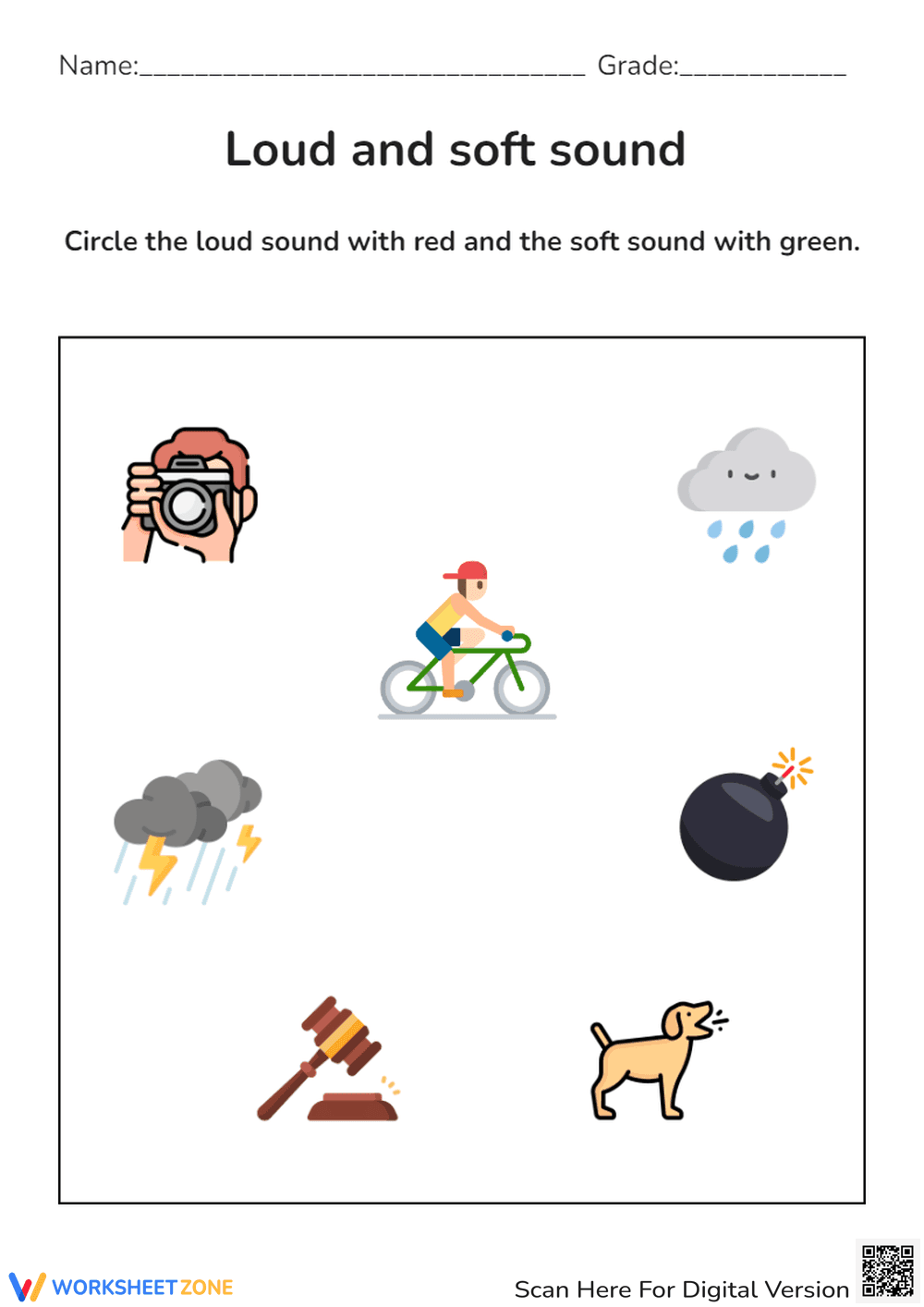
This science worksheet helps early elementary students distinguish between high and low volume by identifying loud and soft sounds in their environment. By categorizing familiar objects like thunder and rain, learners develop a foundational understanding of auditory properties and physical science concepts. It provides immediate practice in observation and classification skills.
At a Glance
- Grade: 1 · Subject: Science
- Standard:
1-PS4-1— Use evidence to describe how different objects create varied sound properties- Skill Focus: Volume Discrimination
- Format: 1 page · 7 problems · Answer key included · PDF
- Best For: Introduction to sound and energy units
- Time: 10–15 minutes
The worksheet features 7 high-quality illustrations of common sound-producing objects, including a camera, a storm, and a barking dog. Students use a color-coding system—red for loud and green for soft—to demonstrate their understanding. The single-page PDF format includes clear instructions and a name/grade header for easy classroom organization.
The zero-prep workflow is designed for maximum efficiency. Teachers can print the single-page PDF in less than 30 seconds. Distribution takes approximately 1 minute, and the color-coded format allows for a 1-minute visual check of student work. This resource is an ideal "grab-and-go" activity for substitute plans or morning work.
This resource aligns with `1-PS4-1`, focusing on the observable properties of sound. While the standard emphasizes vibration, identifying volume is a prerequisite skill for understanding how the intensity of vibration affects sound. It also supports CCSS.ELA-LITERACY.L.1.5.A by sorting common objects into categories. Both standard codes can be copied directly into lesson plans, IEP goals, or district curriculum mapping tools.
Use this as a formative assessment after a "sound walk" around the school. Have students listen for noises, then return to their desks to complete the worksheet. It also works well as a quick exit ticket to gauge student understanding of volume before moving into more complex topics like pitch or frequency.
This activity is designed for Kindergarten through Grade 2 students, particularly those requiring visual supports for science vocabulary. It pairs perfectly with a classroom anchor chart showing "Loud vs. Soft" examples or a hands-on demonstration using musical instruments to explore different volume levels.
According to the RAND AIRS 2024 report on early childhood science education, visual classification tasks are critical for developing the cognitive frameworks necessary for later abstract reasoning in physics. This worksheet targets the 1-PS4-1 standard by requiring students to evaluate the properties of sound through 7 distinct environmental examples. Research from Fisher & Frey (2014) suggests that color-coding information, such as using red and green to distinguish volume, significantly improves retention and retrieval for young learners. By engaging in this structured observation, students build the foundational vocabulary needed to describe energy and waves. The worksheet provides a low-stakes, high-engagement entry point into the NGSS framework, ensuring that students can accurately categorize auditory stimuli before investigating the mechanics of vibration. This resource serves as a reliable tool for documenting student progress toward mastery in early physical science domains.


