




























Views
Downloads
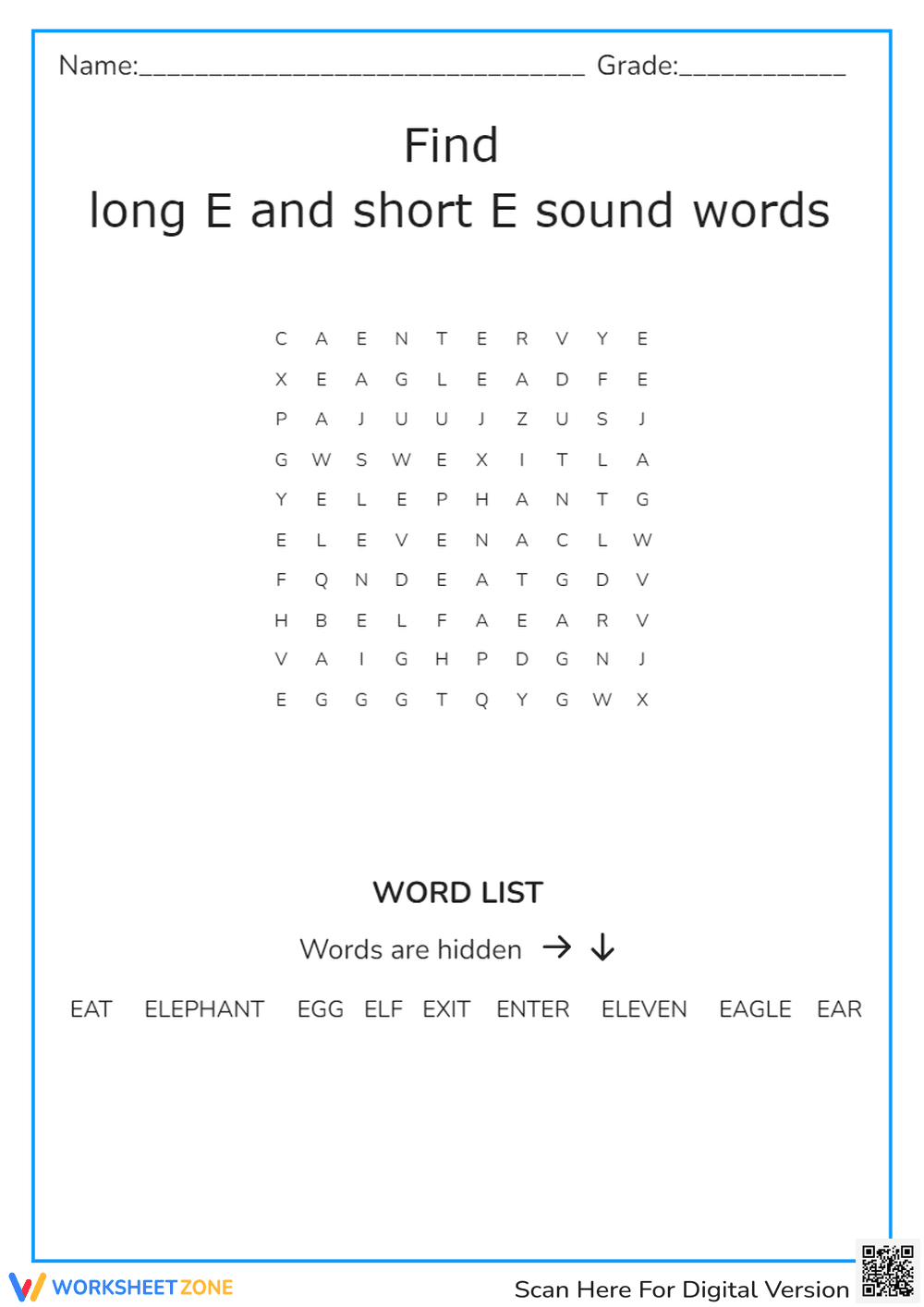

Long E and Short E Word Search | Printable Kindergarten ELA

Paste this activity's link or code into your existing LMS (Google Classroom, Canvas, Teams, Schoology, Moodle, etc.).
Students can open and work on the activity right away, with no student login required.
You'll still be able to track student progress and results from your teacher account.
This Kindergarten phonics worksheet helps students distinguish between long and short E vowel sounds through an engaging word search activity. By identifying words like egg and eagle, learners strengthen their phonemic awareness and letter-sound recognition. This resource provides a focused way to practice vowel sounds while building essential early literacy skills in a fun, interactive format.
At a Glance
- Grade: Kindergarten · Subject: ELA
- Standard:
CCSS.ELA-LITERACY.RF.K.3.B— Associate long and short sounds with common spellings for the five major vowels- Skill Focus: Long and Short E Vowel Sounds
- Format: 1 page · 9 problems · Answer key included · PDF
- Best For: Independent phonics practice and morning work
- Time: 10–15 minutes
What's Inside
This single-page PDF features a clear, 10x10 letter grid containing nine hidden words. The word list includes a mix of short E sounds (egg, elf, exit, enter, elephant, eleven) and long E sounds (eat, eagle, ear). The layout is designed for young learners with large, legible text and simple horizontal and vertical word placements. A full answer key is provided to facilitate quick grading or self-correction.
Zero-Prep Workflow
- Print: Send the single-page PDF to your printer in seconds.
- Distribute: Hand out the sheets during your phonics block or as a transition activity (1 minute).
- Review: Go over the vowel sounds as a group by having students read the found words aloud (2 minutes).
This zero-prep approach makes it an ideal choice for emergency sub plans or last-minute literacy centers where teacher setup time is limited to under two minutes.
Standards Alignment
This resource is directly aligned with CCSS.ELA-LITERACY.RF.K.3.B, which requires students to associate the long and short sounds with common spellings for the five major vowels. By isolating the letter E, students can focus on the specific auditory differences between the two sounds. Both standard codes can be copied directly into lesson plans, IEP goals, or district curriculum mapping tools.
How to Use It
Use this worksheet during the independent practice phase of a gradual release lesson on vowel sounds. After teaching the difference between long and short E, assign the word search to assess individual recognition. It also serves as an excellent formative assessment; observe if students can pronounce the words correctly as they find them. Expected completion typically takes 10 to 15 minutes.
Who It's For
This activity is tailored for Kindergarten students but is also suitable for first-grade review or English Language Learners (ELL) building basic vocabulary. It pairs naturally with a vowel sound anchor chart or a direct instruction lesson on phonics. The visual nature of the word search supports students who benefit from tactile and visual learning modalities.
Research from Fisher & Frey (2014) emphasizes the importance of purposeful independent practice in the literacy development of early learners. This worksheet addresses the CCSS.ELA-LITERACY.RF.K.3.B standard by providing a structured environment for students to interact with long and short E vowel sounds. By identifying words such as elephant and eagle, students engage in orthographic mapping, a process critical for reading fluency. The use of word searches in early childhood education has been shown to improve letter recognition and pattern identification, which are foundational components of the National Assessment of Educational Progress (NAEP) reading framework. This resource offers 9 specific tasks that bridge the gap between phonemic awareness and written word recognition. Educators can utilize this tool to provide high-quality, standards-aligned practice that supports the mastery of complex vowel patterns in a low-stakes, engaging format suitable for diverse classroom settings.


