


























Views
Downloads
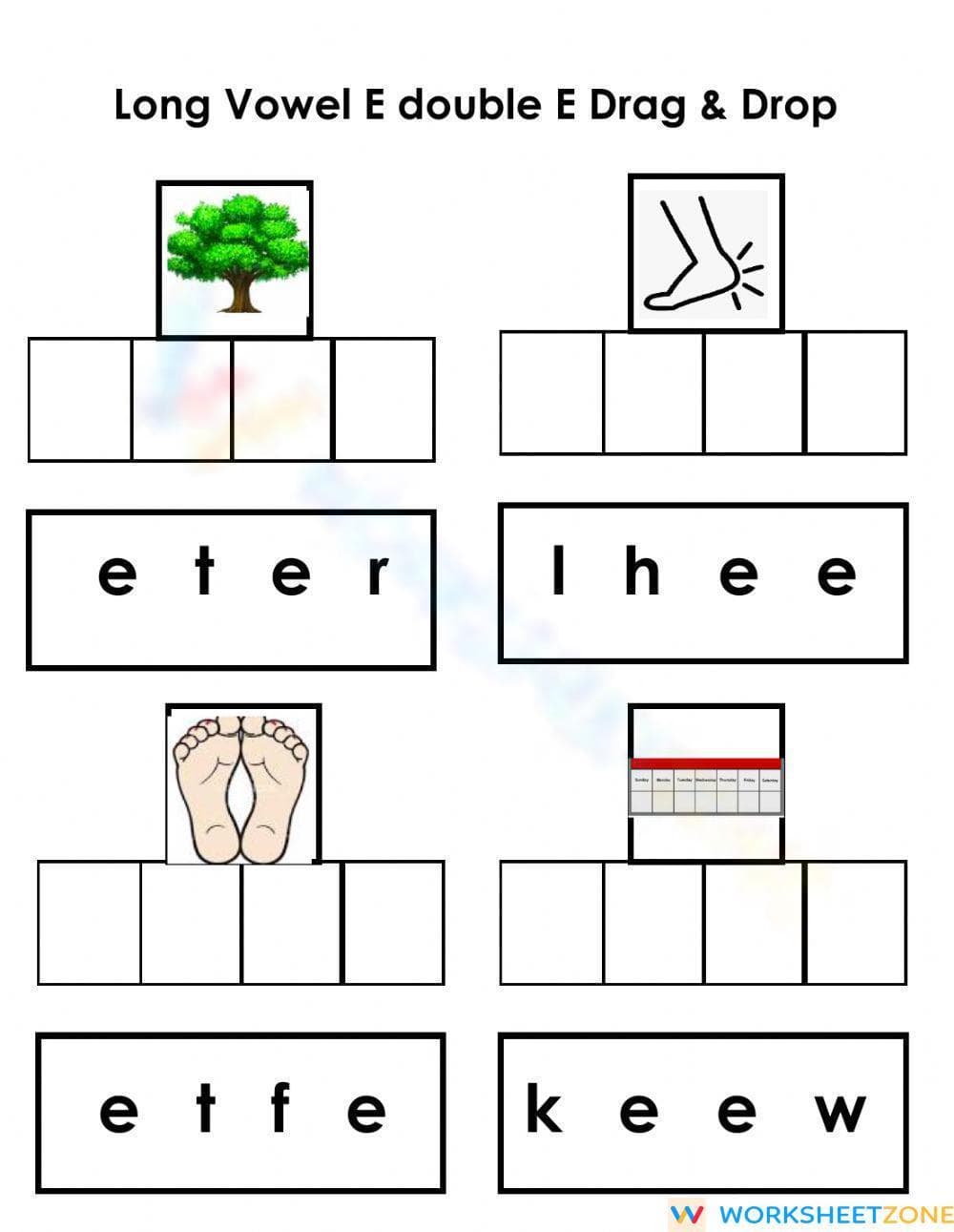

Printable Long E Double E Spelling Worksheet | Grade 1
Paste this activity's link or code into your existing LMS (Google Classroom, Canvas, Teams, Schoology, Moodle, etc.).
Students can open and work on the activity right away, with no student login required.
You'll still be able to track student progress and results from your teacher account.
This essential Grade 1 worksheet focuses on the "ee" vowel team, helping students master long E vowel sounds through targeted spelling practice. By unscrambling letters to name familiar objects, learners bridge the gap between phonemic awareness and written literacy. This printable resource ensures students can accurately identify and spell common words containing double E graphemes.
At a Glance
- Grade: Grade 1 · Subject: ELA (Phonics)
- Standard:
CCSS.ELA-LITERACY.RF.1.3.C— Identify and use common vowel team conventions for representing long vowel sounds- Skill Focus: Long E Vowel Team (ee) Spelling
- Format: 1 page · 4 problems · Answer key included · PDF
- Best For: Literacy centers and independent phonics practice
- Time: 5–10 minutes
What's Inside
What's inside this focused practice page is a set of four visual-to-text challenges. Each task features a clear illustration representing a common long E word: a tree, a heel, a pair of feet, and a calendar representing a week. Below each image, students find scrambled letter boxes containing the exact components needed to construct the word. This single-page PDF includes a self-explanatory layout that allows for immediate student engagement without lengthy teacher instructions.
Skill Progression
The worksheet follows a clear skill progression for early readers. Students engage in guided practice by identifying the pictorial representation of the target word, followed by supported practice where they manipulate provided letter tiles. Finally, the activity leads to independent practice as students finalize the correct grapheme sequence. This gradual release approach ensures mastery of the specific "ee" vowel team convention.
Standards Alignment
Aligned with CCSS.ELA-LITERACY.RF.1.3.C, this resource requires students to know common vowel team conventions for long vowel sounds. It supports phonics recognition by encouraging students to blend sounds into recognizable words. This standard code can be copied directly into lesson plans or IEP goals to track student progress in foundational literacy. Both standard codes can be copied directly into lesson plans, IEP goals, or district curriculum mapping tools.
How to Use It
Use this in a small-group literacy block. Have students say the object name aloud before unscrambling letters to reinforce phoneme-to-grapheme connections. Alternatively, use it as a quick exit ticket after a long vowel lesson. Observe if students correctly place the 'ee' team, revealing their understanding of word structure.
Who It's For
Ideal for Grade 1 students, this serves as enrichment for Kindergarten or remediation for Grade 2. It is effective for students requiring visual scaffolds or tactile-style activities. Pairing this with a long E anchor chart will further solidify the ability to recognize these patterns in varied contexts.
According to the RAND AIRS 2024 report on foundational literacy, explicit instruction in vowel team conventions like the 'ee' digraph is essential for early reading fluency. This Grade 1 worksheet directly supports CCSS.ELA-LITERACY.RF.1.3.C by requiring students to recognize and manipulate long E spellings in familiar words. By engaging in this structured practice, learners move from simple phonemic awareness to grapheme-phoneme mapping. Research from Fisher & Frey (2014) emphasizes that repeated exposure to common vowel patterns through diverse tasks—including visual identification and spelling unscrambles—strengthens the neural pathways necessary for rapid word recognition. This resource provides high-leverage practice that can be integrated into daily literacy blocks to support diverse learners and ensure mastery of complex vowel teams before progressing to multi-syllabic words. This systematic approach to spelling development helps students build the internal dictionary needed for fluent decoding across all primary-level texts.


