


























Views
Plays
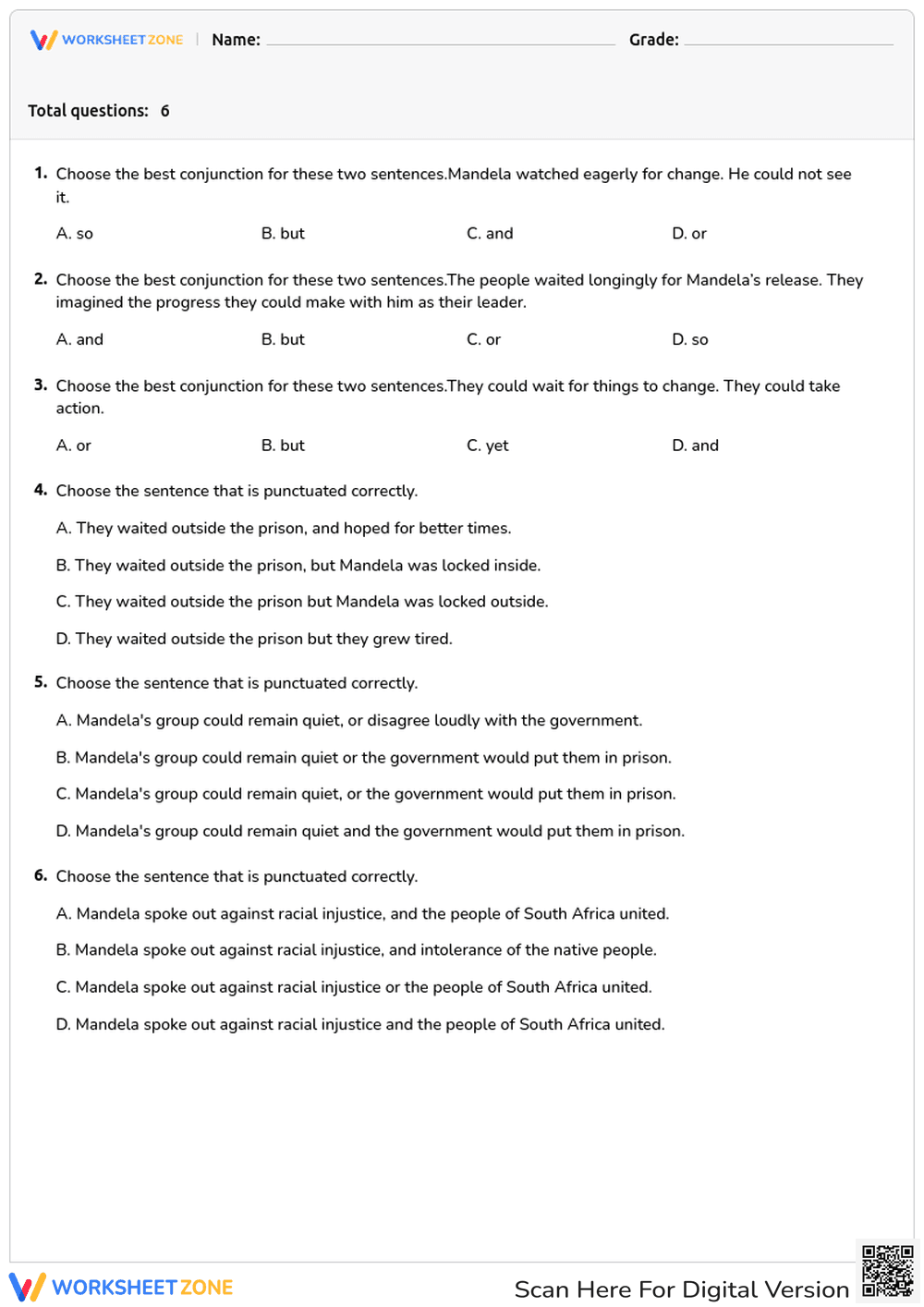

Conjunctions & Commas Worksheet | Grade 4 Printable
Paste this activity's link or code into your existing LMS (Google Classroom, Canvas, Teams, Schoology, Moodle, etc.).
Students can open and work on the activity right away, with no student login required.
You'll still be able to track student progress and results from your teacher account.
This Grade 4 grammar worksheet helps students master coordinating conjunctions and comma placement in compound sentences. By evaluating sentences about Nelson Mandela, learners practice identifying the correct conjunction to connect ideas and recognizing proper punctuation. This focused exercise strengthens foundational writing skills and improves overall sentence fluency.
At a Glance
- Grade: 4 · Subject: ELA
- Standard:
CCSS.ELA-LITERACY.L.4.2.C— Use a comma before a coordinating conjunction.- Skill Focus: Conjunctions and Commas
- Format: 1 page · 6 problems · Answer key included · PDF
- Best For: Independent practice or assessment
- Time: 10–15 minutes
This single-page resource features six multiple-choice questions designed to test students' understanding of compound sentences. The first three questions require learners to select the most appropriate coordinating conjunction (such as and, but, or or) to combine two related thoughts. The final three questions challenge students to identify the correctly punctuated compound sentence from a list of options. A complete answer key is provided to ensure quick and accurate grading.
This worksheet requires zero teacher setup.
- Print (1 minute): Simply download the PDF and print a class set. The clean layout ensures high-quality copies.
- Distribute (1 minute): Hand out the worksheet as a warm-up, exit ticket, or independent practice activity.
- Review (3 minutes): Use the included answer key to quickly check student comprehension or review the correct answers together as a class.
With prep time under two minutes, it perfectly suits emergency sub plans.
This resource is directly aligned to primary standard CCSS.ELA-LITERACY.L.4.2.C: Use a comma before a coordinating conjunction in a compound sentence. It also supports related language skills by requiring students to understand the logical relationship between clauses when choosing conjunctions. Both standard codes can be copied directly into lesson plans, IEP goals, or district curriculum mapping tools.
Assign this worksheet during independent practice, immediately following direct instruction on compound sentences. Alternatively, it serves as an effective formative assessment or quiz at the end of a unit on conjunctions. While students complete the six questions, teachers should observe whether learners are correctly identifying the two independent clauses before checking for comma placement. Expect students to complete this focused task within 10 to 15 minutes.
Designed for fourth graders building sentence skills, this also serves as fifth-grade review. For students requiring additional support, teachers can provide an anchor chart listing the FANBOYS (for, and, nor, but, or, yet, so) coordinating conjunctions. This worksheet pairs perfectly with a historical reading passage about Nelson Mandela, allowing students to connect grammar practice with social studies content.
Mastering the rules of punctuation and sentence structure is a critical component of elementary literacy development. This resource specifically targets CCSS.ELA-LITERACY.L.4.2.C, requiring students to use a comma before a coordinating conjunction. According to Fisher & Frey (2014), providing students with targeted, brief practice opportunities significantly improves their ability to transfer isolated grammar skills into their independent writing. By evaluating sentences in a multiple-choice format, learners must actively analyze the logical relationship between independent clauses and the specific function of punctuation marks. This cognitive process reinforces the mechanics of compound sentences, directly reducing common writing errors such as run-ons and comma splices. Regular engagement with focused grammar exercises ensures that students build the automaticity needed for fluent, effective communication across all academic subjects, ultimately strengthening their overall reading comprehension and written expression capabilities.


