




























Views
Downloads
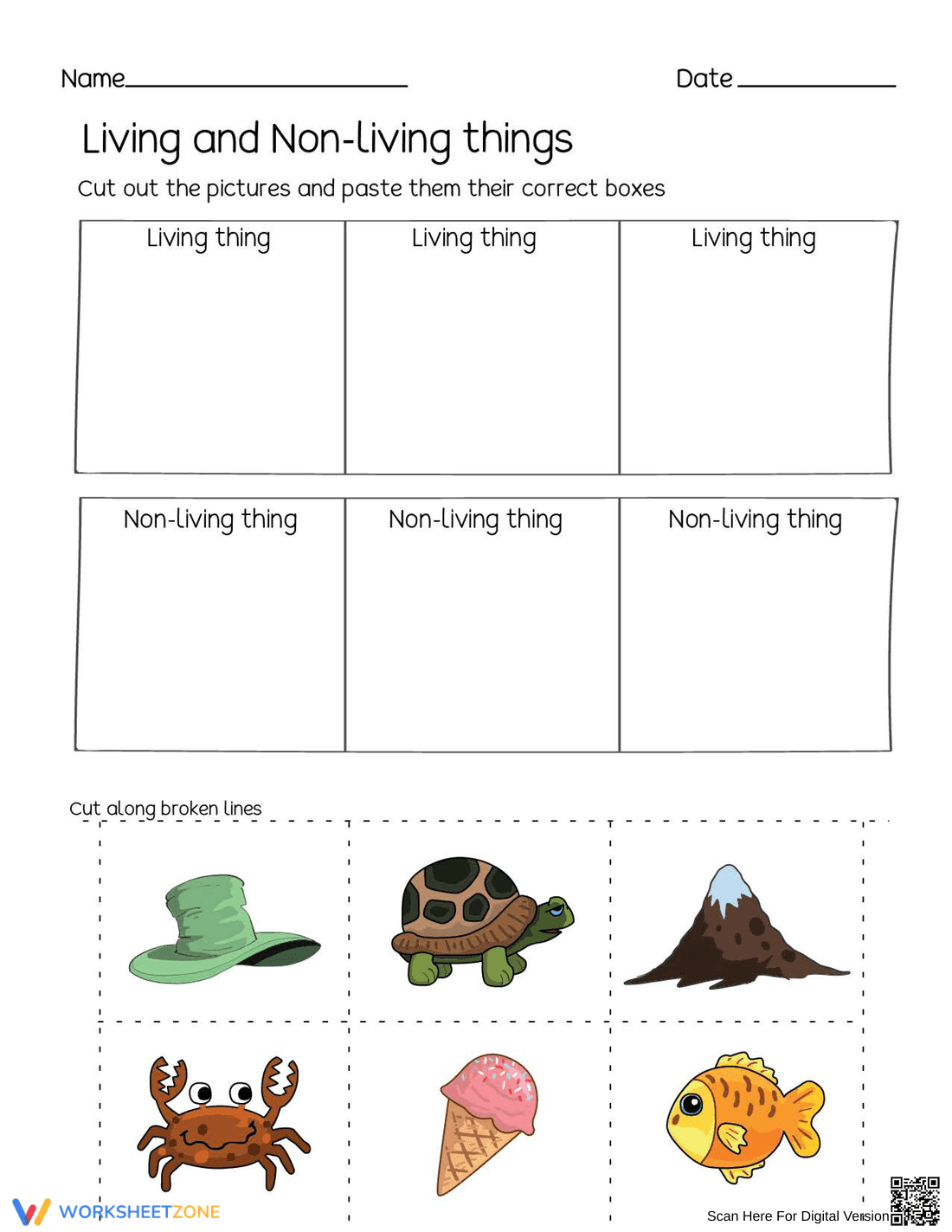

Grade 2 Living vs Non-Living — Printable No-Prep Worksheet

Paste this activity's link or code into your existing LMS (Google Classroom, Canvas, Teams, Schoology, Moodle, etc.).
Students can open and work on the activity right away, with no student login required.
You'll still be able to track student progress and results from your teacher account.
This Grade 2 science worksheet helps students master categorizing living and non-living things. By evaluating observable traits, learners sort six objects into biological classifications. This hands-on activity reinforces early life science concepts while building fine motor skills through cutting and pasting.
At a Glance
- Grade: 2 · Subject: Science
- Standard:
2-LS4-1— Categorize living organisms versus non-living objects based on observable traits.- Skill Focus: Living vs. Non-Living Classification
- Format: 1 page · 6 problems · No answer key needed · PDF
- Best For: Independent practice and centers
- Time: 10–15 minutes
This single-page resource features a cut-and-paste sorting activity for early learners. The top half provides labeled columns for "Living thing" and "Non-living thing," with three blank spaces each. The bottom half contains six illustrations—a turtle, crab, fish, hat, mountain, and ice cream. Students cut out these tiles and paste them into the appropriate boxes, offering a tactile approach to scientific observation.
This resource is designed for a zero-prep workflow:
- Print (1 min): Print the single-page PDF. No complex setup required.
- Distribute (1 min): Hand out sheets, scissors, and glue. Visual instructions are intuitive for second graders.
- Review (3 min): Check work visually as they paste.
With teacher prep under two minutes, this is an excellent option for sub plans or quick transitions.
This activity aligns with life science objectives, supporting 2-LS4-1: Make observations of plants and animals to compare the diversity of life. By distinguishing biological organisms from inanimate objects, students build prerequisite knowledge for ecosystem analysis. Both standard codes can be copied directly into lesson plans, IEP goals, or district curriculum mapping tools.
Deploy this worksheet during independent science centers or as a formative assessment following direct instruction. After discussing what organisms need to survive, students can independently complete this sorting task. As an observation tip, watch how students categorize the mountain; this provides insight into whether they understand non-living things can be natural. Expected completion time is 10 to 15 minutes.
Designed for second-grade students, this resource is also excellent for diverse environments. Visual cues make it accessible for English Language Learners and students needing modified materials. Pair this activity with an anchor chart detailing the "needs of living things" or a nature read-aloud to provide context before sorting begins.
Understanding the fundamental differences between biological organisms and inanimate objects is a critical stepping stone in early elementary science education. This worksheet directly supports standard 2-LS4-1, requiring students to categorize living organisms versus non-living objects based on observable traits. According to a recent ScienceDirect TpT Analysis, integrating tactile activities like cut-and-paste sorting significantly improves knowledge retention and engagement in primary grade science blocks. When students physically manipulate the information—moving the turtle to the living column and the hat to the non-living column—they form stronger cognitive connections regarding biological classifications. This hands-on approach not only reinforces core scientific vocabulary but also develops the fine motor skills necessary for early childhood development. By combining physical interaction with foundational life science concepts, educators can foster a deeper, more intuitive understanding of the natural world that prepares students for advanced ecological studies.


