


























Views
Downloads

Living and Nonliving Things Worksheet | Grade 3 Essential
Paste this activity's link or code into your existing LMS (Google Classroom, Canvas, Teams, Schoology, Moodle, etc.).
Students can open and work on the activity right away, with no student login required.
You'll still be able to track student progress and results from your teacher account.
This Grade 3 science worksheet provides a clear framework for students to distinguish between living and nonliving entities. By focusing on the core biological characteristics of growth, respiration, and reproduction, students develop the foundational classification skills necessary for advanced life science studies. It offers an immediate way to check for understanding during introductory biology units.
At a Glance
- Grade: 3 · Subject: Science
- Standard:
3-LS1-1— Describe that organisms have common traits like growth and reproduction- Skill Focus: Biological Classification
- Format: 1 page · 12 problems · Answer key included · PDF
- Best For: Quick formative assessment or science centers
- Time: 10–15 minutes
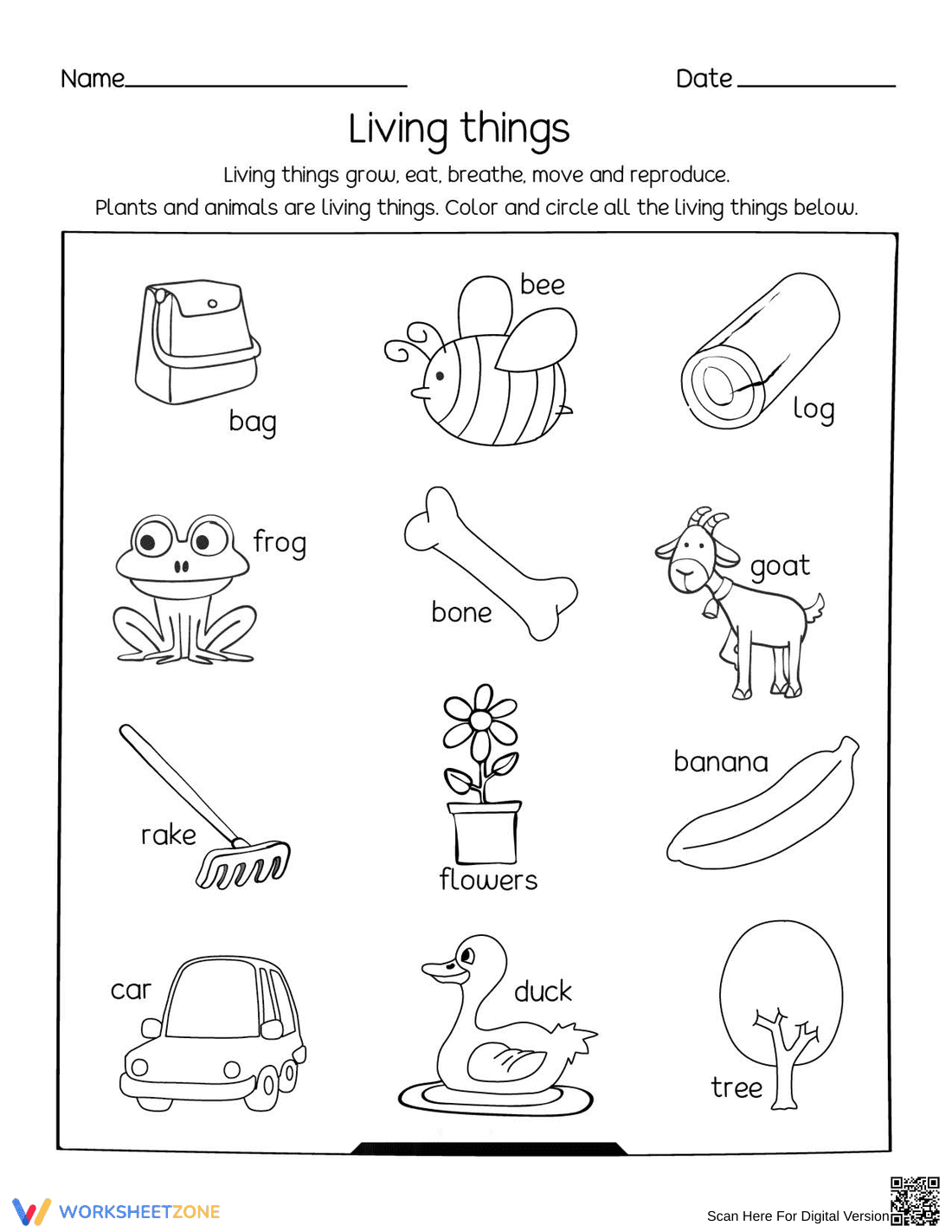
The worksheet features 12 distinct illustrations ranging from biological organisms like bees and ducks to inanimate objects like rakes and cars. Each item is clearly labeled to support vocabulary development. Students are tasked with circling and coloring only the living things, reinforcing the definition provided at the top of the page. The single-page layout ensures students remain focused on the primary learning objective without cognitive overload.
This resource is designed for a zero-prep workflow to maximize instructional time. First, print the single-page PDF (30 seconds). Second, distribute the sheets to students as a bell-ringer or warm-up activity (1 minute). Third, review the answers as a whole group using the included key to address misconceptions about items like logs or bones (5 minutes). Total teacher preparation time is under 2 minutes, making it an ideal emergency sub plan or transition activity.
Aligned primarily to `3-LS1-1`, this activity requires students to recognize that living things share specific life processes. While the standard focuses on life cycles, the prerequisite skill is identifying what constitutes an organism. It also supports `2-LS4-1` by helping students observe the diversity of life in different habitats. Both standard codes can be copied directly into lesson plans, IEP goals, or district curriculum mapping tools.
Use this worksheet as a formative assessment after a direct instruction lesson on the five characteristics of life. As students work, circulate to see if they struggle with the log or bone items; these are excellent instructional moments to discuss the difference between something that is currently living versus something that was once part of a living thing. It typically takes 10 to 15 minutes to complete.
This resource is tailored for Grade 2 and Grade 3 students beginning their life science journey. The visual nature of the tasks makes it highly effective for English Language Learners (ELL) and students with IEPs who benefit from pictorial cues. It pairs naturally with a classroom scavenger hunt or a Living vs. Nonliving anchor chart that lists the requirements for life.
According to research by Fisher & Frey (2014) on the gradual release of responsibility, providing clear visual anchors and structured practice is essential for conceptual mastery in primary science. This worksheet utilizes these principles by defining the characteristics of living things—growth, eating, breathing, moving, and reproducing—before asking students to apply that knowledge to 12 specific examples. By requiring students to both circle and color the correct items, the activity engages multiple modalities, which has been shown to improve retention of biological classification rules. The inclusion of distractor items like cars and rakes ensures that students are not merely guessing but are actively evaluating each object against the provided criteria. This alignment with 3-LS1-1 ensures that the activity serves as a rigorous stepping stone toward understanding complex life cycles and organism interactions within an ecosystem. It provides a quantifiable data point for teachers to assess student readiness for more advanced NGSS-aligned investigations.


