




























Views
Downloads

Living and Non-Living Things Printable Worksheet | Grade 2

Paste this activity's link or code into your existing LMS (Google Classroom, Canvas, Teams, Schoology, Moodle, etc.).
Students can open and work on the activity right away, with no student login required.
You'll still be able to track student progress and results from your teacher account.
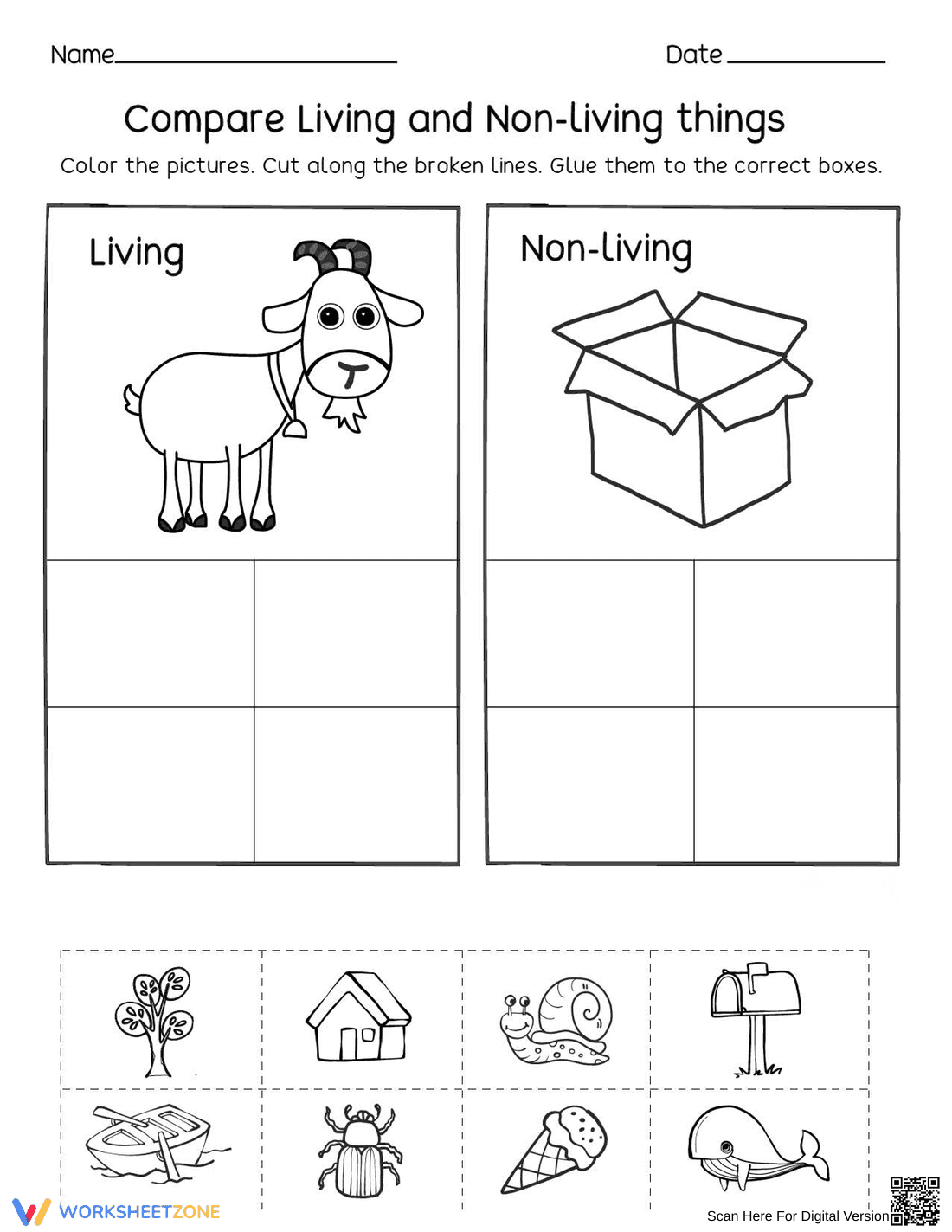
This Grade 2 science worksheet helps students distinguish between living and non-living things through a hands-on classification activity. By identifying specific characteristics such as growth, movement, and nutrition, learners develop a foundational understanding of biological categories. This resource ensures students can accurately sort organisms and objects based on observable traits.
At a Glance
- Grade: 2 · Subject: Science
- Standard:
3-LS1-1— Develop models to describe that organisms have unique and diverse life cycles- Skill Focus: Biological Classification
- Format: 1 page · 8 problems · Answer key included · PDF
- Best For: Independent practice or science centers
- Time: 15–20 minutes
The worksheet features a clear, two-column sorting mat labeled "Living" and "Non-living." It includes 8 distinct illustrations for students to color, cut, and glue into the appropriate categories. The visual cues, such as a snail, a whale, and a mailbox, provide diverse examples that challenge students to apply their knowledge of life processes. A full answer key is provided for quick grading.
This resource follows a zero-prep workflow designed for busy educators. First, print the single-page PDF (30 seconds). Second, distribute the sheets along with scissors and glue to your students (1 minute). Third, review the completed sorting mats as a whole group or through peer-checking (5 minutes). The entire setup requires less than two minutes of teacher preparation time, making it an ideal sub plan or morning work activity.
This activity aligns with 3-LS1-1, focusing on the fundamental differences between living organisms and non-living objects. While the standard emphasizes life cycles, the ability to identify living things is a prerequisite skill for understanding biological development. Both standard codes can be copied directly into lesson plans, IEP goals, or district curriculum mapping tools.
Use this worksheet as a formative assessment after an introductory lesson on the characteristics of life. It works effectively during the "independent practice" phase of a 5E instructional model. Teachers should observe students as they sort the "snail" and "beetle" to ensure they recognize these as living organisms despite their small size. Completion typically takes 15 to 20 minutes.
This resource is designed for Grade 2 and Grade 3 students, including English Language Learners who benefit from the heavy visual support. It pairs naturally with a classroom anchor chart detailing the "MRS GREN" (Movement, Respiration, Sensitivity, Growth, Reproduction, Excretion, Nutrition) acronym or a short introductory video about biological traits.
According to the RAND AIRS 2024 report, tactile classification activities significantly improve retention of scientific categories in early elementary learners. This worksheet utilizes a cut-and-paste format to engage fine motor skills while reinforcing the 3-LS1-1 standard. By requiring students to physically move items into categories, the resource supports cognitive mapping of biological concepts. Research from Fisher & Frey (2014) suggests that such structured sorting tasks provide the necessary scaffolding for students to transition from basic observation to complex scientific reasoning. The inclusion of diverse examples, such as the whale and the ice cream cone, ensures that students are not merely memorizing but are applying criteria for life. This evidence-based approach to science instruction helps bridge the gap between abstract definitions and concrete identification, fostering a robust scientific vocabulary and a clear understanding of the natural world.


