


























Views
Plays
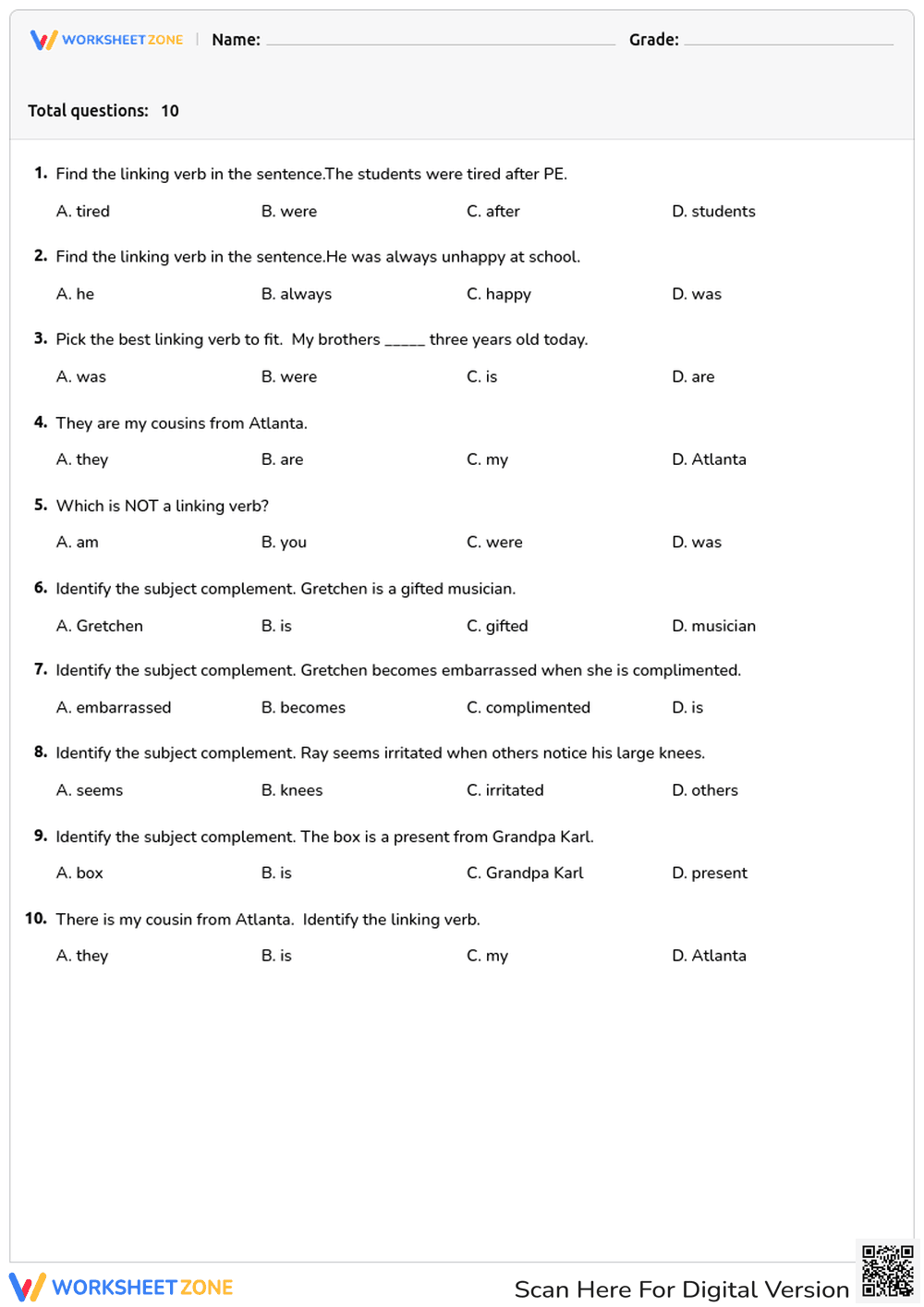

Grade 3 Linking Verbs — Printable No-Prep Worksheet
Paste this activity's link or code into your existing LMS (Google Classroom, Canvas, Teams, Schoology, Moodle, etc.).
Students can open and work on the activity right away, with no student login required.
You'll still be able to track student progress and results from your teacher account.
This ready-to-use worksheet helps students identify linking verbs and subject complements within sentences. By completing these targeted exercises, young learners will strengthen their understanding of sentence structure and verb functions. The clear, multiple-choice format ensures students can confidently practice grammar skills with minimal teacher guidance.
At a Glance
- Grade: 3 · Subject: ELA
- Standard:
CCSS.ELA-LITERACY.L.3.1.A— Explain the function of verbs in particular sentences.- Skill Focus: Linking verbs and subject complements
- Format: 1 page · 10 problems · Answer key included · PDF
- Best For: Independent practice and quick assessment
- Time: 10–15 minutes
This single-page resource features 10 multiple-choice questions focused entirely on linking verbs and subject complements. Students will read short sentences and select the correct verb, identify the complement, or determine which word does not function as a linking verb. The straightforward layout eliminates distractions, while the included answer key allows for immediate grading or self-correction.
This worksheet is designed for maximum efficiency in a busy classroom:
- Print (1 minute): Simply download the PDF and print a class set. No special formatting or cutting is required.
- Distribute (1 minute): Hand out the single-page quiz as a warm-up, exit ticket, or independent center activity.
- Review (3 minutes): Use the provided answer key to quickly check student comprehension or project it on the board for whole-class review.
With under two minutes of total teacher prep time, this activity is an excellent addition to any emergency sub plan or last-minute grammar review session.
This activity aligns directly with CCSS.ELA-LITERACY.L.3.1.A, requiring students to explain the function of nouns, pronouns, verbs, adjectives, and adverbs in general and their functions in particular sentences. By isolating linking verbs and subject complements, students demonstrate mastery of specific verb roles. Both standard codes can be copied directly into lesson plans, IEP goals, or district curriculum mapping tools.
Teachers can deploy this worksheet during the independent practice phase of a grammar lesson, right after direct instruction on linking verbs. Alternatively, it serves as an effective formative assessment at the end of the week to measure retention. While students work, circulate the room and observe whether they are confusing action verbs with linking verbs. This quick check typically takes 10 to 15 minutes to complete.
This resource is ideal for third-grade students developing their foundational grammar skills. The multiple-choice format provides built-in scaffolding, making it accessible for English Language Learners or students who need structured choices rather than open-ended writing tasks. It pairs perfectly with an anchor chart detailing common linking verbs like "is," "are," "was," and "were."
Mastering grammar mechanics, specifically the identification of linking verbs and subject complements, is a critical step in developing strong reading comprehension and writing proficiency. According to a recent EdReports 2024 analysis, explicit grammar instruction combined with targeted, low-stakes practice significantly improves students' ability to construct complex sentences. This worksheet supports that pedagogical approach by aligning with CCSS.ELA-LITERACY.L.3.1.A, prompting students to explain the function of verbs in particular sentences. When students can accurately identify how a linking verb connects a subject to its complement, they transition from passive readers to active writers who understand sentence architecture. Providing consistent, focused exercises like this 10-question assessment ensures that foundational language skills are solidified, ultimately reducing cognitive load during more demanding writing tasks and supporting long-term academic success across all subject areas.


