


























Views
Downloads
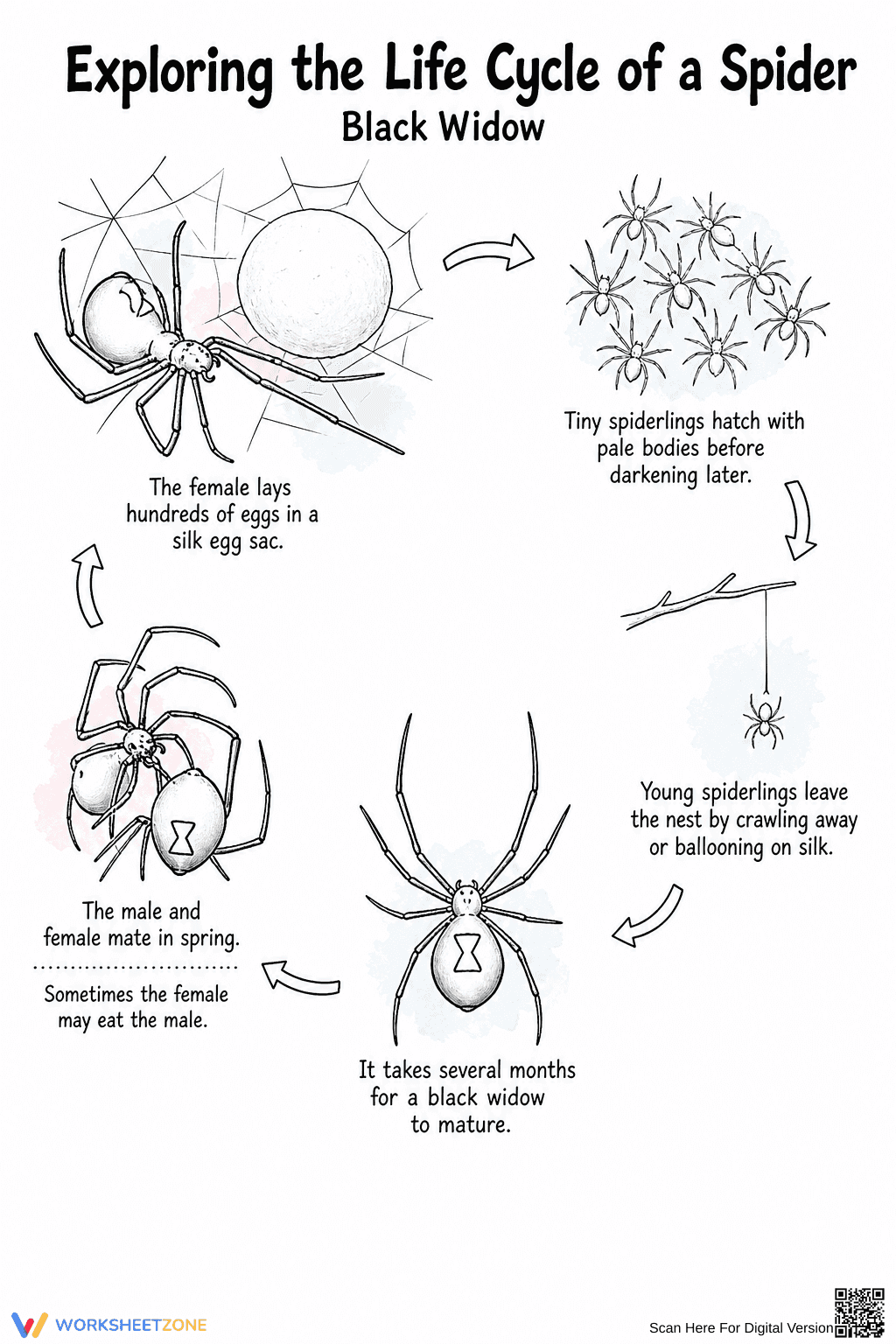

Essential Spider Life Cycle Worksheet | Grade 6 Science
Paste this activity's link or code into your existing LMS (Google Classroom, Canvas, Teams, Schoology, Moodle, etc.).
Students can open and work on the activity right away, with no student login required.
You'll still be able to track student progress and results from your teacher account.
This Grade 6 science worksheet provides a clear visual model of the Black Widow spider's life cycle. Students analyze five distinct stages of development, from egg sacs to maturation and mating, to understand how arachnids grow and reproduce. It serves as an effective tool for mastering biological sequencing and animal behavior in the natural world.
At a Glance
- Grade: 6 · Subject: Science
- Standard:
MS-LS1-4— Use evidence to support how animal behaviors affect the probability of reproduction- Skill Focus: Arachnid life cycle sequencing
- Format: 1 page · 5 stages · Answer key included · PDF
- Best For: Supplemental science instruction and visual learning
- Time: 15–20 minutes
The resource features a high-quality, single-page diagram illustrating the Black Widow's life cycle. It includes five hand-drawn style illustrations paired with concise descriptive text. Key concepts covered include silk egg sacs, spiderling hatching, and the unique behavior of ballooning on silk. A complete answer key is provided to facilitate quick grading or student self-correction during independent study.
This worksheet is designed for immediate classroom implementation with a total teacher prep time of under 2 minutes. Simply print the PDF, distribute it to students as a warm-up or guided notes page, and review the stages as a whole group. Its self-explanatory layout makes it an ideal candidate for emergency sub plans or independent station work where students need to work without constant teacher intervention.
This resource is aligned with MS-LS1-4, focusing on how specialized behaviors and life stages contribute to the survival and reproduction of organisms. It also supports foundational concepts found in 3-LS1-1 for learners transitioning to middle school biological standards. Both standard codes can be copied directly into lesson plans, IEP goals, or district curriculum mapping tools to ensure compliance with state frameworks.
Use this worksheet during the "Explain" phase of a 5E lesson cycle to clarify the specific developmental milestones of arachnids. For a formative assessment, ask students to cover the text and describe the biological significance of "ballooning" based on the visual cues provided. It typically takes 15 to 20 minutes to complete, making it a perfect fit for a standard class period transition.
This worksheet is tailored for Grade 6 students but remains accessible for upper elementary learners exploring life sciences. It is particularly effective for visual learners and English Language Learners (ELLs) who benefit from the direct pairing of detailed images and descriptive text. Pair this with a live observation or a video on spider silk production for a comprehensive and engaging lesson.
According to the RAND AIRS 2024 report on science literacy, visual models are critical for helping middle school students internalize complex biological sequences. This worksheet aligns with MS-LS1-4 by providing a concrete example of how animal behaviors, such as the female laying hundreds of eggs in a protective silk sac, influence the probability of successful reproduction. By breaking down the life cycle into five observable stages, the resource reduces cognitive load and allows students to focus on the relationship between growth and environmental interaction. Research from Fisher & Frey (2014) emphasizes that instructional models are most effective when supported by clear, high-contrast visual aids like this spider life cycle diagram. This ensures that students can accurately identify and explain the transition from spiderlings to mature adults within the broader context of ecosystem dynamics and species survival.


