


























Views
Downloads

Grade 3 Snake Life Cycle — Printable No-Prep Worksheet
Paste this activity's link or code into your existing LMS (Google Classroom, Canvas, Teams, Schoology, Moodle, etc.).
Students can open and work on the activity right away, with no student login required.
You'll still be able to track student progress and results from your teacher account.
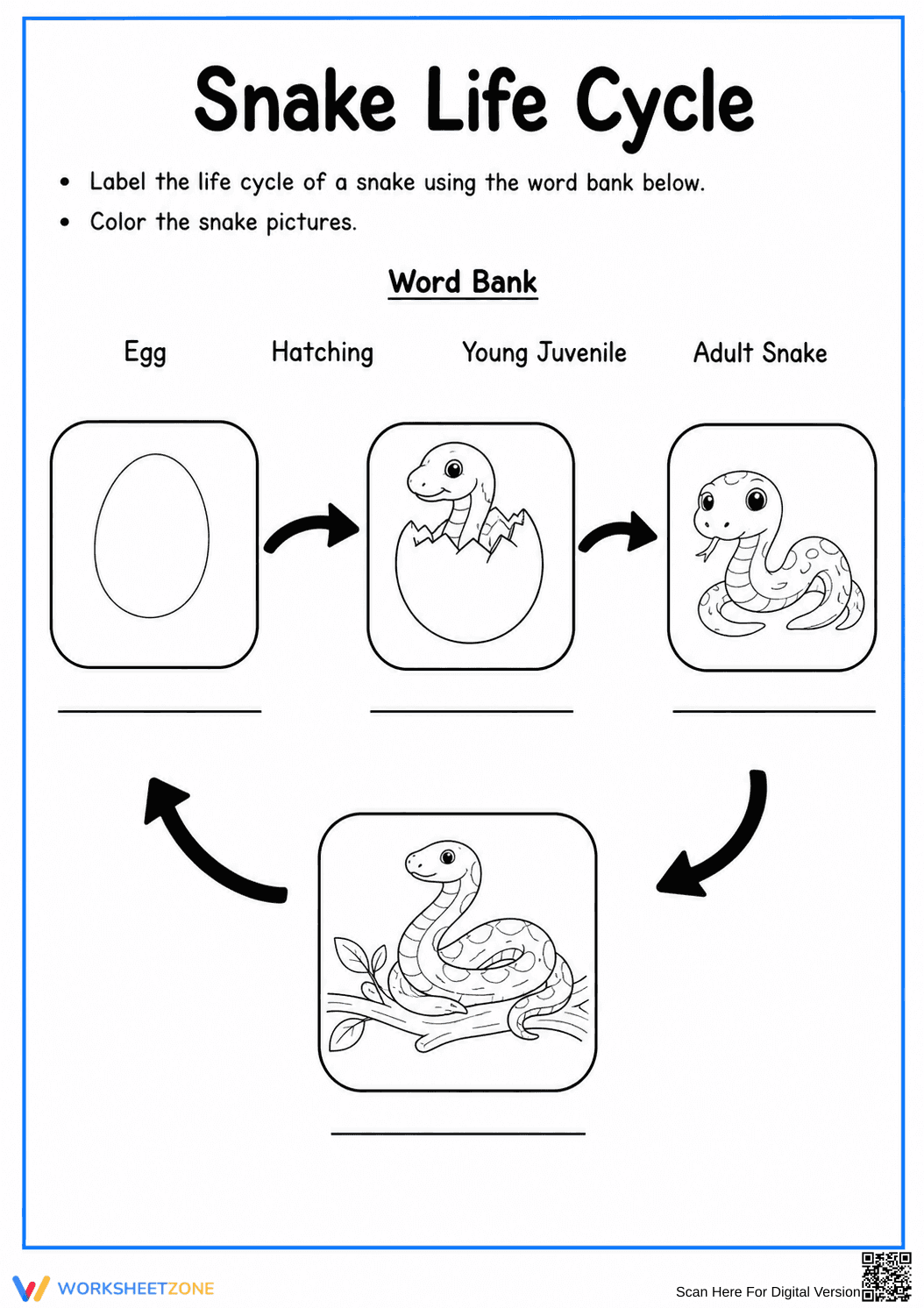
This Grade 3 science worksheet helps students visualize and sequence the biological stages of a snake. By labeling key phases from egg to adult reptile, learners develop a foundational understanding of growth and development. It provides a clear, structured way to practice life cycle modeling while keeping students engaged.
At a Glance
- Grade: 3 · Subject: Science
- Standard:
3-LS1-1— Model the specific developmental stages of an organism- Skill Focus: Snake life cycle sequencing
- Format: 1 page · 4 problems · Answer key included · PDF
- Best For: Independent practice or science centers
- Time: 15–20 minutes
This single-page PDF features a circular diagram representing the four primary stages of a snake's life. It includes a clear word bank containing the terms Egg, Hatching, Young Juvenile, and Adult Snake. The layout is designed for clarity, with large illustration boxes and dedicated lines for student handwriting. A coloring component is also included to support fine motor skills and engagement during the science lesson, alongside a complete answer key for easy grading.
This resource offers a complete zero-prep workflow for busy teachers. First, print the required copies in about one minute. Next, distribute them to students during your life science block, which takes just thirty seconds. Finally, review the completed cycles as a whole group using the provided answer key in another thirty seconds. With total teacher preparation time under two minutes, this self-contained activity is an ideal choice for emergency sub plans or quick formative assessments.
This resource is strictly aligned with 3-LS1-1, requiring students to develop models to describe that organisms have unique and diverse life cycles but all have in common birth, growth, reproduction, and death. It also supports Grade 4 review of biological systems and animal classification. Both standard codes can be copied directly into lesson plans, IEP goals, or district curriculum mapping tools.
Use this worksheet during the explain or evaluate phase of a lesson on animal life cycles. It works effectively as a post-instruction check after reading an informational text about reptiles. For a formative assessment, observe if students can correctly sequence the hatching and young juvenile stages without relying heavily on the word bank. Completion typically takes 15 to 20 minutes depending on the depth of the coloring activity.
This worksheet is designed for third and fourth-grade students studying biology or life science. It is particularly helpful for visual learners and English Language Learners who benefit from the included word bank and pictorial cues. Pair this activity with a reptile anchor chart or a short video of a snake hatching for a complete instructional experience that reinforces the vocabulary used in the task.
According to the NAEP science framework, understanding life cycles is a critical component of biological literacy in the elementary years. This worksheet addresses the 3-LS1-1 standard by requiring students to model the specific developmental stages of a snake, moving from birth to maturity. Research from EdReports 2024 emphasizes that high-quality science materials should provide clear visual representations to help students internalize complex biological sequences. By utilizing a word bank and a circular flow model, this resource reduces cognitive load while reinforcing academic vocabulary. This approach ensures that students can demonstrate mastery of the concept that all organisms follow a predictable pattern of growth and change. The inclusion of a coloring element further supports memory retention and student interest, making it a robust tool for standard-aligned science instruction in diverse classroom settings.


