


























Views
Downloads

Printable Plant Life Cycle Worksheet | Grade 3 Science
Paste this activity's link or code into your existing LMS (Google Classroom, Canvas, Teams, Schoology, Moodle, etc.).
Students can open and work on the activity right away, with no student login required.
You'll still be able to track student progress and results from your teacher account.
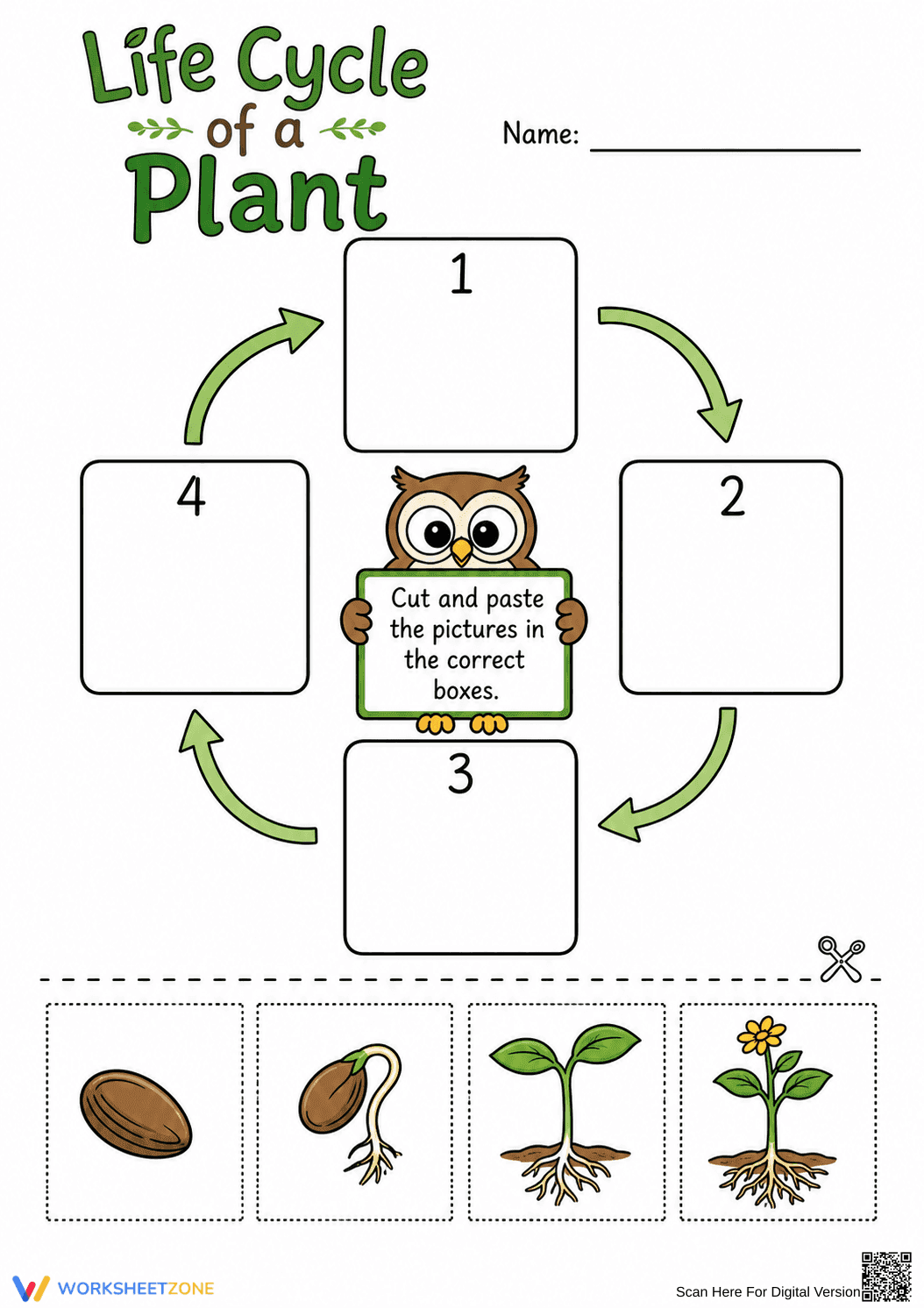
This engaging cut-and-paste worksheet helps students sequence the life cycle of a plant from seed to mature flower. By physically moving the stages into the correct order, young learners solidify their understanding of biological growth and development while practicing essential fine motor skills in a fun, hands-on way.
At a Glance
- Grade: 3 · Subject: Science
- Standard:
3-LS1-1— Sequence the stages of an organism's life cycle- Skill Focus: Sequencing plant growth stages
- Format: 1 page · 4 problems · PDF
- Best For: Independent practice or science centers
- Time: 10–15 minutes
This single-page resource features a circular diagram with four numbered boxes connected by arrows. At the bottom are four illustrations representing key stages of a plant's life: a seed, a sprouting seed, a seedling, and a mature plant. Students cut out these images and paste them into the corresponding boxes to complete the model.
This resource offers a streamlined zero-prep workflow:
- Print (1 minute): Print the single-page PDF. No complex assembly is required beyond scissors and glue.
- Distribute (1 minute): Hand out the worksheets. The visual instructions make the task immediately clear.
- Review (3 minutes): Quickly check the completed cycles as a class.
With under two minutes of teacher prep time, this activity is an excellent option for emergency sub plans or quick science centers.
This activity is directly aligned with the Next Generation Science Standards, specifically focusing on 3-LS1-1: Develop models to describe that organisms have unique and diverse life cycles but all have in common birth, growth, reproduction, and death. By arranging the visual model, students demonstrate their comprehension of this continuous biological process. Both standard codes can be copied directly into lesson plans, IEP goals, or district curriculum mapping tools.
Use this worksheet as independent practice following a direct instruction lesson on plant biology, or as an interactive science center station. As a formative assessment tip, observe students arranging the cut-outs before they glue them down; this provides a quick visual check of their sequencing logic. Expected completion time is 10 to 15 minutes.
This resource is primarily designed for early elementary students, particularly those in third grade who are exploring basic biological concepts. The visual nature of the cut-and-paste format provides excellent differentiation for visual and kinesthetic learners, as well as English Language Learners who benefit from image-based vocabulary reinforcement. It pairs perfectly with a read-aloud book about seeds or a hands-on classroom seed-planting experiment.
Understanding biological progressions through visual modeling is a foundational element of early elementary science education. This worksheet specifically targets 3-LS1-1, helping students sequence the stages of an organism's life cycle through active, hands-on engagement. According to a recent ScienceDirect TpT Analysis, interactive classroom activities that combine cognitive tasks—like logical sequencing—with fine motor skills such as cutting and pasting significantly enhance memory retention and conceptual understanding in young learners. By physically manipulating the distinct stages of plant growth from seed to mature flower, students move beyond passive observation and actively construct their knowledge of biological systems. This tactile approach ensures that abstract scientific concepts become concrete and accessible, fostering a deeper appreciation for the natural world and laying the essential groundwork for more advanced biological studies in later grades.


