


























Views
Downloads
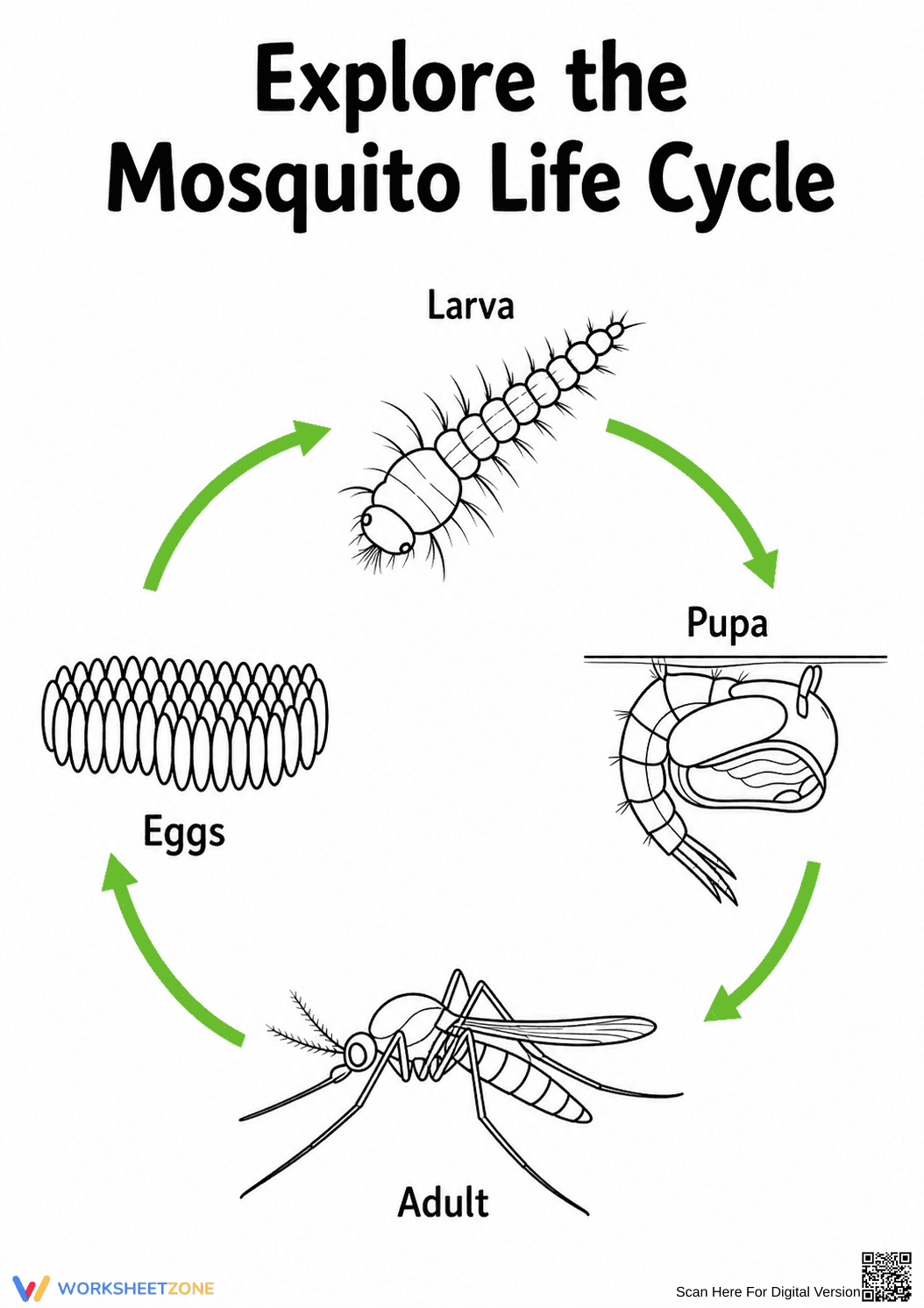

Grade 6 Mosquito Life Cycle — Printable No-Prep Worksheet
Paste this activity's link or code into your existing LMS (Google Classroom, Canvas, Teams, Schoology, Moodle, etc.).
Students can open and work on the activity right away, with no student login required.
You'll still be able to track student progress and results from your teacher account.
This visual science worksheet introduces students to the fascinating process of insect metamorphosis by illustrating the four distinct stages of a mosquito's development. By examining this clear, circular diagram, students will easily grasp how mosquitoes grow from eggs to adults, building a foundational understanding of biological life cycles and organism growth.
At a Glance
- Grade: 6 · Subject: Science
- Standard:
MS-LS1-5— Understand how environmental factors influence organism growth- Skill Focus: Insect life cycles and metamorphosis
- Format: 1 page · 4 stages · No answer key needed · PDF
- Best For: Visual reference and science notebooks
- Time: 10–15 minutes
Inside this single-page resource, you will find a detailed, black-and-white circular diagram depicting the complete life cycle of a mosquito. The page clearly labels the four primary phases: eggs, larva, pupa, and adult. Bold green arrows guide the student's eye through the continuous biological loop, making the progression easy to follow. Because it functions as a standalone visual aid, no separate answer key is required.
This resource is designed for immediate classroom implementation with zero teacher preparation required.
- Print (1 min): Download the PDF and print a class set. The black-and-white illustrations save ink.
- Distribute (1 min): Hand out the diagrams as a quick bell-ringer or transition activity.
- Review (3 mins): Discuss the four stages as a class while students color-code the diagram.
With under two minutes of prep time, this is an excellent addition to any emergency sub plan.
This visual guide aligns with MS-LS1-5: Construct a scientific explanation based on evidence for how environmental and genetic factors influence the growth of organisms. By studying the developmental stages of a mosquito, students build the background knowledge necessary to discuss how environments impact the larva and pupa phases. Both standard codes can be copied directly into lesson plans, IEP goals, or district curriculum mapping tools.
Integrate this diagram into your science instruction as an interactive notebook insert; students can glue the page into their journals and write observations next to each stage. Alternatively, use it as an introductory coloring activity before a unit on ecosystems. As a formative assessment tip, ask students to verbally explain the transition between the aquatic pupa stage and the flying adult stage to check for understanding. Expect students to spend 10 to 15 minutes coloring and annotating.
This resource is primarily designed for middle school science students, though its clear visuals make it adaptable for upper elementary classrooms or special education students who benefit from graphic organizers. The straightforward labeling provides excellent scaffolding for English Language Learners acquiring new biology vocabulary. It pairs perfectly with a direct instruction lesson on complete metamorphosis.
Integrating clear visual models into science instruction is a proven strategy for enhancing student comprehension of complex biological processes. This worksheet aligns with MS-LS1-5, helping students understand how environmental factors influence organism growth by mapping out the specific developmental stages of a mosquito. According to a recent ScienceDirect TpT Analysis, students who utilize structured visual diagrams and graphic organizers during life science units demonstrate significantly higher retention of sequential processes like metamorphosis compared to those who rely solely on text-based instruction. By providing a clear, cyclical representation of the eggs, larva, pupa, and adult phases, educators can reduce cognitive load and allow learners to focus on the underlying mechanisms of biological development. This visually engaging format ensures foundational concepts are accessible, supporting robust scientific literacy in the classroom.


