


























Views
Downloads
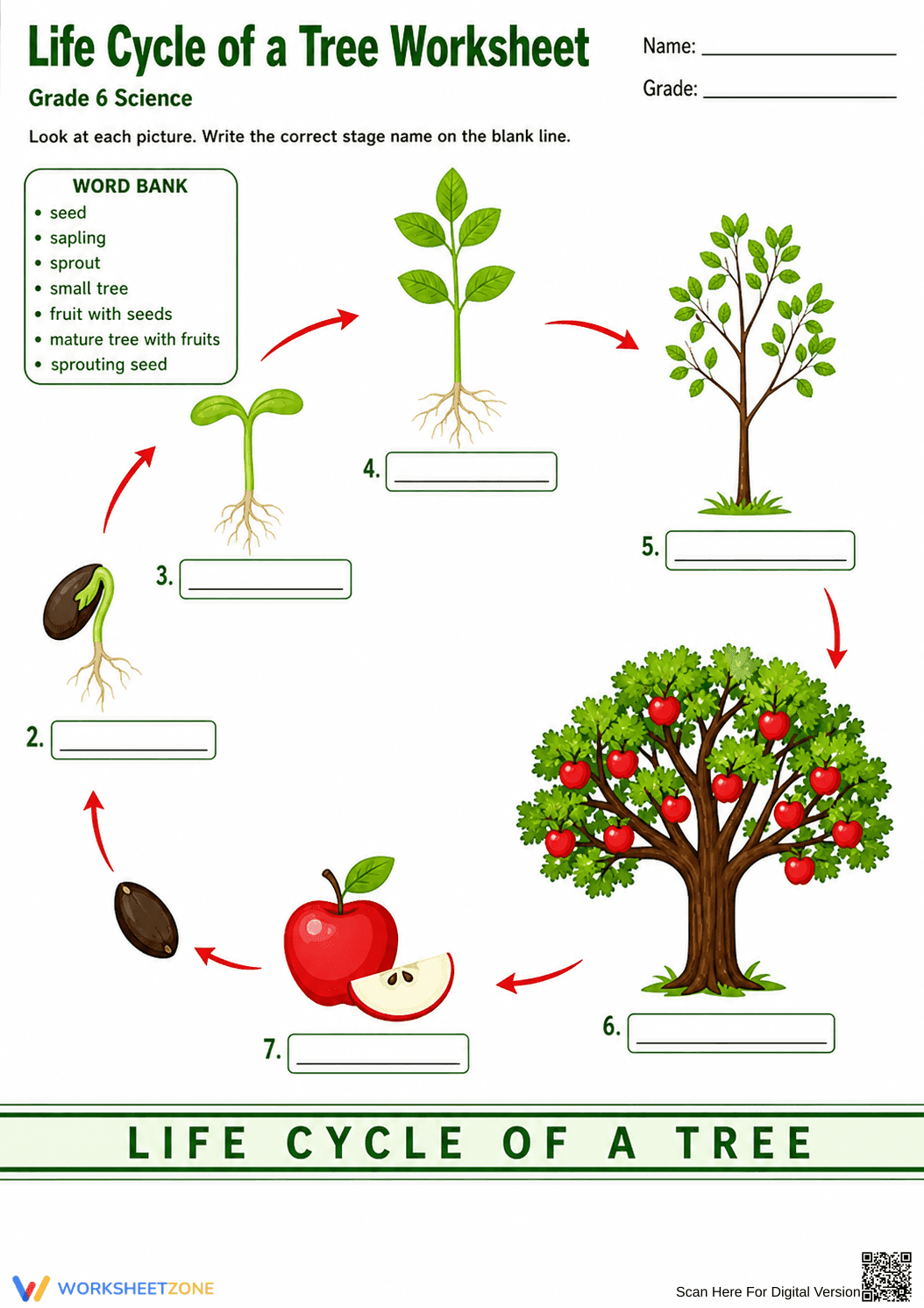

Grade 6 Tree Life Cycle — Printable No-Prep Worksheet
Paste this activity's link or code into your existing LMS (Google Classroom, Canvas, Teams, Schoology, Moodle, etc.).
Students can open and work on the activity right away, with no student login required.
You'll still be able to track student progress and results from your teacher account.
This Grade 6 science worksheet provides a clear visual guide to the life cycle of a tree, helping students identify and sequence biological growth stages. By examining the transition from seed to fruit-bearing adult, learners develop a foundational understanding of plant reproduction and development.
At a Glance
- Grade: 6 · Subject: Science
- Standard:
MS-LS1-4— Identify specialized plant structures affecting reproduction- Skill Focus: Plant life cycle stages
- Format: 1 page · 7 problems · Answer key included · PDF
- Best For: Quick formative assessment or sub plans
- Time: 15–20 minutes
This single-page PDF features a high-quality diagram illustrating seven distinct stages of an apple tree's development. The worksheet includes a helpful word bank and clear fill-in-the-blank labels for the seed, sprouting seed, sprout, sapling, small tree, mature tree, and fruit. It comes with a comprehensive answer key, making it easy for students to self-correct or for teachers to grade quickly during a busy science block.
The workflow for this resource is designed for maximum efficiency. First, print the single-page PDF (30 seconds). Next, distribute the diagrams to your students as a warm-up or exit ticket (1 minute). Finally, review the seven stages as a whole group using the included answer key to solidify understanding (5 minutes). Total teacher preparation time is under two minutes, making it a perfect emergency sub plan.
This resource is aligned with MS-LS1-4, which requires students to use empirical evidence and scientific reasoning to support explanations for how specialized plant structures affect the probability of successful reproduction. By identifying the mature tree and fruit stages, students see the specialized structures necessary for the next generation. Both standard codes can be copied directly into lesson plans, IEP goals, or district curriculum mapping tools.
Use this worksheet during the "Explain" phase of a 5E lesson cycle to provide a concrete visual for plant development, or assign it as independent practice after direct instruction. It serves as an excellent formative assessment tool; observe if students can accurately sequence the transition between the sapling and small tree stages using the provided word bank. Expect students to complete the labeling and analysis in approximately 15 to 20 minutes, depending on prior knowledge.
This worksheet is designed for Grade 6 students but is highly suitable for older learners requiring visual supports or English Language Learners who benefit from clear diagramming. It pairs naturally with a hands-on seed germination lab or an anchor chart detailing the parts of a flower. The simplified vocabulary ensures accessibility while maintaining scientific accuracy for middle school biology.
According to the RAND AIRS 2024 report, high-quality visual aids in science education significantly improve the retention of complex biological sequences among middle school learners. This worksheet addresses the MS-LS1-4 standard by providing a structured look at the life cycle of a tree, helping students identify specialized plant structures affecting reproduction. By breaking down the growth process into seven observable stages—from the initial seed to the fruit-bearing mature tree—the resource helps students build a mental model of organism development. Research indicates that such scaffolded visual tools reduce cognitive load, allowing students to focus on the causal relationships between growth stages rather than just memorizing terms. This alignment ensures that the material meets rigorous academic expectations while remaining accessible for diverse classroom needs. The inclusion of an answer key further supports instructional efficiency, a key factor in successful classroom management and student feedback loops.


