


























Views
Downloads

Spider Life Cycle Printable Worksheet | Grade 3 Science
Paste this activity's link or code into your existing LMS (Google Classroom, Canvas, Teams, Schoology, Moodle, etc.).
Students can open and work on the activity right away, with no student login required.
You'll still be able to track student progress and results from your teacher account.
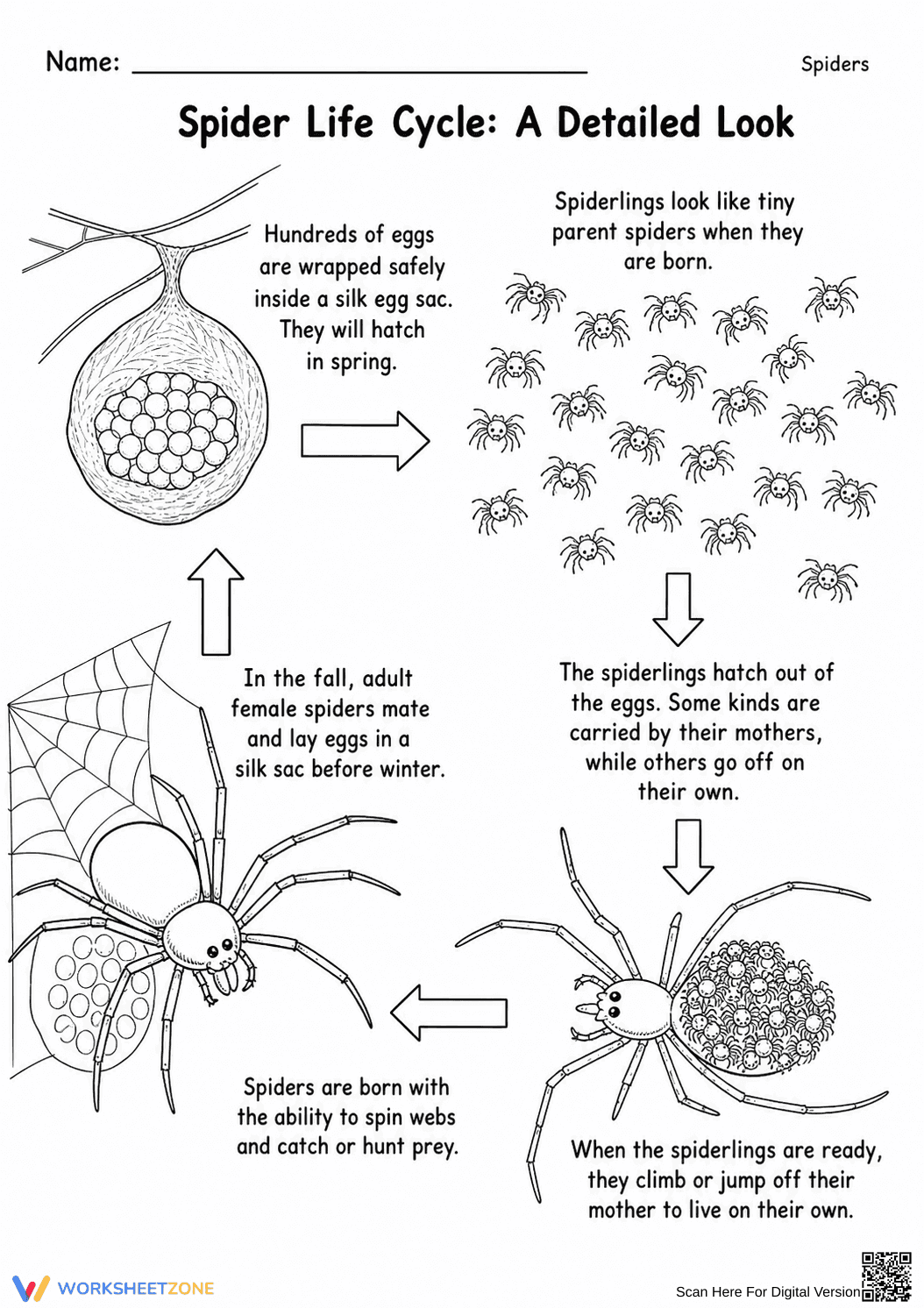
This informational science worksheet introduces students to the fascinating biological stages of arachnids. By reading clear descriptions and following a sequential diagram, learners will trace the spider life cycle from egg sacs to adult reproduction. This visual resource builds foundational science vocabulary and strengthens reading comprehension skills.
At a Glance
- Grade: 3 · Subject: Science
- Standard:
3-LS1-1— Describe that organisms have unique and diverse life cycles- Skill Focus: Animal Life Cycles
- Format: 1 page · 1 reading task · No answer key required · PDF
- Best For: Independent reading and science centers
- Time: 10–15 minutes
This single-page resource features a detailed, circular diagram illustrating the five main stages of a spider's development. Students will read short, descriptive captions accompanying each illustration, covering the initial egg sac, the emergence of spiderlings, their dispersal, and the adult female's reproductive stage. The black-and-white line art also functions as a coloring activity to keep young learners engaged while they process the scientific information.
Zero-Prep Workflow
- Print (1 minute): Simply print the single-page PDF. No special formatting or double-sided copying is required.
- Distribute (1 minute): Hand out the diagrams along with crayons or colored pencils if utilizing the coloring aspect.
- Review (3 minutes): Read the stages aloud together, tracing the arrows to reinforce the cyclical nature of the process.
With under two minutes of total teacher preparation time, this resource is highly effective for immediate classroom use or as a reliable addition to an emergency substitute teacher plan.
Standards Alignment
This resource aligns with the Next Generation Science Standards, specifically 3-LS1-1: Develop models to describe that organisms have unique and diverse life cycles but all have in common birth, growth, reproduction, and death. It provides a concrete, visual model of these universal biological stages applied to arachnids. Both standard codes can be copied directly into lesson plans, IEP goals, or district curriculum mapping tools.
How to Use It
Introduce this diagram before a direct instruction lesson on animal life cycles to build background knowledge. Alternatively, use it during a science center rotation where students read the text and color the corresponding stages. As a formative assessment observation tip, ask students to point to the stage where spiderlings disperse and explain why they leave their mother. Expected completion time ranges from 10 to 15 minutes depending on reading fluency and coloring detail.
Who It's For
This worksheet is designed for third-grade general education students, though the clear visuals make it highly accessible for English Language Learners and students requiring reading accommodations. For differentiation, teachers can read the text aloud to struggling readers while they trace the arrows. It pairs perfectly with a nonfiction read-aloud book about spiders or a broader unit on insect and arachnid biology.
Understanding biological progression is a critical component of early elementary science education. When students describe that organisms have unique and diverse life cycles, they build a framework for comprehending broader ecological systems and animal adaptations. The 3-LS1-1 standard emphasizes the importance of recognizing commonalities like birth, growth, reproduction, and death across different species. According to a recent ScienceDirect TpT Analysis, integrating visual models with informational text significantly improves vocabulary retention and conceptual understanding in young learners. Diagrams that combine sequential arrows with descriptive captions reduce cognitive load, allowing students to process complex biological timelines more effectively. By tracing the physical changes from egg to adult, learners develop essential sequencing skills and scientific literacy that will support more advanced biological studies in later grades.


