




























Views
Downloads

Plant Life Cycle Worksheet | Grade 3 Essential

Paste this activity's link or code into your existing LMS (Google Classroom, Canvas, Teams, Schoology, Moodle, etc.).
Students can open and work on the activity right away, with no student login required.
You'll still be able to track student progress and results from your teacher account.
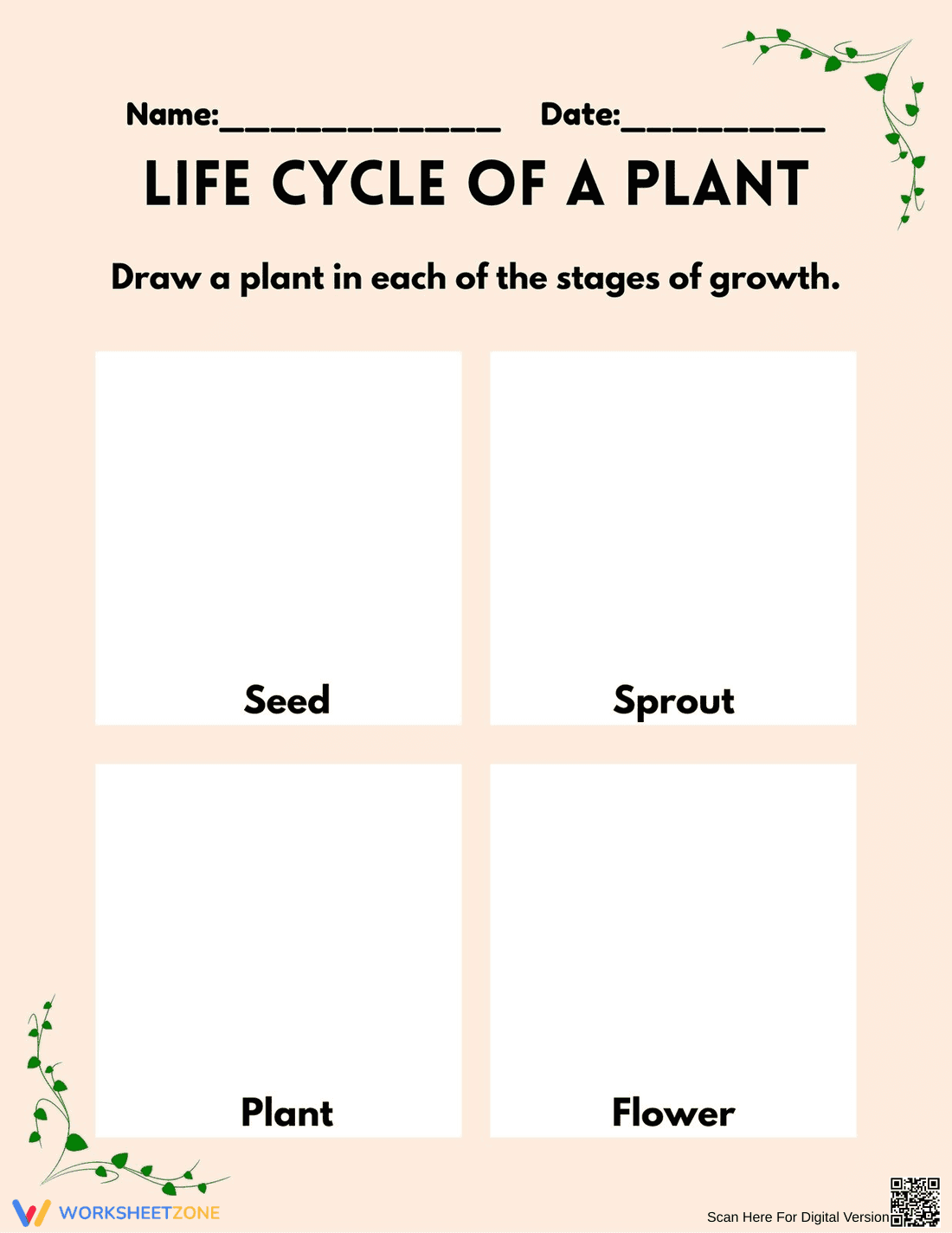
This Grade 3 plant life cycle worksheet helps students visualize biological growth by illustrating four distinct stages of development. By drawing the transition from seed to flower, learners internalize the sequential nature of living organisms. This activity serves as a foundational model for understanding how plants grow and change over time.
At a Glance
At a Glance
- Grade: 3 · Subject: Science
- Standard:
3-LS1-1— Develop models to describe that organisms have unique and diverse life cycles- Skill Focus: Plant life cycle stages
- Format: 1 page · 4 problems · Answer key included · PDF
- Best For: Science centers and formative assessment
- Time: 15–20 minutes
What's Inside
Inside this resource, you will find a single-page layout featuring four dedicated drawing panels. Each panel is clearly labeled with a specific stage: Seed, Sprout, Plant, and Flower. The clean design provides ample white space for student illustrations, while the bold headers ensure learners stay on track with the correct biological sequence.
Zero-Prep Workflow
The zero-prep workflow for this worksheet is designed for efficiency. First, print the single-page PDF (30 seconds). Next, distribute the sheets to students (1 minute). Finally, review the completed cycles as a whole class (5 minutes). Total teacher preparation time is under 2 minutes, making it an ideal choice for emergency sub plans or science block additions.
Standards Alignment
This resource is aligned with `3-LS1-1`, which requires students to develop models to describe that organisms have unique and diverse life cycles but all have in common birth, growth, reproduction, and death. It also supports 1-LS3-1 by highlighting how young plants are similar to their parents. Both standard codes can be copied directly into lesson plans, IEP goals, or district curriculum mapping tools.
How to Use It
Use this worksheet during the "Explain" phase of a 5E lesson model to check for understanding after a read-aloud about botany. It also functions well as a formative assessment after observing real lima bean sprouts in the classroom. Teachers should look for students correctly identifying the emergence of leaves in the "Sprout" stage versus the "Plant" stage. Completion typically takes 15 to 20 minutes.
Who It's For
This activity is perfect for third-grade students beginning their life science unit. It is easily differentiated for English Language Learners (ELLs) who can demonstrate knowledge through drawing rather than complex writing. Pair this worksheet with a physical seed-sorting activity or a time-lapse video of a growing sunflower for a multi-sensory learning experience.
According to the RAND AIRS 2024 report, visual modeling in early science education significantly improves long-term retention of biological sequences. This worksheet addresses the 3-LS1-1 standard by requiring students to construct a visual model of the plant life cycle, moving from seed to mature flower. By engaging in the act of drawing, students move beyond rote memorization of terms like "sprout" to a conceptual understanding of growth phases. Research from Fisher & Frey (2014) emphasizes that non-linguistic representations, such as the 4 tasks included here, are essential for scaffolding complex scientific concepts for diverse learners. This printable resource provides a structured yet creative outlet for students to demonstrate mastery of life science standards. It is a reliable tool for teachers looking to integrate NGSS-aligned modeling into their daily curriculum without increasing administrative burden.


