


























Views
Downloads
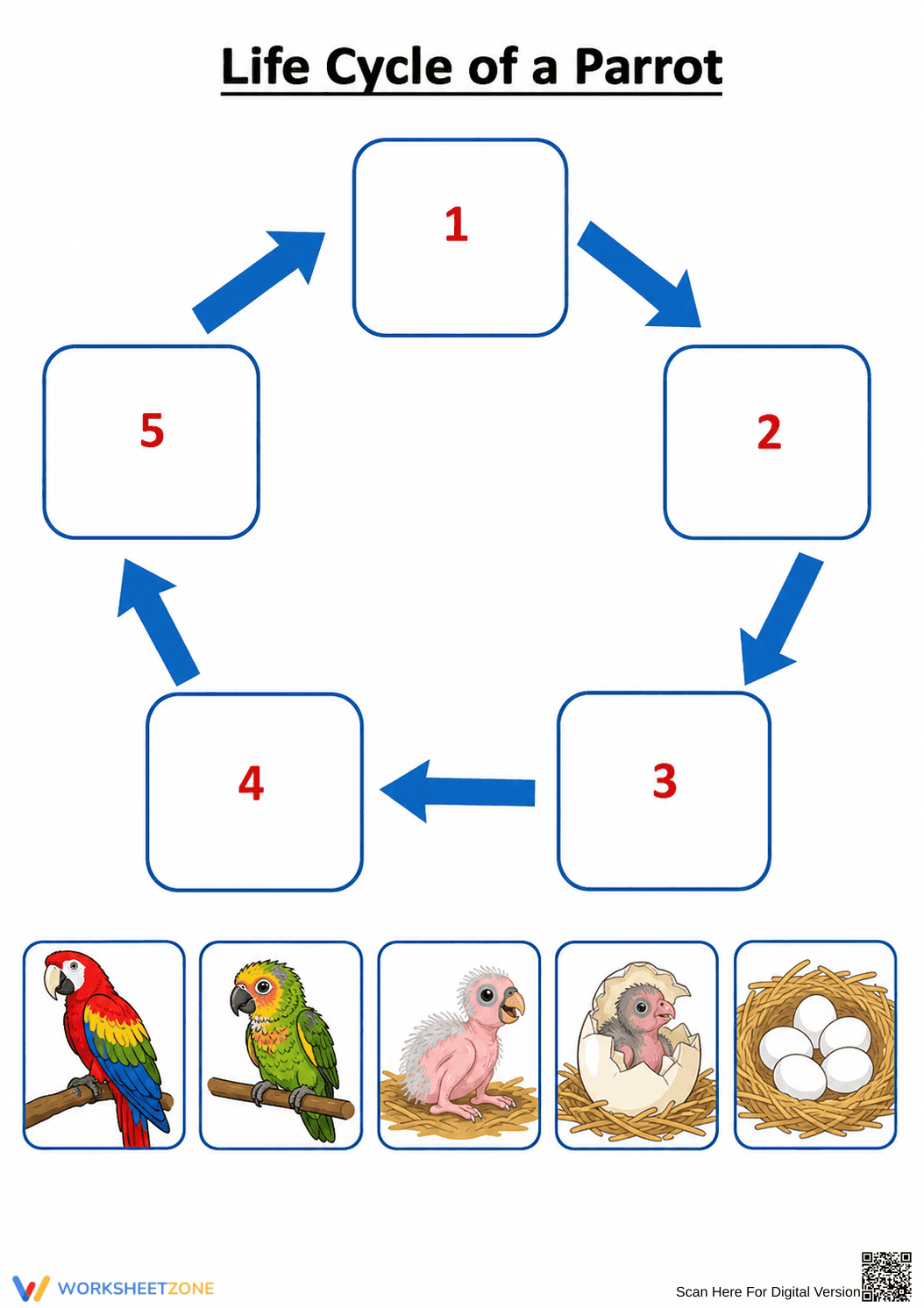

Grade 4-5 Parrot Life Cycle — Printable No-Prep Worksheet
Paste this activity's link or code into your existing LMS (Google Classroom, Canvas, Teams, Schoology, Moodle, etc.).
Students can open and work on the activity right away, with no student login required.
You'll still be able to track student progress and results from your teacher account.
This Grade 4-5 science worksheet helps students master biological sequencing by modeling the life cycle of a parrot. By organizing five distinct developmental stages into a continuous loop, learners build a concrete understanding of avian growth patterns and life cycles.
At a Glance
- Grade: 4-5 · Subject: Science
- Standard:
3-LS1-1— Develop models of unique and diverse life cycles- Skill Focus: Biological sequencing
- Format: 1 page · 5 problems · Answer key included · PDF
- Best For: Independent practice or quick review
- Time: 10–15 minutes
Inside this single-page PDF, educators will find a clear, circular flow diagram featuring five numbered stations. Below the diagram, five high-quality illustrations represent the parrot's journey from a nest of eggs to full maturity. Students must analyze the visual evidence to correctly place each stage—eggs, hatching, chick, juvenile, and adult—into the chronological sequence. A comprehensive answer key is provided for rapid grading.
The zero-prep workflow is designed for maximum classroom efficiency. First, print the single-page PDF (30 seconds). Second, distribute the sheets to students for a quick warm-up, science station, or exit ticket (1 minute). Finally, use the included answer key to review the sequence as a whole class or for individual grading (under 1 minute). Total teacher preparation time is less than two minutes, making this an ideal resource for busy mornings or unexpected sub plans.
This activity aligns with 3-LS1-1, requiring students to develop models to describe that organisms have unique and diverse life cycles. While the standard is introduced in earlier grades, this resource provides the necessary complexity and visual detail for upper elementary review. Both standard codes can be copied directly into lesson plans, IEP goals, or district curriculum mapping tools.
Use this worksheet as a formative assessment after a lesson on vertebrate life cycles to check for understanding of avian development. Alternatively, it serves as an excellent independent station activity during a broader biology unit. Teachers should observe if students can distinguish between the hatching and chick stages, which provides a valuable moment for discussing transition periods in nature. Expected completion time is 10 to 15 minutes.
This resource is ideal for general education students in grades 4 and 5, as well as English Language Learners who benefit from the strong visual support. It pairs naturally with an anchor chart on bird anatomy or a short informational text about tropical rainforest habitats and the species that inhabit them.
According to the RAND AIRS 2024 report, visual sequencing tasks are essential for developing mental models in young scientists. This worksheet targets the 3-LS1-1 standard by requiring students to synthesize visual data into a chronological biological model of unique and diverse life cycles. By focusing on the life cycle of a parrot, students move beyond generic bird cycles to specific species-based observations. Scaffolded visual organizers, like this circular flow diagram, significantly improve the retention of scientific terminology in upper elementary learners. The five-stage task structure ensures that students recognize birth, growth, and maturity as universal biological constants. This resource provides a high-utility, evidence-based tool for any life science curriculum. Educators can rely on this structured approach to meet rigorous state and national requirements while maintaining high student engagement through clear, real-world imagery and logical progression.


