




























Views
Downloads
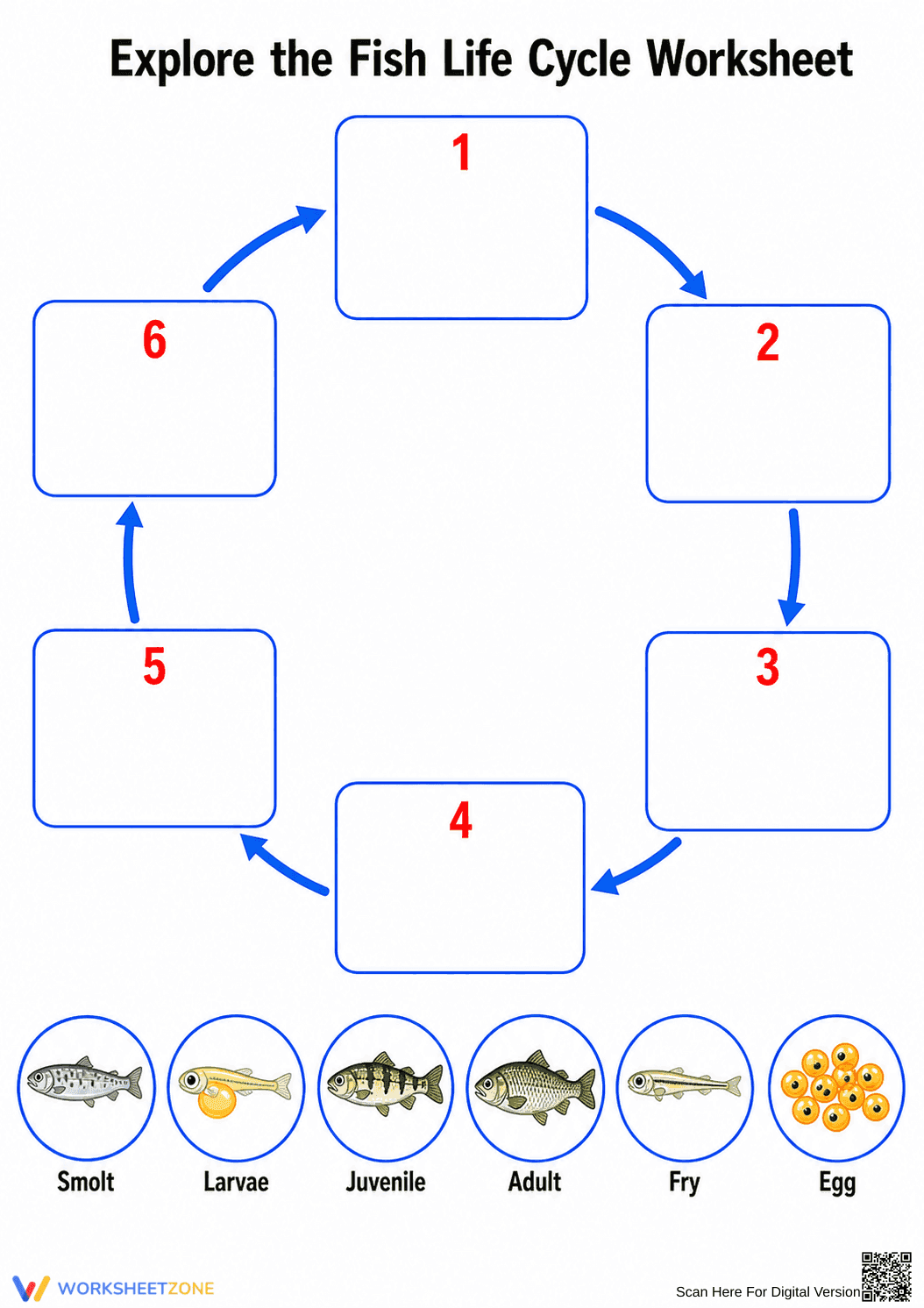

Essential Fish Life Cycle Worksheet | Grade 3 Science

Paste this activity's link or code into your existing LMS (Google Classroom, Canvas, Teams, Schoology, Moodle, etc.).
Students can open and work on the activity right away, with no student login required.
You'll still be able to track student progress and results from your teacher account.
This Grade 3 science worksheet helps students master the sequential stages of aquatic development through a clear, visual model. By identifying and ordering the six distinct phases from egg to adult, learners build a foundational understanding of biological growth and reproduction. It provides an immediate, high-impact activity for any life science unit.
At a Glance
- Grade: 3 · Subject: Science
- Standard:
3-LS1-1— Develop models to describe that organisms have unique and diverse life cycles- Skill Focus: Fish life cycle sequencing
- Format: 1 page · 6 problems · Answer key included · PDF
- Best For: Independent practice or formative assessment
- Time: 15–20 minutes
Inside this resource, you will find a single-page PDF featuring a circular flow diagram with six numbered stages. The bottom of the page contains a visual word bank with labeled illustrations of the Smolt, Larvae, Juvenile, Adult, Fry, and Egg stages. This visual support ensures that students can focus on the logical progression of the cycle while reinforcing scientific vocabulary.
The zero-prep workflow is designed for maximum efficiency. First, print the single-page PDF (30 seconds). Next, distribute the sheets to students as a warm-up or exit ticket (1 minute). Finally, use the included answer key for a rapid whole-class review or individual grading (1 minute). This makes it an ideal resource for emergency sub plans or quick science blocks.
This worksheet is aligned to `3-LS1-1`: "Develop models to describe that organisms have unique and diverse life cycles but all have in common birth, growth, reproduction, and death." It specifically addresses the growth and reproduction components of the standard. Both standard codes can be copied directly into lesson plans, IEP goals, or district curriculum mapping tools.
Use this worksheet as a formative assessment after a lesson on aquatic ecosystems. Observe if students can distinguish between the Fry and Larvae stages, which often indicates a deeper level of attention to detail. It also works well as a collaborative center activity where pairs discuss the physical changes visible in the illustrations. Expected completion time is 15 to 20 minutes.
This resource is designed for elementary students learning about life cycles, particularly those focusing on biology or animal science. It is highly effective for visual learners and English Language Learners (ELLs) due to the clear image-to-label correspondence. Pair this with a short video clip of a salmon run or a classroom aquarium observation for a complete lesson experience.
The fish life cycle worksheet provides a structured visual model that directly supports the NGSS 3-LS1-1 standard, requiring students to sequence biological stages from birth to maturity. According to Fisher & Frey (2014), the use of graphic organizers and visual scaffolds is essential for the gradual release of responsibility, allowing students to move from guided observation to independent mastery of complex scientific concepts. Research from the NAEP indicates that students who engage with visual models in science demonstrate higher retention of technical vocabulary and a better grasp of cyclical processes compared to those using text-only materials. This 1-page resource utilizes six distinct developmental phases—Egg, Larvae, Fry, Juvenile, Smolt, and Adult—to provide a comprehensive overview of aquatic biology. It is a high-utility tool for Grade 3 classrooms, offering a clear path to mastery with minimal teacher preparation time.


