


























Views
Downloads

Oak Tree Life Cycle Worksheet | Essential Grade 6 Science
Paste this activity's link or code into your existing LMS (Google Classroom, Canvas, Teams, Schoology, Moodle, etc.).
Students can open and work on the activity right away, with no student login required.
You'll still be able to track student progress and results from your teacher account.
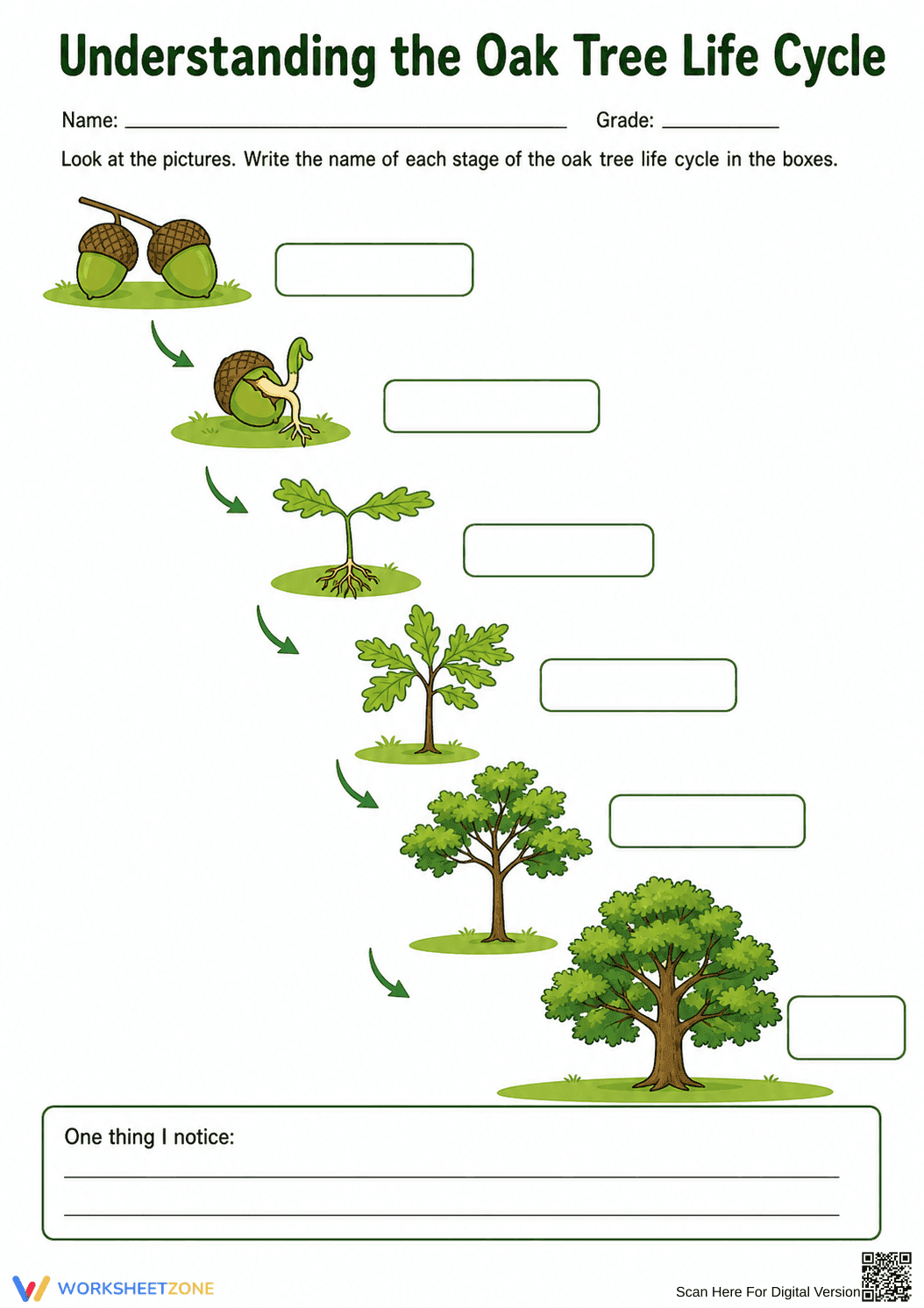
This Grade 6 science worksheet provides a clear visual framework for students to identify and label the developmental stages of an oak tree. By mapping the progression from acorn to mature tree, learners build a foundational understanding of plant biology and reproductive cycles. This resource ensures students articulate how plants grow and change.
At a Glance
At a Glance
- Grade: 6 · Subject: Science
- Standard:
3-LS1-1— Develop models to describe that organisms have unique and diverse life cycles- Skill Focus: Life cycle sequencing and botanical identification
- Format: 1 page · 7 tasks · Answer key included · PDF
- Best For: Independent practice or formative assessment
- Time: 15–20 minutes
What's Inside
This single-page PDF features a vertical diagram illustrating six distinct phases of an oak tree's growth. Each stage includes a labeling box for students to input correct botanical terminology, such as acorn, seedling, and sapling. Below the diagram, an open-ended observation prompt encourages students to practice scientific inquiry by recording one specific detail they notice about the tree's transformation.
Zero-Prep Workflow
This zero-prep resource is designed for maximum efficiency. First, print the single-page PDF in seconds. Second, distribute the sheets to students as a warm-up or exit ticket. Third, review the answers as a whole group using the included key to provide immediate feedback. This streamlined process requires minimal teacher preparation, making it an ideal choice for emergency sub plans.
Standards Alignment
This worksheet aligns with `3-LS1-1`: "Develop models to describe that organisms have unique and diverse life cycles but all have in common birth, growth, reproduction, and death." It serves as a necessary prerequisite for MS-LS1-4, which focuses on how specialized plant structures affect successful reproduction. Both standard codes can be copied directly into lesson plans, IEP goals, or curriculum mapping tools.
How to Use It
Use this worksheet during the "Explain" phase of a 5E lesson cycle to solidify vocabulary after an initial observation of real acorns or seedlings. It also functions effectively as a formative assessment tool; teachers can quickly scan the "One thing I notice" section to gauge student depth of understanding regarding plant morphology. Expect students to complete the labeling and observation tasks within a 15-to-20-minute window.
Who It's For
This resource is designed for middle school students who require visual reinforcement of biological concepts or for elementary students exploring botany. It is particularly effective for English Language Learners (ELLs) due to the heavy reliance on visual cues and clear sequencing. Pair this worksheet with a short informational passage about deciduous trees or an anchor chart detailing the parts of a seed to provide a comprehensive learning experience.
According to the RAND AIRS 2024 report on instructional materials, high-quality visual models are essential for bridging the gap between abstract biological concepts and concrete student understanding. This oak tree life cycle worksheet utilizes a structured sequencing task that aligns with the 3-LS1-1 standard, requiring students to identify the specific stages of plant growth from germination to maturity. By engaging with these visual representations, students develop the cognitive schemas necessary for more complex ecological studies in later grades. Research from Fisher & Frey (2014) suggests that such scaffolded labeling tasks significantly improve the retention of domain-specific vocabulary in science. This resource provides a reliable, evidence-based method for assessing student mastery of life cycle patterns without the need for extensive teacher intervention. It is a robust addition to any science curriculum focusing on the continuity of life and the observable changes in the natural world.


