


























Views
Downloads

Letter Y Beginning Sound Printable Worksheet | Grade K
Paste this activity's link or code into your existing LMS (Google Classroom, Canvas, Teams, Schoology, Moodle, etc.).
Students can open and work on the activity right away, with no student login required.
You'll still be able to track student progress and results from your teacher account.
This foundational phonics resource introduces early learners to the letter Y beginning sound. By connecting the visual representation of the letter with a familiar vocabulary word, students build essential letter-sound correspondence skills. This single-page material provides a clear, engaging visual anchor to support early reading development and phonemic awareness.
At a Glance
- Grade: K · Subject: ELA
- Standard:
CCSS.ELA-LITERACY.RF.K.3.A— Produce primary sounds for consonants- Skill Focus: Letter Y Beginning Sound
- Format: 1 page · 1 visual task · No answer key needed · PDF
- Best For: Phonics introduction
- Time: 5–10 minutes
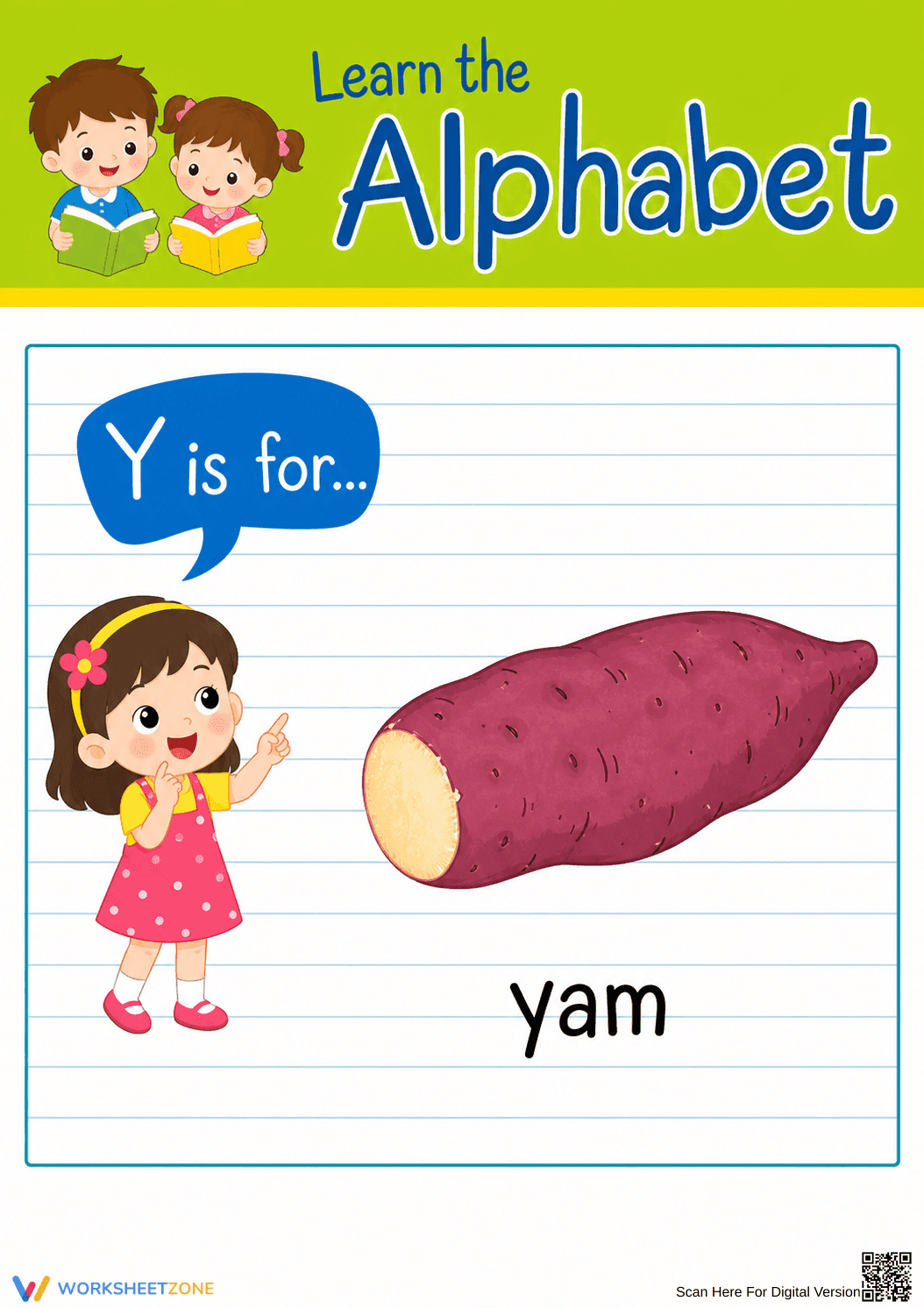
Inside this single-page PDF, educators will find a brightly illustrated instructional anchor chart focused on the letter Y. The page features a clear font displaying "Y is for..." alongside an engaging character graphic. A large illustration of a yam is paired with the text, providing a direct visual link between the target consonant sound and a concrete vocabulary word. This straightforward layout minimizes visual clutter.
This resource is designed for immediate classroom implementation with an efficient zero-prep workflow. First, print the document in full color (under 1 minute). Next, distribute the page or display it on a smartboard for whole-group instruction (1 minute). Finally, review the letter sound and vocabulary word together (3 minutes). Total teacher preparation time is under two minutes, making it an excellent addition to sub plans or quick phonics mini-lessons.
This material is directly aligned with CCSS.ELA-LITERACY.RF.K.3.A, requiring students to demonstrate basic knowledge of one-to-one letter-sound correspondences by producing the primary sound or many of the most frequent sounds for each consonant. It also supports early vocabulary acquisition by pairing the target sound with a specific noun. Both standard codes can be copied directly into lesson plans, IEP goals, or district curriculum mapping tools.
Teachers can utilize this visual worksheet during whole-group direct instruction as an anchor chart to introduce the letter Y. Display the page and have students practice chorally repeating the "yuh" sound and the word "yam." Alternatively, place the printed page in a literacy center where students can reference it while sorting objects or picture cards by their initial sounds. As a formative assessment observation tip, watch students' mouth formations as they repeat the word to ensure they are articulating the consonant correctly. Expected completion time is a brief 5 to 10 minutes.
This resource is primarily designed for Kindergarten students beginning their phonics journey, as well as Pre-K learners showing early reading readiness. It serves as an excellent differentiation tool for first-grade students who require targeted intervention or review of specific consonant sounds. For a comprehensive lesson, pair this visual anchor with a hands-on letter tracing activity or a sensory bin filled with objects starting with the letter Y.
Mastering letter-sound correspondence, such as the letter Y beginning sound, is a critical stepping stone in early literacy. According to an EdReports 2024 analysis of foundational reading programs, explicit phonics instruction that pairs visual anchors with target sounds significantly improves decoding abilities. When young learners practice how to produce primary sounds for consonants, as outlined in CCSS.ELA-LITERACY.RF.K.3.A, they build the neural pathways for fluent reading. Visual aids reduce cognitive load, allowing students to focus entirely on the phonemic connection. By integrating clear materials into daily routines, educators provide the structured repetition required for long-term retention, setting the stage for successful independent reading.


