


























Views
Downloads
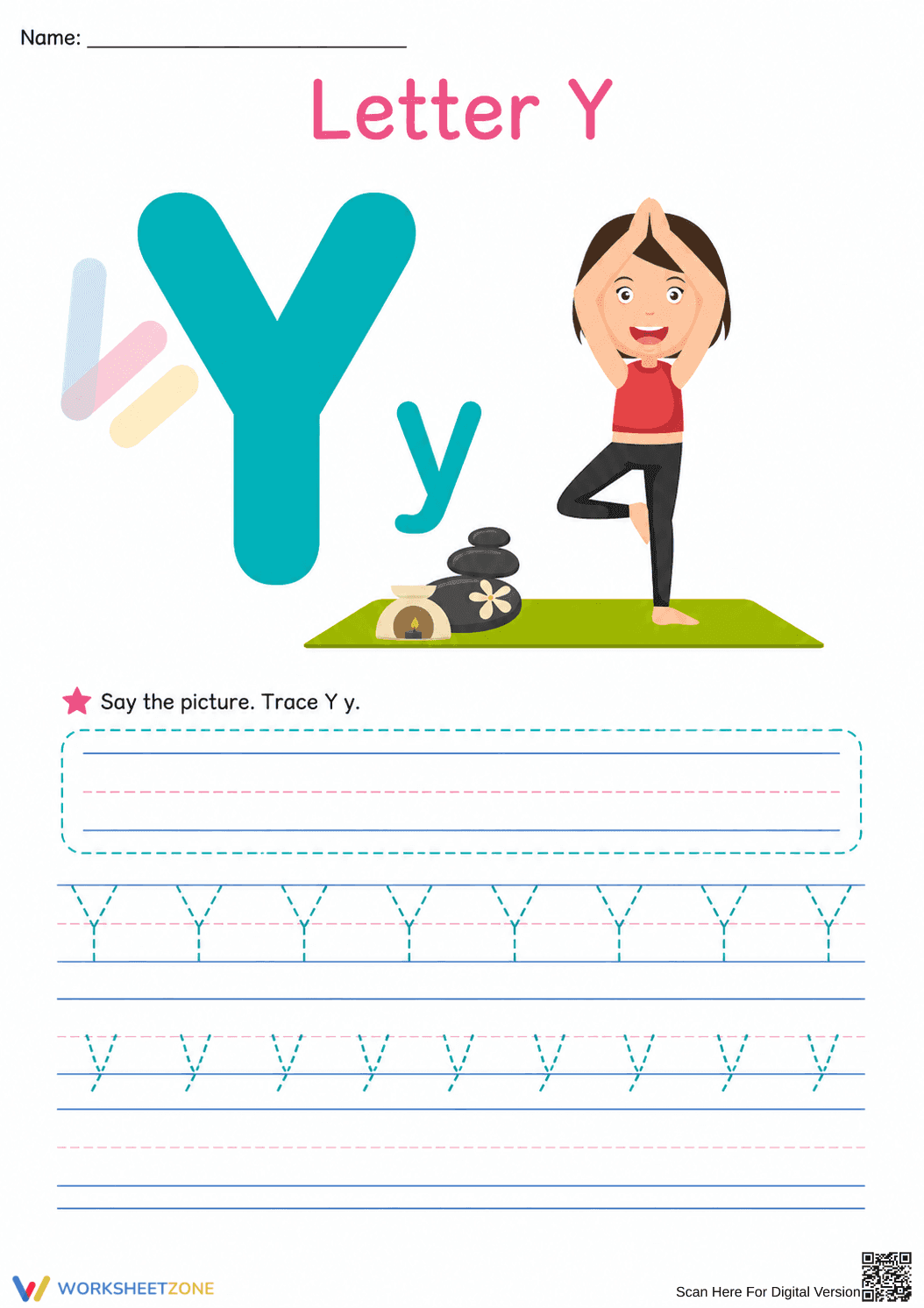

Printable Letter Y Beginning Sound Worksheet | Grade K
Paste this activity's link or code into your existing LMS (Google Classroom, Canvas, Teams, Schoology, Moodle, etc.).
Students can open and work on the activity right away, with no student login required.
You'll still be able to track student progress and results from your teacher account.
This foundational phonics worksheet helps early learners master the Letter Y beginning sound and practice proper letter formation. Students will identify a target vocabulary word, then trace both uppercase and lowercase letters to build fine motor skills and reinforce letter-sound correspondence in a single, focused activity.
At a Glance
- Grade: K · Subject: ELA
- Standard:
CCSS.ELA-LITERACY.RF.K.3.A— Produce primary sounds for consonants- Skill Focus: Letter Y Beginning Sound
- Format: 1 page · 16 problems · No answer key · PDF
- Best For: Independent morning work
- Time: 10–15 minutes
This single-page resource features a distraction-free layout for early readers. The top section features a large, colorful illustration of a yoga pose to anchor the "Y" sound, alongside oversized uppercase and lowercase models. The bottom section provides structured handwriting practice, including two full lines of guided tracing with directional arrows and dashed lines, plus one blank line for independent letter formation attempts.
Designed for a zero-prep workflow:
- Print (1 minute): Simply download the PDF and print the exact number of copies needed for your classroom. No color ink required.
- Distribute (1 minute): Hand out the sheets during morning arrival or transition times. The visual cues make instructions immediately obvious to young learners.
- Review (1 minute): Quickly scan student work to check for proper pencil grip and correct stroke order on the dashed lines.
With a total teacher prep time of under two minutes, this activity is an excellent addition to any emergency sub plan or last-minute literacy center.
This activity aligns directly with CCSS.ELA-LITERACY.RF.K.3.A: "Demonstrate basic knowledge of one-to-one letter-sound correspondences by producing the primary sound or many of the most frequent sounds for each consonant." It also supports early handwriting standards by requiring students to print upper- and lowercase letters. Both standard codes can be copied directly into lesson plans, IEP goals, or district curriculum mapping tools.
Teachers can deploy this worksheet during morning work to establish a calm, productive routine right after the bell rings. It also functions perfectly as an independent station during guided reading rotations. While students are working, teachers should observe their pencil grip and ensure they are starting their letter strokes from the top line rather than the bottom. Most kindergarteners will complete this task within a 10 to 15-minute window.
This printable is ideal for kindergarten students who are just beginning their formal phonics and handwriting instruction. It provides necessary scaffolding for students who struggle with fine motor control by offering clear, dashed tracing paths before asking for independent writing. Pair this worksheet with a whole-class read-aloud focusing on "Y" vocabulary words or a tactile sand-tracing activity to reinforce the letter shape.
Effective early literacy instruction requires explicit teaching of letter-sound correspondences alongside physical handwriting practice. According to a comprehensive RAND AIRS 2024 report on foundational reading skills, integrating motor movements with phonics instruction significantly improves letter recognition and long-term retention in early childhood educational settings. When students practice the CCSS.ELA-LITERACY.RF.K.3.A standard to produce primary sounds for consonants while simultaneously tracing the corresponding grapheme, they build stronger neural pathways for reading fluency. This dual-modality approach ensures that learners do not just memorize abstract shapes, but actively connect the visual symbol of the letter Y to its auditory beginning sound. Providing structured, repetitive tracing tasks with clear directional cues reduces cognitive load, allowing young students to focus entirely on mastering the specific phoneme-grapheme relationship required for future decoding success.


